Services


Sectors
Insights
COMMERCIALIZATION
Insights







Follow Us
.jpg)
Key Takeaways
Introduction
Understanding Post-Registration Compliance Obligations
What are the Essential Post-Registration Compliances in India?
1. Appointment of First Auditor
2. Commencement of Business
3. Issue of Share Certificates
4. Statutory Registers and Records
5. Board Meetings and Corporate Governance
6. FDI and FEMA Compliances
7. Various Tax Registrations
8. Annual and Ongoing Compliances
What Are the Key Post Registration Compliances Deadlines?
What are the Risks and Consequences of Non-Compliance?
How Tecnova helps in Post-Registration Compliance for Foreign Companies in India?
Tecnova helps foreign companies in India handle post-registration compliance through legal support, filings, regulatory updates, and ongoing advisory services efficiently.
Are you confident your company remains fully compliant after registration in India?
India’s regulatory landscape is layered, dynamic and highly structured. Post-registration compliance in India involves continuous interaction with multiple authorities, each operating independently with its own timelines and reporting requirements.
With oversight from bodies such as the MCA, RBI, GST authorities, and tax departments, compliance is both continuous and tightly monitored.
According to industry reports, the infrastructure for business compliance in India will strengthen significantly in 2026 and beyond, with a digital, technology-driven framework. This evolving environment makes it essential for foreign businesses to approach compliance strategically.
Understanding Post-Registration Compliance Obligations
Post-registration compliance in India refers to all legal, regulatory, and procedural requirements a company must fulfil after incorporation to remain operational and compliant under Indian law.
Multiple authorities govern India's compliance structure. Understanding who regulates what is the first step towards clarity on compliance.
● MCA/ROC: It governs company filings under the Companies Act, including annual returns and board resolutions.
● RBI: The central bank manages foreign investment compliance under FEMA regulations.
● CBDT: It oversees income tax filings, TDS, and financial disclosures.
● GSTN: It handles GST registration, returns, and tax payments.
● EPFO/ESIC: It covers employee-related statutory contributions.
● State Authorities: They manage local registrations such as Shops & Establishment and Professional Tax.
According to the Ministry of Commerce & Industry, India has streamlined 22,287 compliance procedures into digital workflows, improving transparency while increasing accountability.
What are the Essential Post-Registration Compliance Requirements in India?
Once a company is incorporated, several immediate and ongoing compliance requirements, such as the appointment of the first auditor, the commencement of business, and the issue of share certificates, must be fulfilled. These are not optional and must be completed within defined timelines. Here is a detailed overview:
1. Appointment of First Auditor
A company must appoint its first statutory auditor within 30 days of incorporation, as mandated under the Companies Act. Failure can result in regulatory scrutiny and penalties.
2. Commencement of Business
Companies must file a declaration of commencement of business within 180 days of incorporation. Without this, the company risks being struck off.
3. Issue of Share Certificates
Share certificates must be issued to shareholders within 60 days of incorporation. It ensures ownership documentation is legally valid.
4. Statutory Registers and Records
Maintaining registers such as members, directors, charges, and relevant beneficial owners is mandatory. These must be physically available at the registered office, even in a digital-first environment.
5. Board Meetings and Corporate Governance
A newly incorporated company must conduct its first board meeting within 30 days, followed by regular meetings as per regulatory norms.
6. FDI and FEMA Compliances
Foreign investment requires strict reporting under FEMA. The FC-GPR filing must be completed within 30 days of share allotment. Keep in mind that this remains one of the most penalised compliance failures.
7. Various Tax Registrations
Companies must obtain and maintain registrations such as:
● GST registration
● PAN and TAN activation
● Professional tax (state-level) and Shops & Establishment registration
8. Annual and Ongoing Compliances
These include:
● Annual ROC filings
● Income tax returns
● Director’s KYC
● GST returns
● TDS filings
● Labour law filings
Together, these define the core of company compliance in India and form the backbone of operational legality.
.jpg)
What Are the Key Deadlines of Post Registration Compliance in India?
Understanding timelines is critical because corporate compliance in India is deadline-intensive. Here are some of the most important timelines businesses must track:
● 30 days - Appointment of first auditor and first board meeting
● 60 days - Issue of share certificates
● 180 days - Declaration of commencement of business filing, Form INC-20A
● Annually - ROC filings (AOC-4, MGT-7)
● Monthly/Quarterly - GST and TDS filings
As per recent reports, over 65% of penalties arise from missed deadlines, which highlights the importance of proactive tracking.
What are the Risks and Consequences of Non-Compliance?
Non-compliance in India is no longer a minor administrative issue. It carries financial, operational, and reputational consequences. Here is a detailed understanding of what are the key risks of non-compliance:
● Financial Penalties: Non-compliance with filings such as AOC-4, MGT-7, or INC-20A can lead to continuous monetary penalties that accumulate with each day of delay.
● Director Disqualification: Failure to meet filing obligations over a prolonged period can result in directors being disqualified from holding positions in any company.
● Loss of Goodwill: A poor compliance track record can weaken investor confidence and reduce credibility with lenders and stakeholders.
● Legal Action: Persistent non-compliance may trigger regulatory action, including prosecution of company officials and, in severe cases, imprisonment.
● Operational Issues: Non-compliant businesses may face restrictions in raising funds, participating in tenders or renewing essential licences.
Compliance is now actively monitored in India and compliance enforcement has increased significantly.
Compliance Differences: Private Ltd vs. LLP vs. Branch Office
Foreign companies entering India often choose between different structures. Each comes with its own compliance burden.
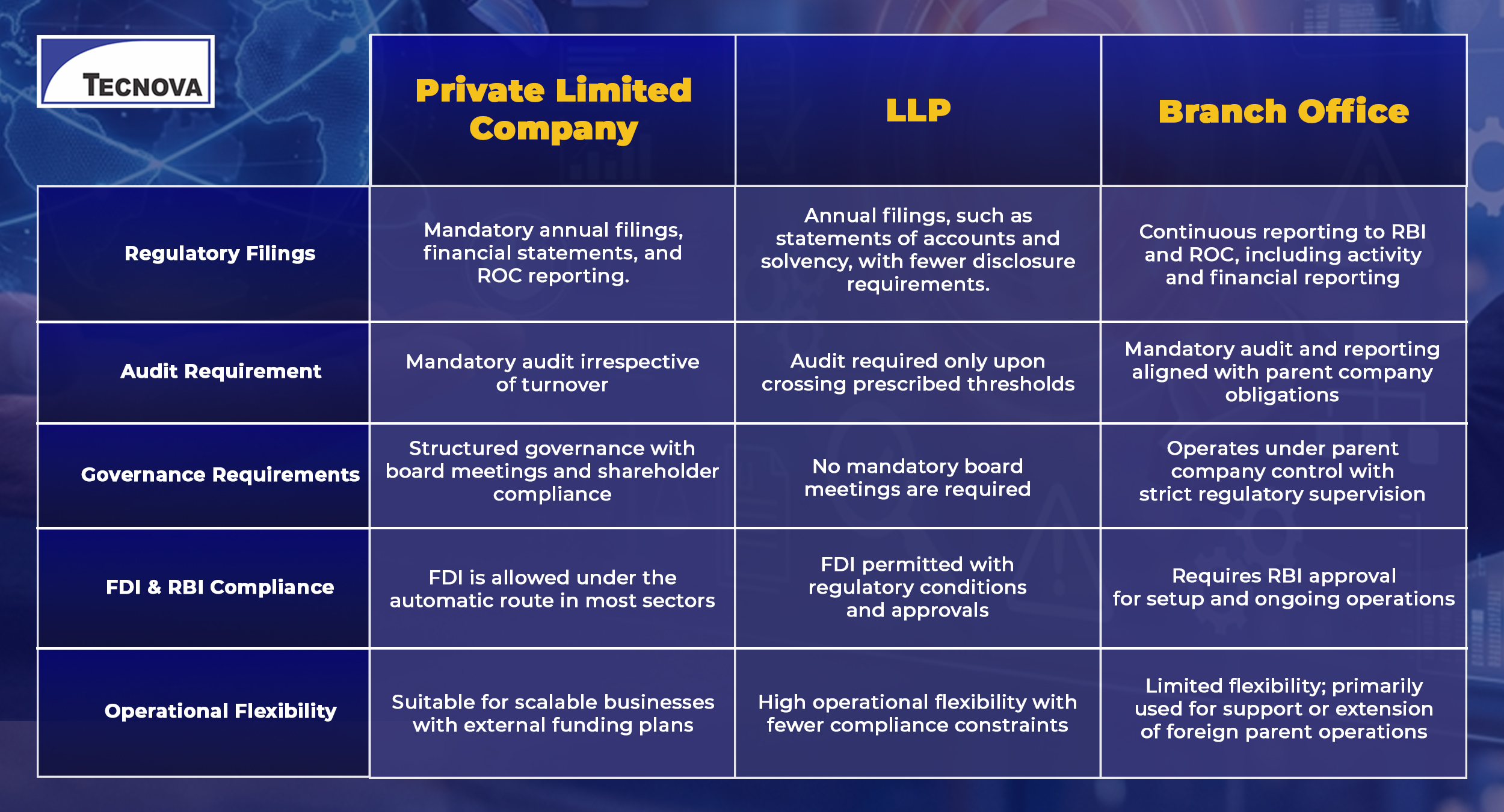
Some Common Compliance Mistakes Foreign Subsidiaries Make
Despite best intentions, many foreign businesses face challenges with post-registration compliance in India. These mistakes are both common and avoidable. It includes:
● Treating compliance as a one-time setup instead of an ongoing process.
● Failure to file annual returns or GST within the prescribed timelines.
● Missing RBI’s FC-GPR filing after receiving FDI.
● Not maintaining statutory registers at the registered office.
● Ignoring state-level labour registrations while focusing only on central compliance.
These errors may account for a significant portion of first-year compliance penalties for foreign companies.
How Tecnova Enables Seamless Post Registration Compliance in India for Foreign Companies?
As a strategic compliance partner, Tecnova helps businesses in the following ways to navigate India’s complex regulatory ecosystem with confidence.
1. Company Formation and Incorporation
We help businesses select the most suitable entity structure and ensure smooth registration with the relevant Indian authorities.
2. Compliance Services
We ensure businesses remain aligned with all applicable laws and ongoing regulatory requirements in India.
3. Tax Registration
Our team assists with obtaining essential tax registrations such as GST, PAN, and other statutory requirements.
4. Government Approvals
We support in securing all required approvals from regulatory bodies, including the RBI and other relevant authorities, for foreign investments.
5. Legal and Regulatory Support
We provide continuous legal and regulatory guidance to help businesses navigate India’s complex compliance landscape with confidence.
With regulatory updates accelerating, businesses require a partner that not only understands compliance but anticipates change. Tecnova brings that foresight!

Key Takeaways
Introduction
Understanding Post-Registration Compliance Obligations
What are the Essential Post-Registration Compliances in India?
1. Appointment of First Auditor
2. Commencement of Business
3. Issue of Share Certificates
4. Statutory Registers and Records
5. Board Meetings and Corporate Governance
6. FDI and FEMA Compliances
7. Various Tax Registrations
8. Annual and Ongoing Compliances
What Are the Key Post Registration Compliances Deadlines?
What are the Risks and Consequences of Non-Compliance?
How Tecnova helps in Post-Registration Compliance for Foreign Companies in India?
Tecnova helps foreign companies in India handle post-registration compliance through legal support, filings, regulatory updates, and ongoing advisory services efficiently.
Are you confident your company remains fully compliant after registration in India?
India’s regulatory landscape is layered, dynamic and highly structured. Post-registration compliance in India involves continuous interaction with multiple authorities, each operating independently with its own timelines and reporting requirements.
With oversight from bodies such as the MCA, RBI, GST authorities, and tax departments, compliance is both continuous and tightly monitored.
According to industry reports, the infrastructure for business compliance in India will strengthen significantly in 2026 and beyond, with a digital, technology-driven framework. This evolving environment makes it essential for foreign businesses to approach compliance strategically.
Understanding Post-Registration Compliance Obligations
Post-registration compliance in India refers to all legal, regulatory, and procedural requirements a company must fulfil after incorporation to remain operational and compliant under Indian law.
Multiple authorities govern India's compliance structure. Understanding who regulates what is the first step towards clarity on compliance.
● MCA/ROC: It governs company filings under the Companies Act, including annual returns and board resolutions.
● RBI: The central bank manages foreign investment compliance under FEMA regulations.
● CBDT: It oversees income tax filings, TDS, and financial disclosures.
● GSTN: It handles GST registration, returns, and tax payments.
● EPFO/ESIC: It covers employee-related statutory contributions.
● State Authorities: They manage local registrations such as Shops & Establishment and Professional Tax.
According to the Ministry of Commerce & Industry, India has streamlined 22,287 compliance procedures into digital workflows, improving transparency while increasing accountability.
What are the Essential Post-Registration Compliance Requirements in India?
Once a company is incorporated, several immediate and ongoing compliance requirements, such as the appointment of the first auditor, the commencement of business, and the issue of share certificates, must be fulfilled. These are not optional and must be completed within defined timelines. Here is a detailed overview:
1. Appointment of First Auditor
A company must appoint its first statutory auditor within 30 days of incorporation, as mandated under the Companies Act. Failure can result in regulatory scrutiny and penalties.
2. Commencement of Business
Companies must file a declaration of commencement of business within 180 days of incorporation. Without this, the company risks being struck off.
3. Issue of Share Certificates
Share certificates must be issued to shareholders within 60 days of incorporation. It ensures ownership documentation is legally valid.
4. Statutory Registers and Records
Maintaining registers such as members, directors, charges, and relevant beneficial owners is mandatory. These must be physically available at the registered office, even in a digital-first environment.
5. Board Meetings and Corporate Governance
A newly incorporated company must conduct its first board meeting within 30 days, followed by regular meetings as per regulatory norms.
6. FDI and FEMA Compliances
Foreign investment requires strict reporting under FEMA. The FC-GPR filing must be completed within 30 days of share allotment. Keep in mind that this remains one of the most penalised compliance failures.
7. Various Tax Registrations
Companies must obtain and maintain registrations such as:
● GST registration
● PAN and TAN activation
● Professional tax (state-level) and Shops & Establishment registration
8. Annual and Ongoing Compliances
These include:
● Annual ROC filings
● Income tax returns
● Director’s KYC
● GST returns
● TDS filings
● Labour law filings
Together, these define the core of company compliance in India and form the backbone of operational legality.
What Are the Key Deadlines of Post Registration Compliance in India?
Understanding timelines is critical because corporate compliance in India is deadline-intensive. Here are some of the most important timelines businesses must track:
● 30 days - Appointment of first auditor and first board meeting
● 60 days - Issue of share certificates
● 180 days - Declaration of commencement of business filing, Form INC-20A
● Annually - ROC filings (AOC-4, MGT-7)
● Monthly/Quarterly - GST and TDS filings
As per recent reports, over 65% of penalties arise from missed deadlines, which highlights the importance of proactive tracking.
What are the Risks and Consequences of Non-Compliance?
Non-compliance in India is no longer a minor administrative issue. It carries financial, operational, and reputational consequences. Here is a detailed understanding of what are the key risks of non-compliance:
● Financial Penalties: Non-compliance with filings such as AOC-4, MGT-7, or INC-20A can lead to continuous monetary penalties that accumulate with each day of delay.
● Director Disqualification: Failure to meet filing obligations over a prolonged period can result in directors being disqualified from holding positions in any company.
● Loss of Goodwill: A poor compliance track record can weaken investor confidence and reduce credibility with lenders and stakeholders.
● Legal Action: Persistent non-compliance may trigger regulatory action, including prosecution of company officials and, in severe cases, imprisonment.
● Operational Issues: Non-compliant businesses may face restrictions in raising funds, participating in tenders or renewing essential licences.
Compliance is now actively monitored in India and compliance enforcement has increased significantly.
Compliance Differences: Private Ltd vs. LLP vs. Branch Office
Foreign companies entering India often choose between different structures. Each comes with its own compliance burden.
Some Common Compliance Mistakes Foreign Subsidiaries Make
Despite best intentions, many foreign businesses face challenges with post-registration compliance in India. These mistakes are both common and avoidable. It includes:
● Treating compliance as a one-time setup instead of an ongoing process.
● Failure to file annual returns or GST within the prescribed timelines.
● Missing RBI’s FC-GPR filing after receiving FDI.
● Not maintaining statutory registers at the registered office.
● Ignoring state-level labour registrations while focusing only on central compliance.
These errors may account for a significant portion of first-year compliance penalties for foreign companies.
How Tecnova Enables Seamless Post Registration Compliance in India for Foreign Companies?
As a strategic compliance partner, Tecnova helps businesses in the following ways to navigate India’s complex regulatory ecosystem with confidence.
1. Company Formation and Incorporation
We help businesses select the most suitable entity structure and ensure smooth registration with the relevant Indian authorities.
2. Compliance Services
We ensure businesses remain aligned with all applicable laws and ongoing regulatory requirements in India.
3. Tax Registration
Our team assists with obtaining essential tax registrations such as GST, PAN, and other statutory requirements.
4. Government Approvals
We support in securing all required approvals from regulatory bodies, including the RBI and other relevant authorities, for foreign investments.
5. Legal and Regulatory Support
We provide continuous legal and regulatory guidance to help businesses navigate India’s complex compliance landscape with confidence.
With regulatory updates accelerating, businesses require a partner that not only understands compliance but anticipates change. Tecnova brings that foresight!







%20copy.webp)







%20(1).png)

.png)




%20(1).png)
.jpg)



.png)





.jpeg)

















.png)

.png)









.jpg)




.jpg)


.jpg)