Services


Sectors
Insights
COMMERCIALIZATION
Insights







Follow Us
A Strategic Market Entry & Investment Perspective for Global Business
Introduction
Understanding Agritech (Including Market Potential)
How Agritech Startups are Revolutionising Farming in India?
Precision Farming
Agri Fintech
Online Marketplaces
AI and Data-Driven Solutions
Farming-as-a-Service (FaaS)
Supply Chain
Machine-Based Quality Management
What are the Challenges in Adopting Agritech in India?
High Initial Investment
Lack of Digital Literacy
Infrastructure and Connectivity Issues
What is the Government’s Role in Enabling Agritech in India?
How Agritech is Set to Turn India into a Global Farming Powerhouse?
How Tecnova Simplifies Your Growth for Agritech in India?
Market Entry Strategy
Business Expansion Planning
Investment Advisory
Strategic Partnerships
Operational Optimization
Policy & Regulatory Support
What does it take to transform one of the world’s largest agricultural economies into a technology-driven global powerhouse?
India supports over 1.47 billion people and is the world’s largest producer of milk, pulses, and jute, and ranks second in rice and wheat production. Yet, nearly 30-40% of agricultural produce is lost due to inefficiencies across the value chain.
This gap between scale and efficiency highlights a critical opportunity that agritech in India is rapidly addressing.
As global food demand is expected to significantly increase, India’s role is becoming increasingly strategic. The country is no longer just focused on domestic food security; it is emerging as a key contributor to global agri-supply chains. And the rapid rise of agritech innovation is at the centre of it.
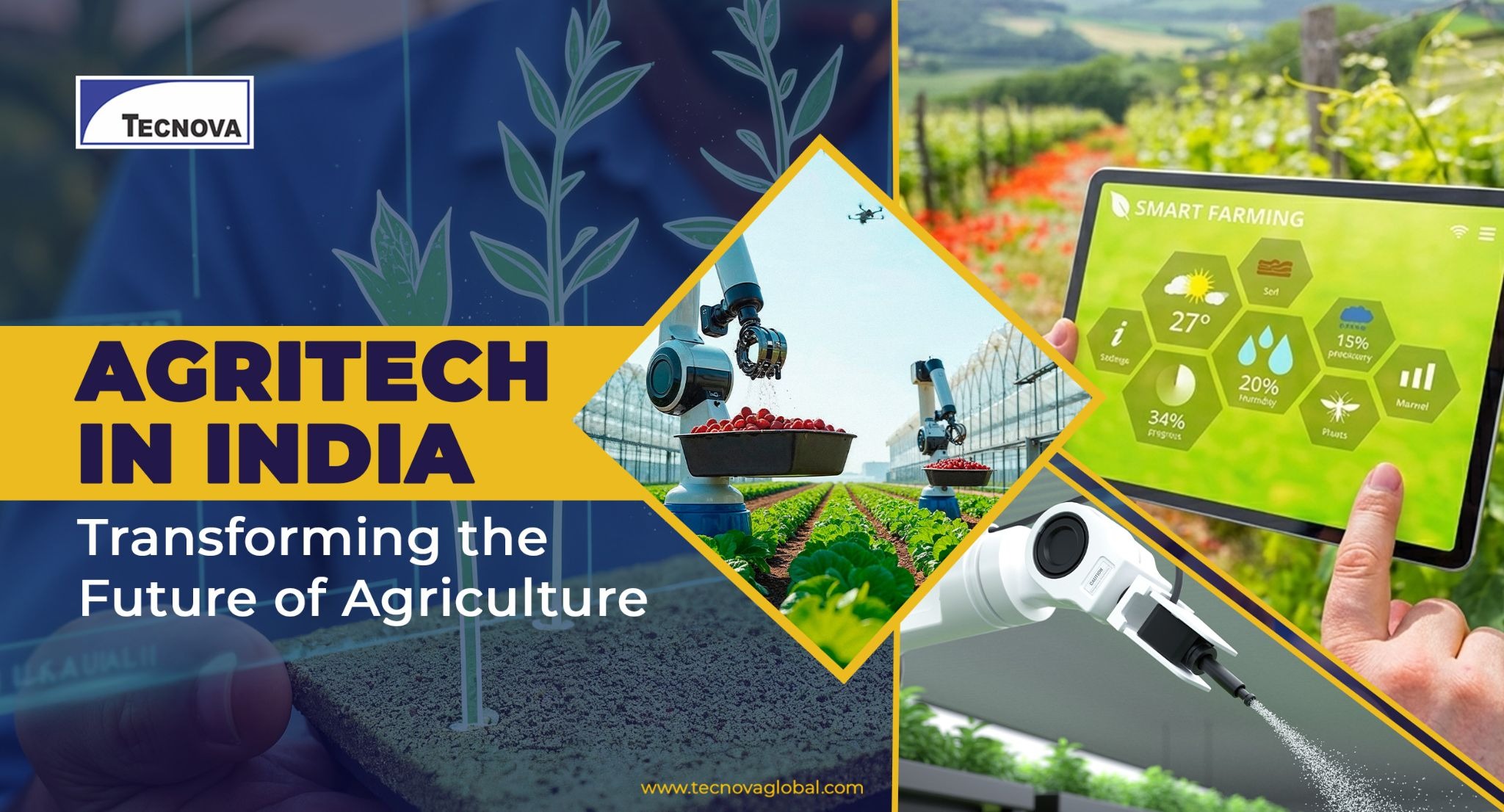
Agritech refers to the application of technology across pre-harvest planning to post-harvest logistics and market access. It includes everything from AI-driven farming solutions and IoT-based monitoring to fintech solutions and supply chain digitisation.
According to recent research, India’s agritech sector has attracted over USD 2.6 billion in investments since FY22. The market is expected to grow at a CAGR of 20.54% by 2023, driven by:
● Rising demand for products
● Government-backed digital infrastructure initiatives
● Increasing investor interest in sustainable and climate-resilient agriculture
More importantly, India’s complex and diverse crops, fragmented landholdings, and multilingual farmers make it a fertile testing ground. Solutions built here are inherently scalable to other emerging markets.

The transformation of Indian agriculture is being driven by a new wave of agritech startups in India that are addressing long-standing inefficiencies.
Precision Farming
Precision farming uses IoT sensors and data analytics to optimise resource usage. Farmers can now monitor soil health, irrigation needs, and crop conditions in real time.
According to recent data, precision agriculture can reduce water usage by up to 30% while increasing yields significantly.
Agri Fintech
Access to credit has historically been a challenge. Agri fintech platforms are using alternative data and transaction histories to provide faster and more inclusive financing. This has improved credit access for millions of smallholder farmers.
Online Marketplaces
Digital platforms are eliminating intermediaries and enabling farmers to sell directly to buyers. This improves price realisation and transparency. Government-backed initiatives such as eNAM have already onboarded millions of farmers and traders.
AI and Data-Driven Solutions
AI is being used for predictive analytics, pest detection, and yield forecasting. These solutions help farmers make informed decisions, which reduces risks and improves productivity.
Farming-as-a-Service (FaaS)
FaaS models provide access to equipment, advisory services and labour on a pay-per-use basis. This is particularly impactful in a country where the average farm size is just 1.08 hectares.
Technology in Supply Chain
Cold storage facilities, blockchain-based traceability, and scientific warehousing are reducing post-harvest losses and improving export readiness.
Machine-Based Quality Management
Automated grading and sorting technologies are ensuring consistent quality, which is critical for both domestic and international markets.
Agri Biotech & Crop Science Tech
Innovations in crop improvement, genome-edited crops and genotyping arrays are attracting global investors. These solutions are helping improve resilience against pests and climate variability.
Climate & Sustainability Tech
With increasing ESG mandates, climate-focused agritech solutions are gaining traction. These include carbon credit platforms, climate-resilient crop advisory, and sustainability compliance solutions for exporters.
The adoption of agritech in India is rising, but several structural and operational barriers, such as high investment, lack of knowledge, and regulatory complexity continue to slow down its full-scale implementation.
These challenges are deeply rooted in the country’s agricultural landscape and require targeted and localised solutions for effective resolution. Here is a detailed understanding of the challenges of adopting agritech in India:
1. High Initial Investment
Advanced technologies such as IoT devices, precision farming tools, and AI-based platforms require significant upfront investment, which can be a barrier for small farmers.
2. Lack of Digital Literacy
While smartphone usage has increased significantly in rural India, digital literacy remains uneven. Many farmers are still unfamiliar with using mobile-based platforms or interpreting data-driven insights.
3. Infrastructure and Connectivity Issues
Reliable internet connectivity, access to electricity, and efficient logistics infrastructure are still developing across several rural regions. These gaps can disrupt the seamless deployment of agriculture technology in India.
4. Fragmented Land Holdings
India’s agricultural structure is highly fragmented, with an average farm size of approximately 1.08 hectares, as per the Agriculture Census. This fragmentation makes it difficult to scale agritech solutions efficiently.
5. Regulatory and Licensing Complexity
Compliance requirements span across food safety regulations, seed laws, pesticide approvals and state-level agricultural market regulations. The lack of uniformity across states further makes local expertise essential for smooth market entry and operations.

India’s policy ecosystem has evolved rapidly to support agritech growth. Several initiatives, such as PK-KISAN, PM Fasal Bima Yojana, and eNAM, create a strong foundation for digital farming in India. Let us take a look:
● PM-KISAN: Provides direct income support to farmers, which improves purchasing power and adoption capacity.
● PM Fasal Bima Yojana: A secure ecosystem that enhances risk coverage through crop insurance.
● Agri Stack: A digital infrastructure initiative aimed at creating a unified farmer database and enabling personalised services.
● National Agriculture Market (eNAM): A pan-India electronic online trading portal that facilitates transparent and efficient agricultural trade.
● Production Linked Incentive (PLI) for Food Processing: It enhances the global visibility of Indian food brands and drives stronger acceptance across international markets.
These initiatives are not just welfare schemes; they are strategic enablers for private investment and foreign participation in agritech.
India’s agritech evolution is not limited to domestic transformation. It is positioning the country as an export hub for agricultural innovation.
Solutions developed for India’s complexity, such as small landholdings, diverse climates, and fragmented markets, are highly adaptable to various regions, including Africa, Southeast Asia, and South Asia.
According to the Ministry of Commerce & Industry, initiatives such as BHARATI (Bharat’s Hub for Agritech, Resilience, Advancement, and Incubation for Export Enablement) are designed to support agritech startups, strengthen agri-value chains and enhance export across key agricultural and food sectors.
This reflects a clear shift from production-centric growth to technology-enabled global competitiveness.
At the same time, the focus on high-value segments such as processed foods, organic produce, and specialty crops is further strengthening India’s export positioning. These advancements are enhancing the global visibility and credibility of Indian agri-products.
In essence, agritech in India is enabling a structural transformation. It is positioning the country as a reliable, scalable, and innovation-driven hub in the global agricultural economy.
For international players, entering the Indian agritech ecosystem requires a well-defined strategy. If you are wondering what the key models are for international agritech companies to enter India, take a look:
Joint ventures enable foreign agritech companies to collaborate with Indian partners who bring strong farmer networks and market understanding. This approach reduces entry risks, accelerates adoption, and helps navigate regional complexities across agriculture technology in India.
2. Acquisition of an Agritech Startup
Acquiring an existing agritech startup in India offers immediate market access, operational presence and local expertise. It allows foreign firms to scale quickly while leveraging established technologies within the growing agritech startups in India.
3. Greenfield Subsidiary with Distribution Tie-Ups
A greenfield approach provides full control over operations and branding but requires strong local partnerships for distribution. Collaborating with farmer organisations and rural networks is essential to effectively deploy digital farming in India.
4. Technology Licensing to Indian Partners
Technology licensing allows foreign companies to enter the Indian market with lower investment by partnering with local players. This model ensures faster adoption and localisation, especially for advanced smart farming technologies and data-driven agricultural solutions.

Entering India’s agritech sector requires precise execution. Tecnova supports businesses across the entire value chain:
● Help businesses understand the Indian market through competition analysis, channel selection and a clear entry roadmap.
● Manage licensing and regulatory approvals to ensure full compliance from day one.
● Identify and connect with reliable partners with us to support seamless market expansion.
● Set up efficient distribution and supply chains to optimise costs and ensure timely delivery.
● Identify potential risks early and provide strategies to minimise them for a safer market entry.
With a deep understanding of India’s agricultural landscape and global business dynamics, Tecnova enables companies to unlock the full potential of agritech in India.
A Strategic Market Entry & Investment Perspective for Global Business
Introduction
Understanding Agritech (Including Market Potential)
How Agritech Startups are Revolutionising Farming in India?
Precision Farming
Agri Fintech
Online Marketplaces
AI and Data-Driven Solutions
Farming-as-a-Service (FaaS)
Supply Chain
Machine-Based Quality Management
What are the Challenges in Adopting Agritech in India?
High Initial Investment
Lack of Digital Literacy
Infrastructure and Connectivity Issues
What is the Government’s Role in Enabling Agritech in India?
How Agritech is Set to Turn India into a Global Farming Powerhouse?
How Tecnova Simplifies Your Growth for Agritech in India?
Market Entry Strategy
Business Expansion Planning
Investment Advisory
Strategic Partnerships
Operational Optimization
Policy & Regulatory Support
What does it take to transform one of the world’s largest agricultural economies into a technology-driven global powerhouse?
India supports over 1.47 billion people and is the world’s largest producer of milk, pulses, and jute, and ranks second in rice and wheat production. Yet, nearly 30-40% of agricultural produce is lost due to inefficiencies across the value chain.
This gap between scale and efficiency highlights a critical opportunity that agritech in India is rapidly addressing.
As global food demand is expected to significantly increase, India’s role is becoming increasingly strategic. The country is no longer just focused on domestic food security; it is emerging as a key contributor to global agri-supply chains. And the rapid rise of agritech innovation is at the centre of it.
Agritech refers to the application of technology across pre-harvest planning to post-harvest logistics and market access. It includes everything from AI-driven farming solutions and IoT-based monitoring to fintech solutions and supply chain digitisation.
According to recent research, India’s agritech sector has attracted over USD 2.6 billion in investments since FY22. The market is expected to grow at a CAGR of 20.54% by 2023, driven by:
● Rising demand for products
● Government-backed digital infrastructure initiatives
● Increasing investor interest in sustainable and climate-resilient agriculture
More importantly, India’s complex and diverse crops, fragmented landholdings, and multilingual farmers make it a fertile testing ground. Solutions built here are inherently scalable to other emerging markets.
The transformation of Indian agriculture is being driven by a new wave of agritech startups in India that are addressing long-standing inefficiencies.
Precision Farming
Precision farming uses IoT sensors and data analytics to optimise resource usage. Farmers can now monitor soil health, irrigation needs, and crop conditions in real time.
According to recent data, precision agriculture can reduce water usage by up to 30% while increasing yields significantly.
Agri Fintech
Access to credit has historically been a challenge. Agri fintech platforms are using alternative data and transaction histories to provide faster and more inclusive financing. This has improved credit access for millions of smallholder farmers.
Online Marketplaces
Digital platforms are eliminating intermediaries and enabling farmers to sell directly to buyers. This improves price realisation and transparency. Government-backed initiatives such as eNAM have already onboarded millions of farmers and traders.
AI and Data-Driven Solutions
AI is being used for predictive analytics, pest detection, and yield forecasting. These solutions help farmers make informed decisions, which reduces risks and improves productivity.
Farming-as-a-Service (FaaS)
FaaS models provide access to equipment, advisory services and labour on a pay-per-use basis. This is particularly impactful in a country where the average farm size is just 1.08 hectares.
Technology in Supply Chain
Cold storage facilities, blockchain-based traceability, and scientific warehousing are reducing post-harvest losses and improving export readiness.
Machine-Based Quality Management
Automated grading and sorting technologies are ensuring consistent quality, which is critical for both domestic and international markets.
Agri Biotech & Crop Science Tech
Innovations in crop improvement, genome-edited crops and genotyping arrays are attracting global investors. These solutions are helping improve resilience against pests and climate variability.
Climate & Sustainability Tech
With increasing ESG mandates, climate-focused agritech solutions are gaining traction. These include carbon credit platforms, climate-resilient crop advisory, and sustainability compliance solutions for exporters.
The adoption of agritech in India is rising, but several structural and operational barriers, such as high investment, lack of knowledge, and regulatory complexity continue to slow down its full-scale implementation.
These challenges are deeply rooted in the country’s agricultural landscape and require targeted and localised solutions for effective resolution. Here is a detailed understanding of the challenges of adopting agritech in India:
1. High Initial Investment
Advanced technologies such as IoT devices, precision farming tools, and AI-based platforms require significant upfront investment, which can be a barrier for small farmers.
2. Lack of Digital Literacy
While smartphone usage has increased significantly in rural India, digital literacy remains uneven. Many farmers are still unfamiliar with using mobile-based platforms or interpreting data-driven insights.
3. Infrastructure and Connectivity Issues
Reliable internet connectivity, access to electricity, and efficient logistics infrastructure are still developing across several rural regions. These gaps can disrupt the seamless deployment of agriculture technology in India.
4. Fragmented Land Holdings
India’s agricultural structure is highly fragmented, with an average farm size of approximately 1.08 hectares, as per the Agriculture Census. This fragmentation makes it difficult to scale agritech solutions efficiently.
5. Regulatory and Licensing Complexity
Compliance requirements span across food safety regulations, seed laws, pesticide approvals and state-level agricultural market regulations. The lack of uniformity across states further makes local expertise essential for smooth market entry and operations.
India’s policy ecosystem has evolved rapidly to support agritech growth. Several initiatives, such as PK-KISAN, PM Fasal Bima Yojana, and eNAM, create a strong foundation for digital farming in India. Let us take a look:
● PM-KISAN: Provides direct income support to farmers, which improves purchasing power and adoption capacity.
● PM Fasal Bima Yojana: A secure ecosystem that enhances risk coverage through crop insurance.
● Agri Stack: A digital infrastructure initiative aimed at creating a unified farmer database and enabling personalised services.
● National Agriculture Market (eNAM): A pan-India electronic online trading portal that facilitates transparent and efficient agricultural trade.
● Production Linked Incentive (PLI) for Food Processing: It enhances the global visibility of Indian food brands and drives stronger acceptance across international markets.
These initiatives are not just welfare schemes; they are strategic enablers for private investment and foreign participation in agritech.
India’s agritech evolution is not limited to domestic transformation. It is positioning the country as an export hub for agricultural innovation.
Solutions developed for India’s complexity, such as small landholdings, diverse climates, and fragmented markets, are highly adaptable to various regions, including Africa, Southeast Asia, and South Asia.
According to the Ministry of Commerce & Industry, initiatives such as BHARATI (Bharat’s Hub for Agritech, Resilience, Advancement, and Incubation for Export Enablement) are designed to support agritech startups, strengthen agri-value chains and enhance export across key agricultural and food sectors.
This reflects a clear shift from production-centric growth to technology-enabled global competitiveness.
At the same time, the focus on high-value segments such as processed foods, organic produce, and specialty crops is further strengthening India’s export positioning. These advancements are enhancing the global visibility and credibility of Indian agri-products.
In essence, agritech in India is enabling a structural transformation. It is positioning the country as a reliable, scalable, and innovation-driven hub in the global agricultural economy.
For international players, entering the Indian agritech ecosystem requires a well-defined strategy. If you are wondering what the key models are for international agritech companies to enter India, take a look:
Joint ventures enable foreign agritech companies to collaborate with Indian partners who bring strong farmer networks and market understanding. This approach reduces entry risks, accelerates adoption, and helps navigate regional complexities across agriculture technology in India.
2. Acquisition of an Agritech Startup
Acquiring an existing agritech startup in India offers immediate market access, operational presence and local expertise. It allows foreign firms to scale quickly while leveraging established technologies within the growing agritech startups in India.
3. Greenfield Subsidiary with Distribution Tie-Ups
A greenfield approach provides full control over operations and branding but requires strong local partnerships for distribution. Collaborating with farmer organisations and rural networks is essential to effectively deploy digital farming in India.
4. Technology Licensing to Indian Partners
Technology licensing allows foreign companies to enter the Indian market with lower investment by partnering with local players. This model ensures faster adoption and localisation, especially for advanced smart farming technologies and data-driven agricultural solutions.
Entering India’s agritech sector requires precise execution. Tecnova supports businesses across the entire value chain:
● Help businesses understand the Indian market through competition analysis, channel selection and a clear entry roadmap.
● Manage licensing and regulatory approvals to ensure full compliance from day one.
● Identify and connect with reliable partners with us to support seamless market expansion.
● Set up efficient distribution and supply chains to optimise costs and ensure timely delivery.
● Identify potential risks early and provide strategies to minimise them for a safer market entry.
With a deep understanding of India’s agricultural landscape and global business dynamics, Tecnova enables companies to unlock the full potential of agritech in India.



















%20(1).png)
.jpg)
.png)




%20(1).png)
.jpg)



.png)





.jpeg)














.png)

.png)








.jpg)




.jpg)


.jpg)