Services


Sectors
Insights
COMMERCIALIZATION
Insights







Follow Us
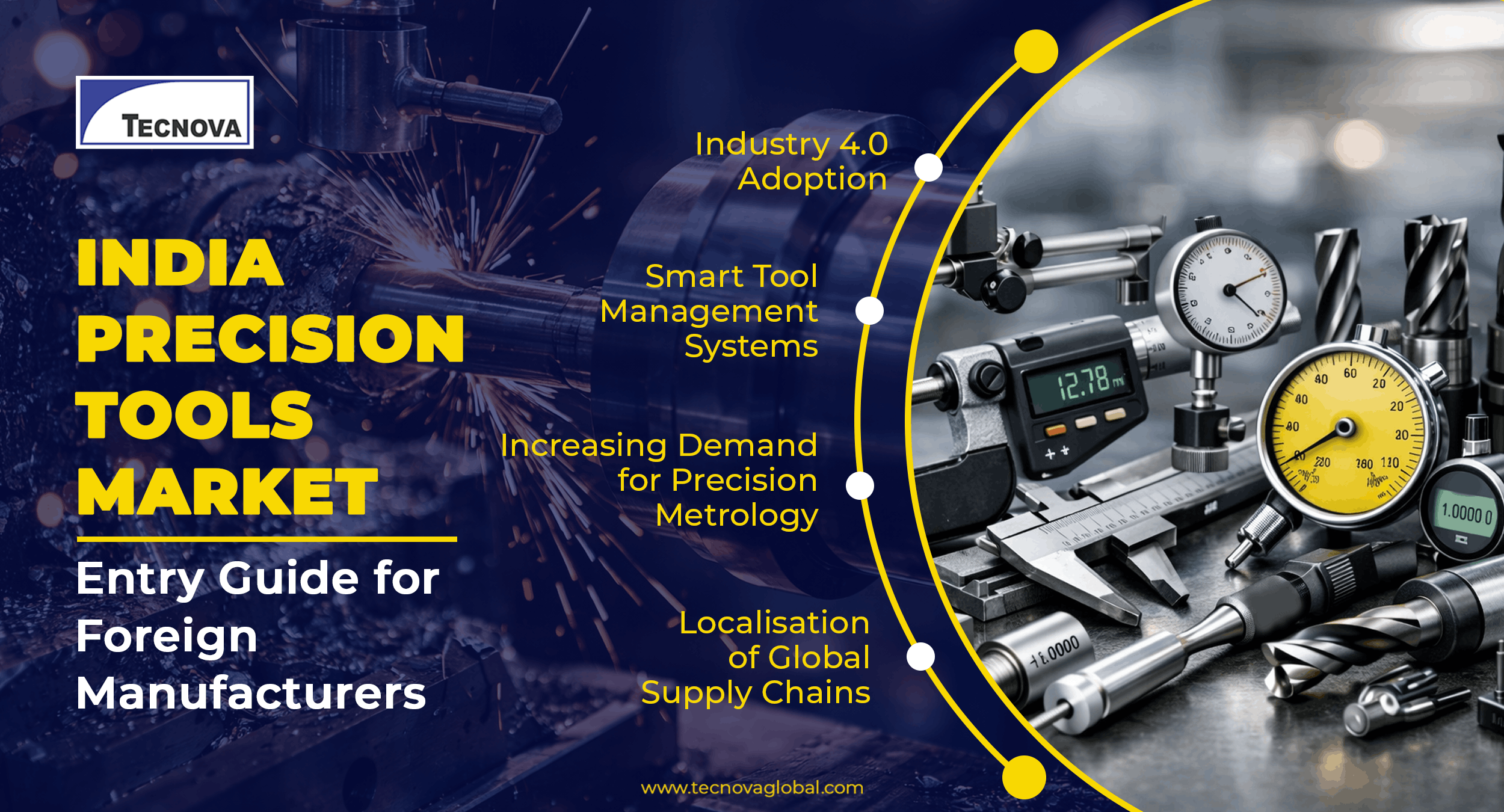
India Precision Tools Market: Entry Guide for Foreign Manufacturers
Market Size and Growth Outlook
Why 2026 Is the Right Moment to Enter
Risks and Challenges: What Foreign Manufacturers Should Know
Key Growth Drivers of the Indian Precision Tools Market
Government Policies Supporting Market Growth
How Global Businesses Can Enter and Benefit
Setting Up Precision Tool Manufacturing in India: Key Considerations
Expanding Precision Tool Manufacturing: For Existing Businesses
Tecnova's Approach to Precision Tool Market Entry in India
With industrial automation and infrastructure development advancing rapidly worldwide, the demand for precision tools is rising exponentially.
The Indian precision tools market was estimated at USD 1.83 billion in 2025 and is expected to touch USD 3.51 billion by 2034, securing a CAGR of 7.49% between 2026 and 2034.
However, due to their high manufacturing costs, precision tool businesses are largely out of reach for small and medium-scale companies. Such companies, especially foreign ones, can consider manufacturing these tools in a country like India, where production costs are lower than in other developing nations.
However, setting up a manufacturing plant in India can be a cumbersome process. Businesses require efficient local resources, strategic locations and reliable distribution services.
Partnering up with manufacturing consulting firms in India can be an outstanding solution in this regard.
Here are some trends that are currently driving the Indian precision tool market:
1. Industry 4.0 Adoption
Indian manufacturers are increasingly embracing Industry 4.0 technologies to improve productivity and product quality. Powered by smart factories, India’s industrial automation market is projected to expand at a CAGR of 14.26%, reaching an estimated value of USD 29.43 billion by FY 2029.
Here are some key technologies being adopted:
These developments are generating demand for intelligent tooling solutions capable of supporting real-time monitoring, data analytics and predictive maintenance strategies.
2. Smart Tool Management Systems
Manufacturers are increasingly investing in digital tool management solutions to reduce downtime and improve production efficiency.
Smart CNC machining strategies can reduce raw material expenses by 10% to 15% while increasing tool life up to 50%. This trend presents various opportunities to foreign suppliers who offer integrated tooling and software solutions.
3. Increasing Demand for Precision Metrology
As quality standards become more stringent, demand for advanced metrology solutions is growing rapidly across multiple industries. The demand is significantly increasing for:
a. Coordinate Measuring Machines (CMMs)
b. Optical inspection systems
c. Laser scanning technologies
d. Automated quality-control solutions.
4. Localisation of Global Supply Chains
Geopolitical uncertainty and supply-chain disruptions have accelerated efforts by multinational corporations to diversify manufacturing operations.
As global businesses adopt the China+1 strategy, India continues to benefit from its large domestic market, skilled engineering workforce, improving infrastructure and supportive policy environment.
This trend is expected to further strengthen demand across the Indian precision tools market over the coming decade.
These are some of the challenges faced by precision tool manufacturers:
∘ Fluctuations in Steel Prices
The primary raw material needed for manufacturing precision tools is steel. Now, due to several micro and macroeconomic factors, the price of this commodity can fluctuate. For example, the Russian invasion of Ukraine resulted in a huge appreciation of steel prices, which in turn increased the cost of production for precision tools.
Additionally, significant price rises can affect the overall demand for the commodity, thereby affecting the entire sector as a whole.
∘ Demand for Smaller Batch Sizes
Another major challenge associated with the precision tool industry is the demand for smaller batch sizes. This is risky for businesses as manufacturing these tools is time-consuming and expensive. Thus, they are often not able to gain back the capital spent on manufacturing these small lots.
∘ Miniaturisation Trend
There is an increasing trend of machine parts becoming smaller to make them more energy efficient. This demands tighter tolerances and machinists having additional skills and using more expensive equipment. Furthermore, the miniaturisation of machine parts also demands higher quality control as discrepancies can lead to major issues.
Despite these challenges, foreign precision tool manufacturers can still capture the Indian precision tool market by leveraging its key drivers like CNC tooling and the defence manufacturing industry.
One of the primary drivers of the Indian precision tools market is the rapid expansion of domestic manufacturing. India's manufacturing sector currently contributes approximately 17% of the country's GDP and the Government of India aims to increase this share to 25% by 2047 as part of its long-term industrial development strategy.
According to government estimates, India aims to become a USD 1 trillion manufacturing economy by 2026. Rising domestic consumption and export-oriented production are accelerating this industrial activity across sectors such as automotive, engineering, electronics and defence.
Other growth drivers include:
Rise of the CNC Tooling Industry
The CNC tooling industry in India has emerged as one of the most significant growth drivers for the precision tooling sector. CNC machines account for approximately 60% of India's machine tools market, reflecting the increasing adoption of advanced manufacturing technologies.
Growth of Defence Manufacturing
India's defence industries are undergoing a significant transformation. As per the Times of India, the defence exports have increased dramatically over the past decade. In 2025 - 26, the defence exports reached an all-time high of approximately USD 4.1 billion (INR 38,424 crore).
Defence equipment and missile systems require highly precise manufacturing processes that depend on advanced cutting tools and specialised tooling solutions. This presents considerable opportunities for foreign companies with expertise in aerospace-grade machining technologies.
Electronics and Semiconductor Investments
India is rapidly emerging as a global electronics manufacturing powerhouse. According to the Government of India, electronics production increased nearly sixfold from approximately USD 23 billion ( INR 1.9 lakh crore) in 2014–15 to around USD 132 billion ( INR 11.3 lakh crore) in 2024–25. During the same period, mobile phone exports surged more than 130 times, rising from approximately USD 180 million ( INR 1,500 crore) to about USD 23.4 billion ( INR 2 lakh crore). Today, India ranks as the world's second-largest mobile phone manufacturer, reflecting its growing role in global electronics supply chains.
*Considering 1 USD = INR 94.63.
The expansion of smartphone production, consumer electronics manufacturing, telecom equipment and semiconductor packaging facilities is generating substantial demand for precision machining and micro-tooling applications.
To pace up this growth, the Government of India introduced several policies, such as the PLI scheme and the Make in India initiative. Let us take a look at how these reforms are pushing the Indian precision tool market:
⁃ Make in India Initiative
The Make in India initiative remains one of the most influential policy frameworks supporting industrial growth and foreign investment. Since its launch, India has attracted more than USD 667.4 billion from 2014 to 2024, reflecting a 119% increase compared to the previous decade in cumulative Foreign Direct Investment (FDI).
The initiative encourages domestic production, technology transfer, innovation and investment across strategic sectors such as automotive, aerospace, defence, electronics and industrial engineering.
For companies operating within the Indian precision tools market, this initiative continues to create opportunities through increased manufacturing activity.
⁃ Production Linked Incentive (PLI) Schemes
India's Production Linked Incentive (PLI) schemes represent one of the world's largest industrial incentive programmes, with a total allocation exceeding approximately USD 24 billion.
The schemes cover multiple sectors, including:
⁃ National Logistics and Infrastructure Development:
India continues to invest heavily in industrial and logistics infrastructure through initiatives such as:
These investments support the development of industrial ecosystems that consume significant volumes of precision tooling products and advanced manufacturing equipment.

Here’s how international companies can benefit from entering the Indian precision tools market:
✧ Availability of Inexpensive Raw Materials and Labour
Businesses can lower production costs by manufacturing them locally in India. This is primarily because both raw materials and skilled labour are available in this country at low costs.
This lowers manufacturing costs significantly, allowing companies to offer their products at competitive rates. Moreover, doing so also helps businesses gain access to a greater share of the market in comparison to their competitors.
✧ Wide Consumer Base
India is a country with an increasing population. This factor contributes to growing its consumer base, which can help create a sustainable demand for a variety of goods. Now, as precision tools are being used in a multitude of industries, India’s ever-increasing population can create a rise in demand for such equipment.
✧ Ease of Manufacturing Products Locally
Due to the government’s industry-friendly policies, foreign companies can easily get permission to manufacture products in India. Moreover, thanks to the ‘Make in India’ initiative, it is now much easier for foreign businesses to indirectly invest in an Indian firm. Apart from this, if an organisation wants to outsource its work, it can easily hire a local contract manufacturing partner in India.
Efficient Plant Setup: Foreign companies must ensure that manufacturing plants are optimised for space, resources and usability.
Regulatory Compliance: Companies must adhere to various legal and regulatory requirements before starting manufacturing operations.
Site Selection: Choosing the right location for factory setup is crucial for minimising costs and maximising operational efficiency.
Outsourcing Options: In cases of outsourcing, identifying reliable Indian manufacturers is key for seamless production.
Consulting Support: Partnering with a manufacturing consulting firm like Tecnova ensures all regulatory hurdles are met and the setup process is smooth.
Strategic Assistance: Tecnova helps businesses with site selection, legal compliance and connecting with suitable Indian manufacturers.
➢ Facility Optimisation: Even if you already have a business, optimising your current facility to ensure efficiency in terms of space, resources and production processes is essential for long-term success.
➢ Regulatory Compliance: Established businesses must regularly assess their adherence to evolving Indian regulations to avoid penalties and disruptions.
➢ Scaling Operations: As demand grows, expanding your existing facility or establishing new production units in key locations may become necessary for greater efficiency.
➢ Outsourcing Production: For foreign companies already operational in India, finding reliable local manufacturers to outsource some production activities can improve cost-efficiency and scalability.
➢ Supply Chain Optimisation: Streamlining the supply chain and improving operational efficiency is crucial to meet evolving market demands and enhance competitiveness.
➢ Consulting Support: Tecnova can assist in identifying potential improvements, complying with regulations, optimising manufacturing processes and expanding operations effectively.
Summing up, the Indian precision tools market is set for strong growth, driven by automation and supportive government initiatives. Global players can gain a competitive edge by leveraging India’s cost advantages and expanding the manufacturing ecosystem.
India Precision Tools Market: Entry Guide for Foreign Manufacturers
Market Size and Growth Outlook
Why 2026 Is the Right Moment to Enter
Risks and Challenges: What Foreign Manufacturers Should Know
Key Growth Drivers of the Indian Precision Tools Market
Government Policies Supporting Market Growth
How Global Businesses Can Enter and Benefit
Setting Up Precision Tool Manufacturing in India: Key Considerations
Expanding Precision Tool Manufacturing: For Existing Businesses
Tecnova's Approach to Precision Tool Market Entry in India
With industrial automation and infrastructure development advancing rapidly worldwide, the demand for precision tools is rising exponentially.
The Indian precision tools market was estimated at USD 1.83 billion in 2025 and is expected to touch USD 3.51 billion by 2034, securing a CAGR of 7.49% between 2026 and 2034.
However, due to their high manufacturing costs, precision tool businesses are largely out of reach for small and medium-scale companies. Such companies, especially foreign ones, can consider manufacturing these tools in a country like India, where production costs are lower than in other developing nations.
However, setting up a manufacturing plant in India can be a cumbersome process. Businesses require efficient local resources, strategic locations and reliable distribution services.
Partnering up with manufacturing consulting firms in India can be an outstanding solution in this regard.
Here are some trends that are currently driving the Indian precision tool market:
1. Industry 4.0 Adoption
Indian manufacturers are increasingly embracing Industry 4.0 technologies to improve productivity and product quality. Powered by smart factories, India’s industrial automation market is projected to expand at a CAGR of 14.26%, reaching an estimated value of USD 29.43 billion by FY 2029.
Here are some key technologies being adopted:
These developments are generating demand for intelligent tooling solutions capable of supporting real-time monitoring, data analytics and predictive maintenance strategies.
2. Smart Tool Management Systems
Manufacturers are increasingly investing in digital tool management solutions to reduce downtime and improve production efficiency.
Smart CNC machining strategies can reduce raw material expenses by 10% to 15% while increasing tool life up to 50%. This trend presents various opportunities to foreign suppliers who offer integrated tooling and software solutions.
3. Increasing Demand for Precision Metrology
As quality standards become more stringent, demand for advanced metrology solutions is growing rapidly across multiple industries. The demand is significantly increasing for:
a. Coordinate Measuring Machines (CMMs)
b. Optical inspection systems
c. Laser scanning technologies
d. Automated quality-control solutions.
4. Localisation of Global Supply Chains
Geopolitical uncertainty and supply-chain disruptions have accelerated efforts by multinational corporations to diversify manufacturing operations.
As global businesses adopt the China+1 strategy, India continues to benefit from its large domestic market, skilled engineering workforce, improving infrastructure and supportive policy environment.
This trend is expected to further strengthen demand across the Indian precision tools market over the coming decade.
These are some of the challenges faced by precision tool manufacturers:
∘ Fluctuations in Steel Prices
The primary raw material needed for manufacturing precision tools is steel. Now, due to several micro and macroeconomic factors, the price of this commodity can fluctuate. For example, the Russian invasion of Ukraine resulted in a huge appreciation of steel prices, which in turn increased the cost of production for precision tools.
Additionally, significant price rises can affect the overall demand for the commodity, thereby affecting the entire sector as a whole.
∘ Demand for Smaller Batch Sizes
Another major challenge associated with the precision tool industry is the demand for smaller batch sizes. This is risky for businesses as manufacturing these tools is time-consuming and expensive. Thus, they are often not able to gain back the capital spent on manufacturing these small lots.
∘ Miniaturisation Trend
There is an increasing trend of machine parts becoming smaller to make them more energy efficient. This demands tighter tolerances and machinists having additional skills and using more expensive equipment. Furthermore, the miniaturisation of machine parts also demands higher quality control as discrepancies can lead to major issues.
Despite these challenges, foreign precision tool manufacturers can still capture the Indian precision tool market by leveraging its key drivers like CNC tooling and the defence manufacturing industry.
One of the primary drivers of the Indian precision tools market is the rapid expansion of domestic manufacturing. India's manufacturing sector currently contributes approximately 17% of the country's GDP and the Government of India aims to increase this share to 25% by 2047 as part of its long-term industrial development strategy.
According to government estimates, India aims to become a USD 1 trillion manufacturing economy by 2026. Rising domestic consumption and export-oriented production are accelerating this industrial activity across sectors such as automotive, engineering, electronics and defence.
Other growth drivers include:
Rise of the CNC Tooling Industry
The CNC tooling industry in India has emerged as one of the most significant growth drivers for the precision tooling sector. CNC machines account for approximately 60% of India's machine tools market, reflecting the increasing adoption of advanced manufacturing technologies.
Growth of Defence Manufacturing
India's defence industries are undergoing a significant transformation. As per the Times of India, the defence exports have increased dramatically over the past decade. In 2025 - 26, the defence exports reached an all-time high of approximately USD 4.1 billion (INR 38,424 crore).
Defence equipment and missile systems require highly precise manufacturing processes that depend on advanced cutting tools and specialised tooling solutions. This presents considerable opportunities for foreign companies with expertise in aerospace-grade machining technologies.
Electronics and Semiconductor Investments
India is rapidly emerging as a global electronics manufacturing powerhouse. According to the Government of India, electronics production increased nearly sixfold from approximately USD 23 billion ( INR 1.9 lakh crore) in 2014–15 to around USD 132 billion ( INR 11.3 lakh crore) in 2024–25. During the same period, mobile phone exports surged more than 130 times, rising from approximately USD 180 million ( INR 1,500 crore) to about USD 23.4 billion ( INR 2 lakh crore). Today, India ranks as the world's second-largest mobile phone manufacturer, reflecting its growing role in global electronics supply chains.
*Considering 1 USD = INR 94.63.
The expansion of smartphone production, consumer electronics manufacturing, telecom equipment and semiconductor packaging facilities is generating substantial demand for precision machining and micro-tooling applications.
To pace up this growth, the Government of India introduced several policies, such as the PLI scheme and the Make in India initiative. Let us take a look at how these reforms are pushing the Indian precision tool market:
⁃ Make in India Initiative
The Make in India initiative remains one of the most influential policy frameworks supporting industrial growth and foreign investment. Since its launch, India has attracted more than USD 667.4 billion from 2014 to 2024, reflecting a 119% increase compared to the previous decade in cumulative Foreign Direct Investment (FDI).
The initiative encourages domestic production, technology transfer, innovation and investment across strategic sectors such as automotive, aerospace, defence, electronics and industrial engineering.
For companies operating within the Indian precision tools market, this initiative continues to create opportunities through increased manufacturing activity.
⁃ Production Linked Incentive (PLI) Schemes
India's Production Linked Incentive (PLI) schemes represent one of the world's largest industrial incentive programmes, with a total allocation exceeding approximately USD 24 billion.
The schemes cover multiple sectors, including:
⁃ National Logistics and Infrastructure Development:
India continues to invest heavily in industrial and logistics infrastructure through initiatives such as:
These investments support the development of industrial ecosystems that consume significant volumes of precision tooling products and advanced manufacturing equipment.
Here’s how international companies can benefit from entering the Indian precision tools market:
✧ Availability of Inexpensive Raw Materials and Labour
Businesses can lower production costs by manufacturing them locally in India. This is primarily because both raw materials and skilled labour are available in this country at low costs.
This lowers manufacturing costs significantly, allowing companies to offer their products at competitive rates. Moreover, doing so also helps businesses gain access to a greater share of the market in comparison to their competitors.
✧ Wide Consumer Base
India is a country with an increasing population. This factor contributes to growing its consumer base, which can help create a sustainable demand for a variety of goods. Now, as precision tools are being used in a multitude of industries, India’s ever-increasing population can create a rise in demand for such equipment.
✧ Ease of Manufacturing Products Locally
Due to the government’s industry-friendly policies, foreign companies can easily get permission to manufacture products in India. Moreover, thanks to the ‘Make in India’ initiative, it is now much easier for foreign businesses to indirectly invest in an Indian firm. Apart from this, if an organisation wants to outsource its work, it can easily hire a local contract manufacturing partner in India.
Efficient Plant Setup: Foreign companies must ensure that manufacturing plants are optimised for space, resources and usability.
Regulatory Compliance: Companies must adhere to various legal and regulatory requirements before starting manufacturing operations.
Site Selection: Choosing the right location for factory setup is crucial for minimising costs and maximising operational efficiency.
Outsourcing Options: In cases of outsourcing, identifying reliable Indian manufacturers is key for seamless production.
Consulting Support: Partnering with a manufacturing consulting firm like Tecnova ensures all regulatory hurdles are met and the setup process is smooth.
Strategic Assistance: Tecnova helps businesses with site selection, legal compliance and connecting with suitable Indian manufacturers.
➢ Facility Optimisation: Even if you already have a business, optimising your current facility to ensure efficiency in terms of space, resources and production processes is essential for long-term success.
➢ Regulatory Compliance: Established businesses must regularly assess their adherence to evolving Indian regulations to avoid penalties and disruptions.
➢ Scaling Operations: As demand grows, expanding your existing facility or establishing new production units in key locations may become necessary for greater efficiency.
➢ Outsourcing Production: For foreign companies already operational in India, finding reliable local manufacturers to outsource some production activities can improve cost-efficiency and scalability.
➢ Supply Chain Optimisation: Streamlining the supply chain and improving operational efficiency is crucial to meet evolving market demands and enhance competitiveness.
➢ Consulting Support: Tecnova can assist in identifying potential improvements, complying with regulations, optimising manufacturing processes and expanding operations effectively.
Summing up, the Indian precision tools market is set for strong growth, driven by automation and supportive government initiatives. Global players can gain a competitive edge by leveraging India’s cost advantages and expanding the manufacturing ecosystem.




















%20(1).png)

.jpg)
.png)


%20(1).png)
.jpg)


.png)





.jpeg)
















.png)

.png)








.jpg)




.jpg)


.jpg)