Services


Sectors
Insights
COMMERCIALIZATION
Insights







Follow Us
EV Charging Infrastructure in India: Growth and Business Opportunities
Key Takeaways
• India's public EV charging network expanded from 5,151 stations in 2022 to nearly 29,151 stations by 2025.
• The EV charging station market is projected to grow to USD 1.16 billion by 2034.
• Location-centric charging networks are improving utilisation rates and strengthening business viability for charging operators.
• Fast-charging infrastructure is becoming essential for fleets, logistics operators, and commercial mobility providers.
• Government initiatives such as FAME, PM E-DRIVE, and state EV policies are accelerating the growth of charging infrastructure.
• India offers opportunities across the entire EV charging value chain, including charging equipment, software, network operations, energy management, and infrastructure development.
• Tecnova enables foreign companies to navigate India's EV ecosystem through market intelligence, business strategy, partner ecosystem development, regulatory support, and market-entry execution.
Electric vehicle adoption is accelerating across passenger vehicles, commercial fleets, logistics operations, public transport, and two-wheelers. However, charging accessibility remains one of the most critical factors influencing long-term growth.
According to the Ministry of Heavy Industries, India had nearly 29,151 public EV charging stations by the end of 2025, up from 5,151 in early 2022, making it one of the fastest-growing charging networks globally.
At the same time, EV registrations crossed 2.5 million units during FY 2025-26, reflecting growing consumer confidence and policy support. As India advances towards its 2030 EV goals, significant opportunities are emerging for investors, infrastructure developers, and businesses entering the EV charging infrastructure in India.
India's EV ecosystem has moved beyond its early adoption stage and entered a period of large-scale infrastructure expansion. Public EV charging stations have grown at a CAGR exceeding 78%, indicating strong policy support and increasing private-sector participation.
The majority of charging stations remain concentrated in major metropolitan regions, industrial corridors, and highway networks. States such as Maharashtra, Karnataka, Delhi, Gujarat, Tamil Nadu, and Telangana continue to lead infrastructure deployment due to favourable EV policies and strong demand.
The EV charging station business in India was valued at approximately USD 577.50 million in 2024 and is projected to reach nearly USD 1.16 billion by 2034. This highlights the scale of opportunity available across the charging ecosystem.
Despite this progress, charging density remains lower than in mature EV markets. It creates significant room for future investments and innovation.
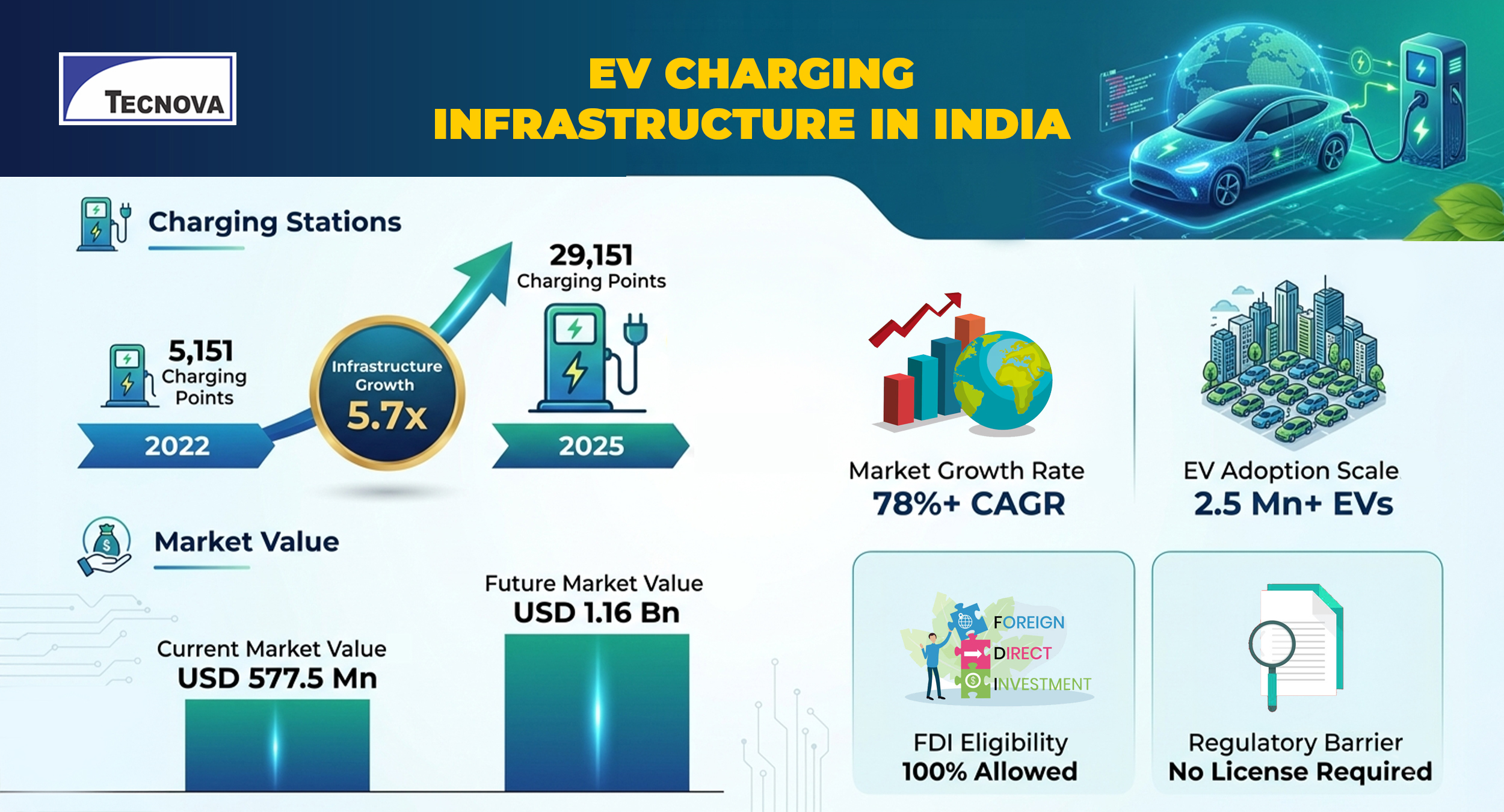
Foreign companies can fully own and operate EV charging stations in India, making the country an attractive destination for global EV infrastructure investors. With 100% Foreign Direct Investment (FDI) permitted in the sector, international charging network operators, technology providers, and infrastructure companies can establish a strong presence in one of the world's fastest-growing EV markets.
• No Power Distribution License Required
Setting up and operating an EV charging station is classified as a service activity rather than the sale of electricity. As a result, companies do not need a separate electricity generation or distribution license, simplifying market entry and reducing regulatory complexity.
• Flexible Market Entry Models
Foreign investors can choose from multiple business structures based on their growth strategy, including wholly owned subsidiaries, joint ventures with local partners, Limited Liability Partnerships (LLPs), or franchise-led expansion models.
• Mandatory BIS Certification
All EV charging equipment, whether imported or manufactured locally, must comply with Bureau of Indian Standards (BIS) requirements. Overseas manufacturers are required to obtain certification through the Foreign Manufacturers Certification Scheme (FMCS) and appoint an Authorized Indian Representative to facilitate compliance.
• Compliance with Technical Standards
Charging infrastructure must meet the technical standards prescribed by the Central Electricity Authority (CEA). This includes compatibility with commonly used charging protocols such as CCS, CHAdeMO, and Type 2 connectors, as well as integration with digital network service providers to enable remote monitoring, booking, and payment.
As India's EV ecosystem continues to expand, supportive regulations, growing vehicle adoption, and increasing infrastructure demand are creating significant opportunities for foreign companies looking to participate in the country's clean mobility transition.
.jpg)
India's EV charging ecosystem is not a single market — it is a layered value chain, and each layer represents a distinct entry point for foreign companies looking to establish or scale their presence in India. From charging hardware and software platforms to energy management systems and supply chain partnerships, global businesses can participate in multiple ways depending on their core strengths and investment objectives.
Understanding how leading operators in India currently build and source their infrastructure reveals where international companies can plug in — whether as technology providers, manufacturing partners, joint venture collaborators, or integrated solution suppliers.
Several market forces are accelerating the development of EV charging infrastructure in India. These trends are reshaping investment priorities and creating new business opportunities. Here is a detailed overview of what are the growth factors of India’s EV charging ecosystem:
1. Rise of Location-Centric EV Charging Networks
Charging infrastructure planning is becoming increasingly location-driven rather than vehicle-driven. Operators are focusing on high-utilisation zones such as commercial complexes, office parks, shopping centres, residential communities, logistics hubs, fuel stations, and transport terminals.
The objective is to place charging points where vehicles naturally spend significant amounts of time. This location-focused strategy is improving utilisation rates and strengthening business viability for charging operators.
2. Growth of Fast-Charging Infrastructure to Accelerate EV Adoption
Fast charging has become one of the strongest enablers of EV adoption. Consumers increasingly expect charging experiences comparable to traditional refuelling. As a result, investment is shifting towards DC fast-charging networks capable of significantly reducing charging times.
The growth of fast charging is particularly important for fleet operators, commercial mobility providers, and logistics companies that depend on vehicle uptime and operational efficiency.
3. Smart Grid Integration to Strengthen EV Charging Infrastructure
The future of charging infrastructure extends beyond hardware deployment. As charging volumes increase, integration with smart grids, energy management and load management systems is becoming increasingly important.
Smart charging technologies allow operators to manage demand fluctuations, reduce peak load stress, improve electricity utilisation, and optimise charging schedules.
4. Better Economics for Charging Operators
The economics of EV charging businesses are improving steadily. Higher EV registrations, growing charging demand, supportive electricity tariffs, and increasing equipment standardisation are contributing to stronger commercial viability.
As utilisation levels improve, charging infrastructure is increasingly being viewed as a long-term infrastructure asset rather than an emerging technology experiment.
5. Interoperability and Enhanced User Experience
Consumer convenience is becoming a major competitive differentiator. Users increasingly expect seamless charging experiences across networks, payment platforms, and charging standards. This has accelerated efforts towards interoperability, standardisation, mobile-based charging access, and real-time charger availability tracking.
As charging networks become more connected, operators that prioritise customer experience are likely to gain a competitive advantage.
Government support remains one of the strongest growth drivers for India's EV charging ecosystem. Several national and state-level initiatives are creating favourable conditions for infrastructure development. Here is a detailed understanding:
1. FAME India Scheme
The Faster Adoption and Manufacturing of Electric Vehicles (FAME) scheme laid the foundation for India's EV charging ecosystem. Under FAME II (2019-2024), the government allocated approximately USD 105 million (INR 1,000 crore) for developing public charging infrastructure across the country.
The scheme supported the installation of charging stations in major cities and on highways, which helped create the initial charging network required for EV adoption. FAME II also encouraged private sector participation and accelerated the transition towards electric mobility.
2. PM E-Drive Initiative
The PM E-DRIVE scheme has emerged as the flagship programme supporting EV infrastructure development after FAME II. It earmarked dedicated funding for public charging stations and the EV manufacturing ecosystem in India.
The initiative aims to deploy approximately 72,300 public charging points across cities and 50 national highway corridors. It will significantly improve charging accessibility and support large-scale EV adoption.
3. State-Level EV Policies Supporting Charging Infrastructure
Several state governments have introduced dedicated EV policies to accelerate charging infrastructure deployment. States such as Karnataka, Maharashtra, Tamil Nadu, and Uttar Pradesh offer various incentives, including support for charging station development, electricity tariff benefits, and streamlined approval processes.
These state-led initiatives are helping create regional EV ecosystems while attracting investments into charging infrastructure projects.
4. Ministry of Power Guidelines for Public EV Charging Stations
The Ministry of Power has established comprehensive guidelines in 2024 to standardise charging infrastructure deployment. The framework covers charger specifications, technical standards, accessibility requirements, and safety protocols.
The guidelines have significantly improved investor confidence by providing greater regulatory clarity and encouraging private sector participation.
.jpg)
The growth of EV charging infrastructure in India presents significant opportunities, but success requires more than capital investment. Businesses must navigate regulatory approvals, market entry strategies, technology selection, partnership development, and long-term expansion planning.
This is where Tecnova helps organisations build a structured and scalable market entry roadmap. Here is how we help foreign companies in India:
1. Market Assessment and Opportunity Mapping
We help businesses identify high-growth EV charging opportunities through market research, demand analysis, location assessment, competitive benchmarking, and investment feasibility studies.
2. Market Entry and Business Strategy Development
We support businesses in developing market entry strategies, operating models, partnership frameworks, and go-to-market plans tailored to India's evolving EV ecosystem.
3. Regulatory Compliance and Policy Guidance
We help organisations navigate regulatory approvals, policy requirements, infrastructure standards, and compliance frameworks, enabling faster market entry and reduced operational risks.
4. Supply Chain and Partner Ecosystem Development
We assist businesses in identifying technology providers, infrastructure partners, suppliers, and local stakeholders to build efficient and scalable charging networks.
5. Expansion and Long-Term Growth Planning
We support growth through expansion planning, market intelligence, operational optimisation, and investment strategies that help businesses scale sustainably across India.
➤ Why is EV charging infrastructure in India becoming an attractive investment opportunity?
India's EV charging infrastructure market is expanding rapidly due to rising EV adoption, supportive government policies, and increasing demand for public charging stations. For global investors, the EV charging infrastructure in India presents opportunities across charging networks, equipment manufacturing, energy management, and charging-as-a-service business models.
➤ What is the current size of the EV charging station market in India?
The EV charging station market in India was valued at approximately USD 577.5 million in 2024 and is projected to reach nearly USD 1.16 billion by 2034. This growth is being driven by increasing EV registrations, infrastructure investments, and supportive EV policies.
➤ Which regions offer the best opportunities for EV charging infrastructure investment in India?
States such as Maharashtra, Karnataka, Gujarat, Tamil Nadu, Telangana, Uttar Pradesh, and Delhi NCR are leading EV infrastructure deployment. These regions offer strong EV adoption, industrial growth, logistics activity, and favorable EV policies for charging infrastructure development.
➤ What are the key business opportunities in the EV charging ecosystem in India?
Opportunities extend beyond charging stations and include fast-charging solutions, charging equipment manufacturing, software platforms, energy management systems, fleet charging solutions, battery-swapping infrastructure, smart grid integration, and EV charging network operations.
➤ How do government initiatives support EV charging infrastructure in India?
Government programs such as FAME India, PM E-DRIVE, and various state EV policies provide incentives, funding support, infrastructure development assistance, and regulatory frameworks that encourage investment in EV charging infrastructure across India.
➤ Why is fast-charging infrastructure becoming critical for EV growth in India?
Fast-charging infrastructure reduces vehicle downtime and improves operational efficiency for fleets, logistics operators, ride-hailing services, and commercial transport providers. As EV adoption grows, demand for DC fast chargers is expected to increase significantly.
➤ What challenges should foreign companies consider before entering India's EV charging market?
Foreign companies should evaluate regulatory requirements, state-level policy variations, land acquisition considerations, power connectivity, location selection, technology standards, and partnership opportunities before entering the Indian EV charging market.
➤ How important is location strategy for EV charging station profitability in India?
Location selection is one of the most important success factors for EV charging station businesses in India. High-utilization locations such as office parks, commercial centers, logistics hubs, highways, residential communities, and transport terminals can significantly improve charging station economics.
➤ How can foreign companies establish an EV charging business in India?
Foreign companies can enter the market through wholly owned subsidiaries, joint ventures, strategic partnerships, franchise models, infrastructure collaborations, or technology licensing arrangements, depending on their business objectives and investment strategy.
➤ How can Tecnova help foreign companies enter India's EV charging infrastructure market?
Tecnova supports global companies through market assessment, EV charging market research, location analysis, partner identification, regulatory compliance support, go-to-market strategy development, supply chain establishment, and long-term expansion planning across India.
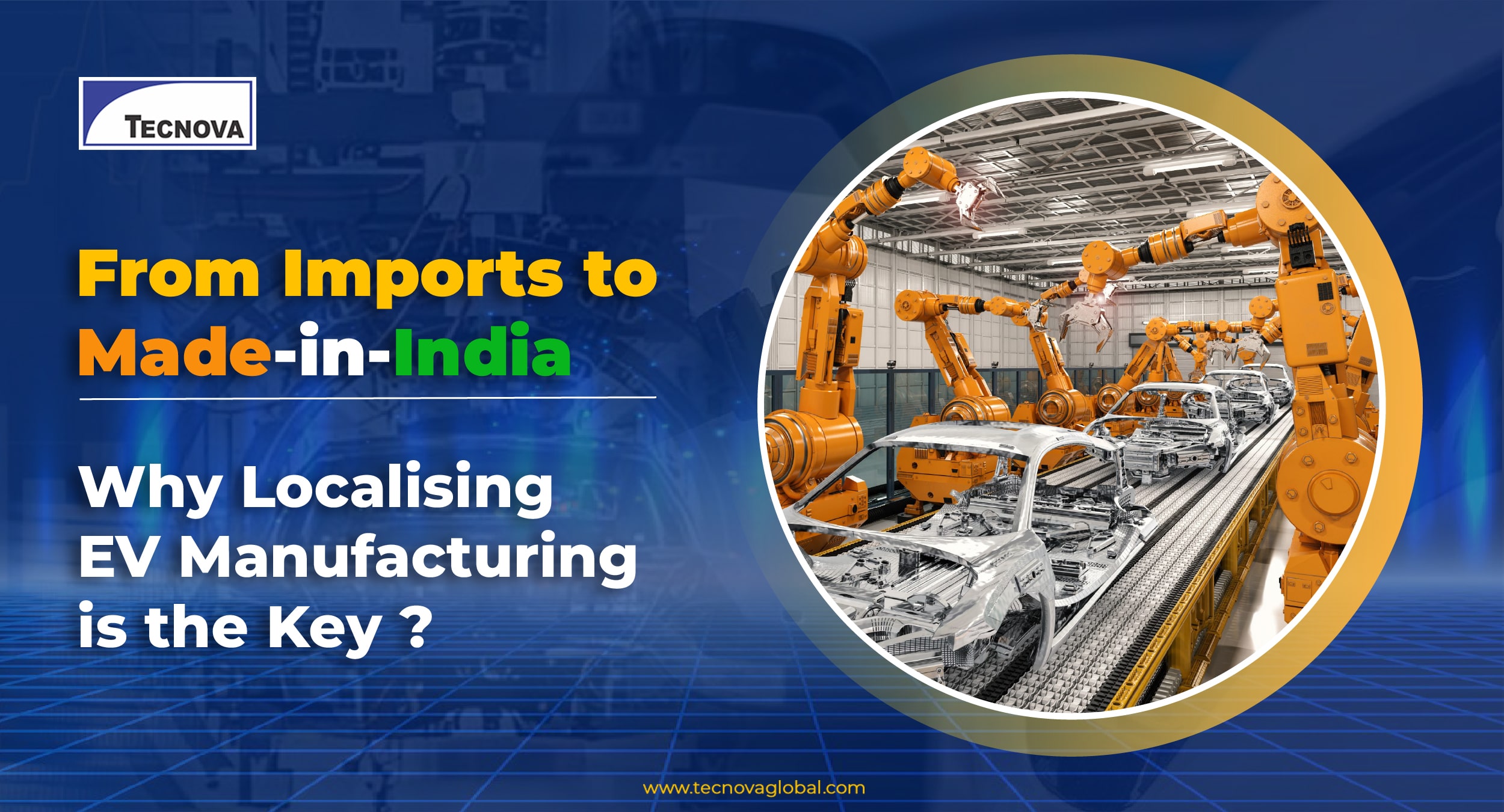
From Imports to Made-in-India: Why Localising EV Manufacturing is the Key
Automotive + OEM Manufacturing & Strategy Consulting Firms in India
Battery Energy Storage in India: A Strategic Investment Opportunity
Note:- For Conversion, 1 USD is equivalent to 95.31 INR
EV Charging Infrastructure in India: Growth and Business Opportunities
Key Takeaways
• India's public EV charging network expanded from 5,151 stations in 2022 to nearly 29,151 stations by 2025.
• The EV charging station market is projected to grow to USD 1.16 billion by 2034.
• Location-centric charging networks are improving utilisation rates and strengthening business viability for charging operators.
• Fast-charging infrastructure is becoming essential for fleets, logistics operators, and commercial mobility providers.
• Government initiatives such as FAME, PM E-DRIVE, and state EV policies are accelerating the growth of charging infrastructure.
• India offers opportunities across the entire EV charging value chain, including charging equipment, software, network operations, energy management, and infrastructure development.
• Tecnova enables foreign companies to navigate India's EV ecosystem through market intelligence, business strategy, partner ecosystem development, regulatory support, and market-entry execution.
Electric vehicle adoption is accelerating across passenger vehicles, commercial fleets, logistics operations, public transport, and two-wheelers. However, charging accessibility remains one of the most critical factors influencing long-term growth.
According to the Ministry of Heavy Industries, India had nearly 29,151 public EV charging stations by the end of 2025, up from 5,151 in early 2022, making it one of the fastest-growing charging networks globally.
At the same time, EV registrations crossed 2.5 million units during FY 2025-26, reflecting growing consumer confidence and policy support. As India advances towards its 2030 EV goals, significant opportunities are emerging for investors, infrastructure developers, and businesses entering the EV charging infrastructure in India.
India's EV ecosystem has moved beyond its early adoption stage and entered a period of large-scale infrastructure expansion. Public EV charging stations have grown at a CAGR exceeding 78%, indicating strong policy support and increasing private-sector participation.
The majority of charging stations remain concentrated in major metropolitan regions, industrial corridors, and highway networks. States such as Maharashtra, Karnataka, Delhi, Gujarat, Tamil Nadu, and Telangana continue to lead infrastructure deployment due to favourable EV policies and strong demand.
The EV charging station business in India was valued at approximately USD 577.50 million in 2024 and is projected to reach nearly USD 1.16 billion by 2034. This highlights the scale of opportunity available across the charging ecosystem.
Despite this progress, charging density remains lower than in mature EV markets. It creates significant room for future investments and innovation.
Foreign companies can fully own and operate EV charging stations in India, making the country an attractive destination for global EV infrastructure investors. With 100% Foreign Direct Investment (FDI) permitted in the sector, international charging network operators, technology providers, and infrastructure companies can establish a strong presence in one of the world's fastest-growing EV markets.
• No Power Distribution License Required
Setting up and operating an EV charging station is classified as a service activity rather than the sale of electricity. As a result, companies do not need a separate electricity generation or distribution license, simplifying market entry and reducing regulatory complexity.
• Flexible Market Entry Models
Foreign investors can choose from multiple business structures based on their growth strategy, including wholly owned subsidiaries, joint ventures with local partners, Limited Liability Partnerships (LLPs), or franchise-led expansion models.
• Mandatory BIS Certification
All EV charging equipment, whether imported or manufactured locally, must comply with Bureau of Indian Standards (BIS) requirements. Overseas manufacturers are required to obtain certification through the Foreign Manufacturers Certification Scheme (FMCS) and appoint an Authorized Indian Representative to facilitate compliance.
• Compliance with Technical Standards
Charging infrastructure must meet the technical standards prescribed by the Central Electricity Authority (CEA). This includes compatibility with commonly used charging protocols such as CCS, CHAdeMO, and Type 2 connectors, as well as integration with digital network service providers to enable remote monitoring, booking, and payment.
As India's EV ecosystem continues to expand, supportive regulations, growing vehicle adoption, and increasing infrastructure demand are creating significant opportunities for foreign companies looking to participate in the country's clean mobility transition.
India's EV charging ecosystem is not a single market — it is a layered value chain, and each layer represents a distinct entry point for foreign companies looking to establish or scale their presence in India. From charging hardware and software platforms to energy management systems and supply chain partnerships, global businesses can participate in multiple ways depending on their core strengths and investment objectives.
Understanding how leading operators in India currently build and source their infrastructure reveals where international companies can plug in — whether as technology providers, manufacturing partners, joint venture collaborators, or integrated solution suppliers.
Several market forces are accelerating the development of EV charging infrastructure in India. These trends are reshaping investment priorities and creating new business opportunities. Here is a detailed overview of what are the growth factors of India’s EV charging ecosystem:
1. Rise of Location-Centric EV Charging Networks
Charging infrastructure planning is becoming increasingly location-driven rather than vehicle-driven. Operators are focusing on high-utilisation zones such as commercial complexes, office parks, shopping centres, residential communities, logistics hubs, fuel stations, and transport terminals.
The objective is to place charging points where vehicles naturally spend significant amounts of time. This location-focused strategy is improving utilisation rates and strengthening business viability for charging operators.
2. Growth of Fast-Charging Infrastructure to Accelerate EV Adoption
Fast charging has become one of the strongest enablers of EV adoption. Consumers increasingly expect charging experiences comparable to traditional refuelling. As a result, investment is shifting towards DC fast-charging networks capable of significantly reducing charging times.
The growth of fast charging is particularly important for fleet operators, commercial mobility providers, and logistics companies that depend on vehicle uptime and operational efficiency.
3. Smart Grid Integration to Strengthen EV Charging Infrastructure
The future of charging infrastructure extends beyond hardware deployment. As charging volumes increase, integration with smart grids, energy management and load management systems is becoming increasingly important.
Smart charging technologies allow operators to manage demand fluctuations, reduce peak load stress, improve electricity utilisation, and optimise charging schedules.
4. Better Economics for Charging Operators
The economics of EV charging businesses are improving steadily. Higher EV registrations, growing charging demand, supportive electricity tariffs, and increasing equipment standardisation are contributing to stronger commercial viability.
As utilisation levels improve, charging infrastructure is increasingly being viewed as a long-term infrastructure asset rather than an emerging technology experiment.
5. Interoperability and Enhanced User Experience
Consumer convenience is becoming a major competitive differentiator. Users increasingly expect seamless charging experiences across networks, payment platforms, and charging standards. This has accelerated efforts towards interoperability, standardisation, mobile-based charging access, and real-time charger availability tracking.
As charging networks become more connected, operators that prioritise customer experience are likely to gain a competitive advantage.
Government support remains one of the strongest growth drivers for India's EV charging ecosystem. Several national and state-level initiatives are creating favourable conditions for infrastructure development. Here is a detailed understanding:
1. FAME India Scheme
The Faster Adoption and Manufacturing of Electric Vehicles (FAME) scheme laid the foundation for India's EV charging ecosystem. Under FAME II (2019-2024), the government allocated approximately USD 105 million (INR 1,000 crore) for developing public charging infrastructure across the country.
The scheme supported the installation of charging stations in major cities and on highways, which helped create the initial charging network required for EV adoption. FAME II also encouraged private sector participation and accelerated the transition towards electric mobility.
2. PM E-Drive Initiative
The PM E-DRIVE scheme has emerged as the flagship programme supporting EV infrastructure development after FAME II. It earmarked dedicated funding for public charging stations and the EV manufacturing ecosystem in India.
The initiative aims to deploy approximately 72,300 public charging points across cities and 50 national highway corridors. It will significantly improve charging accessibility and support large-scale EV adoption.
3. State-Level EV Policies Supporting Charging Infrastructure
Several state governments have introduced dedicated EV policies to accelerate charging infrastructure deployment. States such as Karnataka, Maharashtra, Tamil Nadu, and Uttar Pradesh offer various incentives, including support for charging station development, electricity tariff benefits, and streamlined approval processes.
These state-led initiatives are helping create regional EV ecosystems while attracting investments into charging infrastructure projects.
4. Ministry of Power Guidelines for Public EV Charging Stations
The Ministry of Power has established comprehensive guidelines in 2024 to standardise charging infrastructure deployment. The framework covers charger specifications, technical standards, accessibility requirements, and safety protocols.
The guidelines have significantly improved investor confidence by providing greater regulatory clarity and encouraging private sector participation.
The growth of EV charging infrastructure in India presents significant opportunities, but success requires more than capital investment. Businesses must navigate regulatory approvals, market entry strategies, technology selection, partnership development, and long-term expansion planning.
This is where Tecnova helps organisations build a structured and scalable market entry roadmap. Here is how we help foreign companies in India:
1. Market Assessment and Opportunity Mapping
We help businesses identify high-growth EV charging opportunities through market research, demand analysis, location assessment, competitive benchmarking, and investment feasibility studies.
2. Market Entry and Business Strategy Development
We support businesses in developing market entry strategies, operating models, partnership frameworks, and go-to-market plans tailored to India's evolving EV ecosystem.
3. Regulatory Compliance and Policy Guidance
We help organisations navigate regulatory approvals, policy requirements, infrastructure standards, and compliance frameworks, enabling faster market entry and reduced operational risks.
4. Supply Chain and Partner Ecosystem Development
We assist businesses in identifying technology providers, infrastructure partners, suppliers, and local stakeholders to build efficient and scalable charging networks.
5. Expansion and Long-Term Growth Planning
We support growth through expansion planning, market intelligence, operational optimisation, and investment strategies that help businesses scale sustainably across India.
➤ Why is EV charging infrastructure in India becoming an attractive investment opportunity?
India's EV charging infrastructure market is expanding rapidly due to rising EV adoption, supportive government policies, and increasing demand for public charging stations. For global investors, the EV charging infrastructure in India presents opportunities across charging networks, equipment manufacturing, energy management, and charging-as-a-service business models.
➤ What is the current size of the EV charging station market in India?
The EV charging station market in India was valued at approximately USD 577.5 million in 2024 and is projected to reach nearly USD 1.16 billion by 2034. This growth is being driven by increasing EV registrations, infrastructure investments, and supportive EV policies.
➤ Which regions offer the best opportunities for EV charging infrastructure investment in India?
States such as Maharashtra, Karnataka, Gujarat, Tamil Nadu, Telangana, Uttar Pradesh, and Delhi NCR are leading EV infrastructure deployment. These regions offer strong EV adoption, industrial growth, logistics activity, and favorable EV policies for charging infrastructure development.
➤ What are the key business opportunities in the EV charging ecosystem in India?
Opportunities extend beyond charging stations and include fast-charging solutions, charging equipment manufacturing, software platforms, energy management systems, fleet charging solutions, battery-swapping infrastructure, smart grid integration, and EV charging network operations.
➤ How do government initiatives support EV charging infrastructure in India?
Government programs such as FAME India, PM E-DRIVE, and various state EV policies provide incentives, funding support, infrastructure development assistance, and regulatory frameworks that encourage investment in EV charging infrastructure across India.
➤ Why is fast-charging infrastructure becoming critical for EV growth in India?
Fast-charging infrastructure reduces vehicle downtime and improves operational efficiency for fleets, logistics operators, ride-hailing services, and commercial transport providers. As EV adoption grows, demand for DC fast chargers is expected to increase significantly.
➤ What challenges should foreign companies consider before entering India's EV charging market?
Foreign companies should evaluate regulatory requirements, state-level policy variations, land acquisition considerations, power connectivity, location selection, technology standards, and partnership opportunities before entering the Indian EV charging market.
➤ How important is location strategy for EV charging station profitability in India?
Location selection is one of the most important success factors for EV charging station businesses in India. High-utilization locations such as office parks, commercial centers, logistics hubs, highways, residential communities, and transport terminals can significantly improve charging station economics.
➤ How can foreign companies establish an EV charging business in India?
Foreign companies can enter the market through wholly owned subsidiaries, joint ventures, strategic partnerships, franchise models, infrastructure collaborations, or technology licensing arrangements, depending on their business objectives and investment strategy.
➤ How can Tecnova help foreign companies enter India's EV charging infrastructure market?
Tecnova supports global companies through market assessment, EV charging market research, location analysis, partner identification, regulatory compliance support, go-to-market strategy development, supply chain establishment, and long-term expansion planning across India.
From Imports to Made-in-India: Why Localising EV Manufacturing is the Key
Automotive + OEM Manufacturing & Strategy Consulting Firms in India
Battery Energy Storage in India: A Strategic Investment Opportunity
Note:- For Conversion, 1 USD is equivalent to 95.31 INR


















%20(1).png)

.jpg)
.png)



%20(1).png)
.jpg)


.png)





.jpeg)













.png)

.png)







.jpg)




.jpg)


.jpg)