Services


Sectors
Insights
COMMERCIALIZATION
Insights







Follow Us
Pharmacovigilance in India: A Strategic Advantage for Global Pharma
India is no longer just a manufacturing destination for global pharma - it's becoming a key hub for drug safety and pharmacovigilance.
As regulations become more robust and AI transforms drug safety monitoring, global pharmaceutical companies are looking at India for more than compliance. They are investing in capabilities that improve patient safety, strengthen regulatory readiness, and support long-term growth.
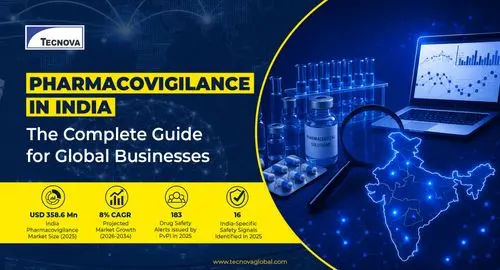
India's pharmacovigilance market, currently valued at USD 358.6 million, is expected to reach USD 732 million by 2034, reflecting the country's growing role in global drug safety.
What's driving this growth?
• Stronger CDSCO regulations and post-marketing surveillance
• AI-powered pharmacovigilance and smarter safety monitoring
• Increased patient reporting and real-world evidence
• Rising demand for global pharmacovigilance operations in India
For international pharmaceutical companies, pharmacovigilance is no longer just about meeting regulatory requirements. It's about building safer products, making informed decisions, and creating a strong foundation for sustainable growth in one of the world's fastest-growing pharmaceutical markets.
How Tecnova helps
Expanding into India's pharmaceutical market requires more than regulatory approvals. It calls for the right market-entry strategy, local regulatory expertise, and a strong pharmacovigilance framework. At Tecnova, we help global pharmaceutical companies navigate CDSCO compliance, establish pharmacovigilance systems, support clinical trial market entry, and build a compliant, future-ready presence in India.
India’s pharmaceutical and clinical research ecosystem is transforming fast, making the country one of the world’s top destinations for clinical trials and post-marketing drug surveillance.
The pharmacovigilance market of India reached nearly USD 358.6 million and is projected to grow at a CAGR of 8% between 2026 and 2034.
This surge creates a major opportunity for global drug manufacturers and clinical research organisations (CROs) to enter and expand in the market.
This guide explores India’s pharmacovigilance framework: its key trends, challenges and opportunities for foreign pharma companies.
The Central Drugs Standard Control Organization (CDSCO) has issued a circular directing all stakeholders to establish and maintain an effective Pharmacovigilance (PV) system in accordance with Para 6.11 of Schedule M of the Drugs & Cosmetics Rules, 1945. The circular reiterates that manufacturers and marketers of pharmaceutical products must have systems in place for collecting, processing and reporting adverse drug reactions to the licensing authorities. Compliance may also be verified during routine inspections.
Pharmacovigilance monitors drugs and their real-world effects, and this
As per a report published by the Ministry of Health and Family Welfare in May 2026, the Indian Council of Medical Research (ICMR) organised the ‘1st ICMR Annual Clinical Trial Meet 2026’. The meet-up highlighted India’s role in evidence-based, comprehensive medical research and ethical governance of healthcare practices.
Rising regulatory mandates will push India’s pharmacovigilance market to USD 732 million by 2034. A booming domestic pharmaceutical sector, AI-led digital transformation, tighter global regulations and a rise in outsourced clinical trials drive this growth.
For example, a US-based biopharmaceutical company invested over USD 100 million in India to support early-stage drug discovery and development through its Global Capability Centre (GCC) in Hyderabad.
As of November 2024, the company had 23 active clinical trials underway and aims to achieve more than double this number by 2026.
The Indian government has strengthened regulations around post-marketing surveillance and adverse drug reaction (ADR) reporting. For foreign pharma brands entering India, pharmacovigilance is not only a compliance requirement but a strategic business function.
The Pharmacovigilance Programme of India (PvPI) was launched by the Central Drugs Standard Control Organisation (CDSCO) in July 2010 to monitor drug safety and protect public health.
The Indian Pharmacopoeia Commission (IPC) currently acts as the National Coordination Centre for PvPI. PvPI collects and evaluates adverse drug reaction reports from hospitals, healthcare professionals, pharmaceutical companies and patients.
In 2025, PvPI identified 16 India-specific safety signals and issued 183 drug safety alerts to strengthen patient safety measures nationwide. These interventions also resulted in updates to 66 package inserts for marketed drugs.
India now operates a large network of ADR Monitoring Centres (AMCs), helping multinational companies access robust pharmacovigilance services in India while ensuring CDSCO compliance.

AI integration and automation are reshaping India’s pharmacovigilance market:
Artificial Intelligence is transforming pharmacovigilance services in India by improving signal detection and enabling predictive analytics. AI-powered pharmacovigilance platforms can process massive datasets from electronic health records.
This significantly reduces reporting delays and improves regulatory compliance. The global pharmacovigilance market was valued at USD 9.2 billion in 2025, with AI adoption emerging as a key growth driver.
Many people now ask: “Will AI dominate the pharmacovigilance market?” The answer is no.
AI will enhance pharmacovigilance workflows, but human medical judgment remains essential for signal validation and regulatory interpretation.
India is shifting toward patient-driven adverse event reporting. In 2025, CDSCO mandated QR-code-based ADR reporting systems at pharmacies nationwide. This helps the patients to directly report side effects.
This patient-centric approach increases transparency and enhances pharmacovigilance services in India by harnessing real-world evidence generation.
Regulatory compliance is becoming increasingly stringent under CDSCO. Companies entering the Indian market must comply with post-marketing surveillance obligations and periodic safety update reports (PSURs).
The new drug approval process in India now requires safety documentation, especially for imported drugs, biosimilars, vaccines and speciality therapies.
India is witnessing growing investment in rare disease therapies and orphan drug development through public-interest pharmaceuticals.
The nation’s large patient pool and expanding genomic research infrastructure also support clinical trial market entry in India for foreign companies focusing on rare disease therapies.
Automation is the primary pillar of modern pharmacovigilance operations. Case intake, duplicate detection, MedDRA coding, literature screening and report generation are increasingly automated through cloud-based systems and machine learning models.
The Indian pharmacovigilance and drug safety software market is projected to grow at a CAGR of 8.8% through 2033, reflecting rising investment in automation technologies.

Despite the growth, pharmacovigilance in India faces significant hurdles like infrastructural gaps and a lack of awareness. Have a look:
There are some regions in India, especially in rural and semi-urban areas, where adverse drug reaction reporting remains underdeveloped. Many healthcare professionals and patients lack awareness about pharmacovigilance reporting mechanisms. This underreporting impacts the effectiveness of pharmacovigilance services in India.
India’s regulatory infrastructure has improved considerably in recent years, but certain inconsistencies still exist across states and healthcare institutions.
Foreign companies entering the new drug approval process in India may encounter variable implementation standards and infrastructure limitations at regional healthcare centres.
India’s healthcare ecosystem includes public hospitals, private institutions, pharmacies, telemedicine providers and informal healthcare practitioners. This diversity complicates data standardisation and safety monitoring.
For companies planning clinical trial market entry in India, understanding regional healthcare dynamics is essential for effective pharmacovigilance integration.
India generates vast volumes of clinical and post-marketing safety data. However, fragmented databases and inconsistent reporting quality limit the progress of pharmacovigilance data management.
Foreign pharmaceutical companies must establish robust pharmacovigilance services in India with multilingual reporting capabilities for improved data management.
Despite infrastructural and managerial challenges, India is a strategic destination for global pharmacovigilance outsourcing, offering a skilled workforce and cost-efficient services. To capture this market, foreign companies should focus on:
India offers a strong talent pool of pharmacists and healthcare professionals trained in global safety standards. Foreign companies can establish centralised safety hubs in India to support worldwide pharmacovigilance operations.
Cost-efficient outsourcing and skilled manpower make pharmacovigilance services in India highly attractive for multinational pharmaceutical companies.
India’s regulatory landscape requires active engagement with CDSCO, IPC, ethics committees and local health authorities.
Foreign companies entering through the new drug approval process in India can coordinate with local regulatory experts who understand evolving compliance requirements and reporting expectations.
India’s large patient population provides valuable real-world evidence for risk-benefit assessments across diverse therapeutic categories.
Pharmacovigilance services in India enable global pharmaceutical companies to collect population-specific safety data and improve post-marketing surveillance.
India’s growing ADR database supports advanced signal detection and epidemiological analysis. With increased digitisation and AI integration, pharmacovigilance services in India are becoming important contributors to global safety intelligence systems.
For multinational organisations pursuing clinical trial market entry in India, integrating local signal detection systems with global safety operations can enhance regulatory responsiveness and improve patient outcomes.

Tecnova, with over 40 years of experience, helps global pharmaceutical companies navigate pharmacovigilance services in India through end-to-end support.
We:
♦ Assist in navigating pharmacovigilance services in India and CDSCO compliance requirements
♦ Guide through the new drug approval process in India for regulatory approvals
♦ Help companies establish compliant pharmacovigilance systems and adverse event reporting frameworks
♦ Facilitate clinical trial market entry in India through local partnerships and regulatory coordination
As India continues to strengthen its pharmaceutical and regulatory ecosystem, foreign pharma companies entering and expanding in India with robust pharmacovigilance strategies will gain long-term success. With expert market-entry support and industry expertise, Tecnova can help international brands navigate the pharmacovigilance ecosystem of India efficiently.
References
India MedTech Industry: Roadmap to Global Healthcare Leadership
Pharmacovigilance in India: A Strategic Advantage for Global Pharma
India is no longer just a manufacturing destination for global pharma - it's becoming a key hub for drug safety and pharmacovigilance.
As regulations become more robust and AI transforms drug safety monitoring, global pharmaceutical companies are looking at India for more than compliance. They are investing in capabilities that improve patient safety, strengthen regulatory readiness, and support long-term growth.
India's pharmacovigilance market, currently valued at USD 358.6 million, is expected to reach USD 732 million by 2034, reflecting the country's growing role in global drug safety.
What's driving this growth?
• Stronger CDSCO regulations and post-marketing surveillance
• AI-powered pharmacovigilance and smarter safety monitoring
• Increased patient reporting and real-world evidence
• Rising demand for global pharmacovigilance operations in India
For international pharmaceutical companies, pharmacovigilance is no longer just about meeting regulatory requirements. It's about building safer products, making informed decisions, and creating a strong foundation for sustainable growth in one of the world's fastest-growing pharmaceutical markets.
How Tecnova helps
Expanding into India's pharmaceutical market requires more than regulatory approvals. It calls for the right market-entry strategy, local regulatory expertise, and a strong pharmacovigilance framework. At Tecnova, we help global pharmaceutical companies navigate CDSCO compliance, establish pharmacovigilance systems, support clinical trial market entry, and build a compliant, future-ready presence in India.
India’s pharmaceutical and clinical research ecosystem is transforming fast, making the country one of the world’s top destinations for clinical trials and post-marketing drug surveillance.
The pharmacovigilance market of India reached nearly USD 358.6 million and is projected to grow at a CAGR of 8% between 2026 and 2034.
This surge creates a major opportunity for global drug manufacturers and clinical research organisations (CROs) to enter and expand in the market.
This guide explores India’s pharmacovigilance framework: its key trends, challenges and opportunities for foreign pharma companies.
The Central Drugs Standard Control Organization (CDSCO) has issued a circular directing all stakeholders to establish and maintain an effective Pharmacovigilance (PV) system in accordance with Para 6.11 of Schedule M of the Drugs & Cosmetics Rules, 1945. The circular reiterates that manufacturers and marketers of pharmaceutical products must have systems in place for collecting, processing and reporting adverse drug reactions to the licensing authorities. Compliance may also be verified during routine inspections.
Pharmacovigilance monitors drugs and their real-world effects, and this
As per a report published by the Ministry of Health and Family Welfare in May 2026, the Indian Council of Medical Research (ICMR) organised the ‘1st ICMR Annual Clinical Trial Meet 2026’. The meet-up highlighted India’s role in evidence-based, comprehensive medical research and ethical governance of healthcare practices.
Rising regulatory mandates will push India’s pharmacovigilance market to USD 732 million by 2034. A booming domestic pharmaceutical sector, AI-led digital transformation, tighter global regulations and a rise in outsourced clinical trials drive this growth.
For example, a US-based biopharmaceutical company invested over USD 100 million in India to support early-stage drug discovery and development through its Global Capability Centre (GCC) in Hyderabad.
As of November 2024, the company had 23 active clinical trials underway and aims to achieve more than double this number by 2026.
The Indian government has strengthened regulations around post-marketing surveillance and adverse drug reaction (ADR) reporting. For foreign pharma brands entering India, pharmacovigilance is not only a compliance requirement but a strategic business function.
The Pharmacovigilance Programme of India (PvPI) was launched by the Central Drugs Standard Control Organisation (CDSCO) in July 2010 to monitor drug safety and protect public health.
The Indian Pharmacopoeia Commission (IPC) currently acts as the National Coordination Centre for PvPI. PvPI collects and evaluates adverse drug reaction reports from hospitals, healthcare professionals, pharmaceutical companies and patients.
In 2025, PvPI identified 16 India-specific safety signals and issued 183 drug safety alerts to strengthen patient safety measures nationwide. These interventions also resulted in updates to 66 package inserts for marketed drugs.
India now operates a large network of ADR Monitoring Centres (AMCs), helping multinational companies access robust pharmacovigilance services in India while ensuring CDSCO compliance.
AI integration and automation are reshaping India’s pharmacovigilance market:
Artificial Intelligence is transforming pharmacovigilance services in India by improving signal detection and enabling predictive analytics. AI-powered pharmacovigilance platforms can process massive datasets from electronic health records.
This significantly reduces reporting delays and improves regulatory compliance. The global pharmacovigilance market was valued at USD 9.2 billion in 2025, with AI adoption emerging as a key growth driver.
Many people now ask: “Will AI dominate the pharmacovigilance market?” The answer is no.
AI will enhance pharmacovigilance workflows, but human medical judgment remains essential for signal validation and regulatory interpretation.
India is shifting toward patient-driven adverse event reporting. In 2025, CDSCO mandated QR-code-based ADR reporting systems at pharmacies nationwide. This helps the patients to directly report side effects.
This patient-centric approach increases transparency and enhances pharmacovigilance services in India by harnessing real-world evidence generation.
Regulatory compliance is becoming increasingly stringent under CDSCO. Companies entering the Indian market must comply with post-marketing surveillance obligations and periodic safety update reports (PSURs).
The new drug approval process in India now requires safety documentation, especially for imported drugs, biosimilars, vaccines and speciality therapies.
India is witnessing growing investment in rare disease therapies and orphan drug development through public-interest pharmaceuticals.
The nation’s large patient pool and expanding genomic research infrastructure also support clinical trial market entry in India for foreign companies focusing on rare disease therapies.
Automation is the primary pillar of modern pharmacovigilance operations. Case intake, duplicate detection, MedDRA coding, literature screening and report generation are increasingly automated through cloud-based systems and machine learning models.
The Indian pharmacovigilance and drug safety software market is projected to grow at a CAGR of 8.8% through 2033, reflecting rising investment in automation technologies.
Despite the growth, pharmacovigilance in India faces significant hurdles like infrastructural gaps and a lack of awareness. Have a look:
There are some regions in India, especially in rural and semi-urban areas, where adverse drug reaction reporting remains underdeveloped. Many healthcare professionals and patients lack awareness about pharmacovigilance reporting mechanisms. This underreporting impacts the effectiveness of pharmacovigilance services in India.
India’s regulatory infrastructure has improved considerably in recent years, but certain inconsistencies still exist across states and healthcare institutions.
Foreign companies entering the new drug approval process in India may encounter variable implementation standards and infrastructure limitations at regional healthcare centres.
India’s healthcare ecosystem includes public hospitals, private institutions, pharmacies, telemedicine providers and informal healthcare practitioners. This diversity complicates data standardisation and safety monitoring.
For companies planning clinical trial market entry in India, understanding regional healthcare dynamics is essential for effective pharmacovigilance integration.
India generates vast volumes of clinical and post-marketing safety data. However, fragmented databases and inconsistent reporting quality limit the progress of pharmacovigilance data management.
Foreign pharmaceutical companies must establish robust pharmacovigilance services in India with multilingual reporting capabilities for improved data management.
Despite infrastructural and managerial challenges, India is a strategic destination for global pharmacovigilance outsourcing, offering a skilled workforce and cost-efficient services. To capture this market, foreign companies should focus on:
India offers a strong talent pool of pharmacists and healthcare professionals trained in global safety standards. Foreign companies can establish centralised safety hubs in India to support worldwide pharmacovigilance operations.
Cost-efficient outsourcing and skilled manpower make pharmacovigilance services in India highly attractive for multinational pharmaceutical companies.
India’s regulatory landscape requires active engagement with CDSCO, IPC, ethics committees and local health authorities.
Foreign companies entering through the new drug approval process in India can coordinate with local regulatory experts who understand evolving compliance requirements and reporting expectations.
India’s large patient population provides valuable real-world evidence for risk-benefit assessments across diverse therapeutic categories.
Pharmacovigilance services in India enable global pharmaceutical companies to collect population-specific safety data and improve post-marketing surveillance.
India’s growing ADR database supports advanced signal detection and epidemiological analysis. With increased digitisation and AI integration, pharmacovigilance services in India are becoming important contributors to global safety intelligence systems.
For multinational organisations pursuing clinical trial market entry in India, integrating local signal detection systems with global safety operations can enhance regulatory responsiveness and improve patient outcomes.
Tecnova, with over 40 years of experience, helps global pharmaceutical companies navigate pharmacovigilance services in India through end-to-end support.
We:
♦ Assist in navigating pharmacovigilance services in India and CDSCO compliance requirements
♦ Guide through the new drug approval process in India for regulatory approvals
♦ Help companies establish compliant pharmacovigilance systems and adverse event reporting frameworks
♦ Facilitate clinical trial market entry in India through local partnerships and regulatory coordination
As India continues to strengthen its pharmaceutical and regulatory ecosystem, foreign pharma companies entering and expanding in India with robust pharmacovigilance strategies will gain long-term success. With expert market-entry support and industry expertise, Tecnova can help international brands navigate the pharmacovigilance ecosystem of India efficiently.
References
India MedTech Industry: Roadmap to Global Healthcare Leadership

















%20(1).png)

.jpg)
.png)




%20(1).png)
.jpg)



.png)




.jpeg)
















.png)

.png)









.jpg)




.jpg)

.jpg)