Services


Sectors
Insights
COMMERCIALIZATION
Insights







Follow Us
Is your private limited company fully prepared to handle India’s increasingly strict compliance environment in 2026?
With India crossing over 2 million active companies, regulatory oversight has become more technology-driven and transparent than ever before.
Authorities now use automated systems to monitor ROC filings, tax disclosures and governance records, which makes compliance lapses easier to identify. This has made annual compliance for private limited companies in India far more than a legal formality.
Timely compliance strengthens investor confidence, protects businesses from penalties and supports long-term operational growth in one of the world’s fastest-growing economies.
Annual compliance refers to the mandatory legal, financial, regulatory and governance-related obligations that every private limited company must fulfil under Indian corporate laws.
These compliances primarily fall under the Companies Act, 2013, along with requirements administered by the Ministry of Corporate Affairs (MCA), the Income-tax Act, 1961, the Foreign Exchange Management Act, 1999 (FEMA), applicable labour laws and other sector-specific regulators such as the Reserve Bank of India (RBI), where applicable.
India’s regulatory framework has evolved significantly over the last few years. The MCA has expanded digital compliance mechanisms to improve transparency and strengthen corporate accountability.
As more global businesses establish operations in India, maintaining proper annual compliance for private limited companies in India has become essential for sustainable business expansion.
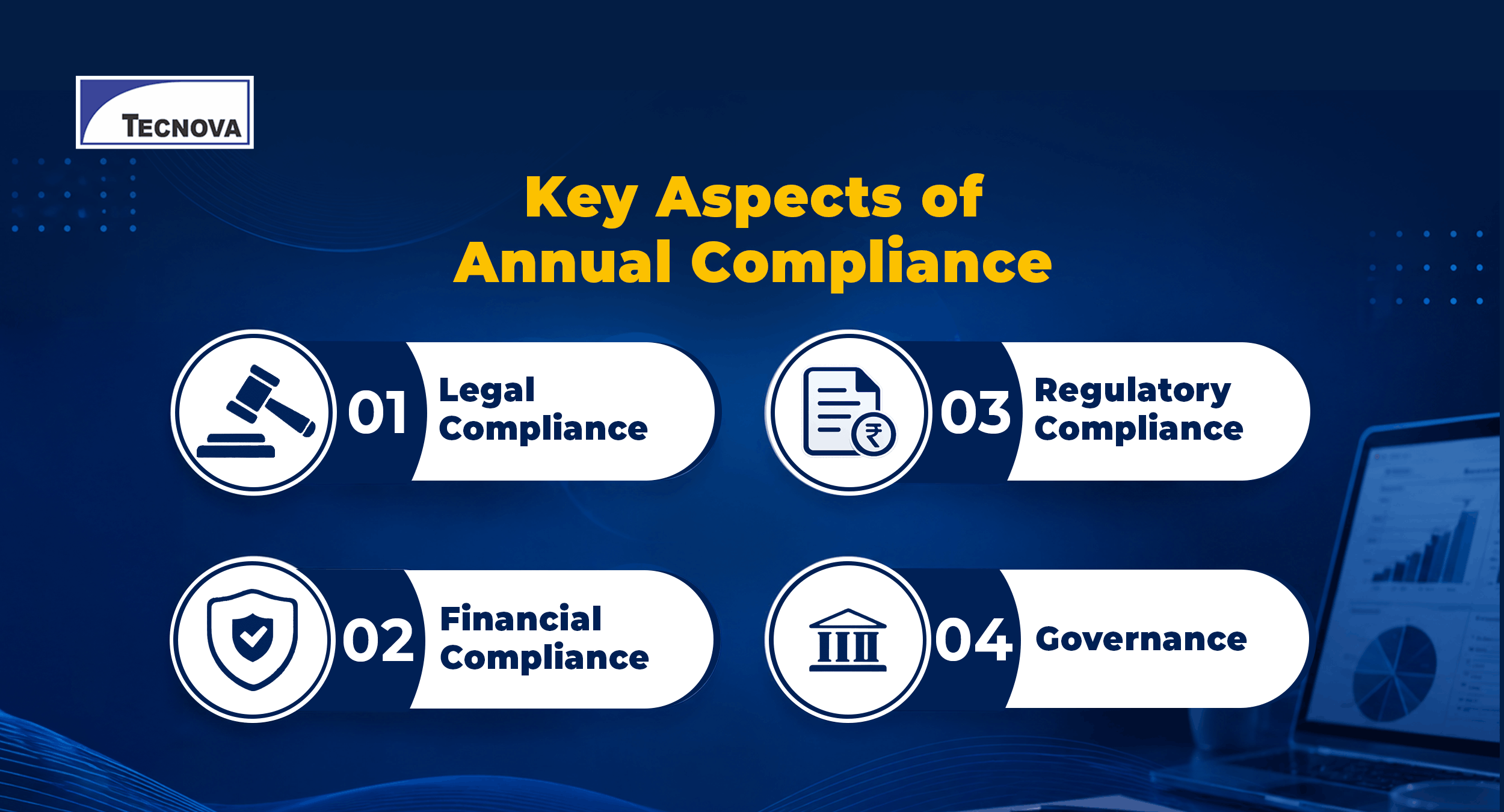
Annual compliance involves several interconnected areas. Businesses must maintain consistency across all compliance functions to avoid regulatory complications. Here is a detailed overview of what are the major aspects of compliance for private limited companies in India:
1. Legal Compliance
Corporate legal compliance focuses on fulfilling mandatory obligations under the Companies Act, 2013. Companies must maintain proper documentation, conduct board meetings, hold Annual General Meetings (AGMs) and complete annual ROC filings within prescribed timelines.
Important filings and activities generally include:
• Filing Form AOC-4 for financial statements
• Filing Form MGT-7/7A for annual returns
• Completing DIR-3 KYC for directors
• Filing Form DPT-3 and PAS-6, where applicable
• Maintaining board resolutions and AGM records
2. Financial Compliance
Financial compliance ensures that businesses maintain accurate accounting records, complete audits and fulfil tax-related obligations. Private limited companies must prepare audited financial statements, file corporate income tax returns and comply with GST and TDS requirements where applicable.
Key financial compliance requirements include:
• Statutory audit completion
• Filing ITR-6
• GST return filings, where applicable
• TDS filings and reconciliations
3. Regulatory Compliance
Apart from company law requirements, businesses must also comply with sector-specific regulations depending on their operations. Regulatory compliance may vary across industries such as manufacturing, food processing, healthcare, fintech, logistics and technology services.
These obligations can include:
• FSSAI registrations and renewals
• MSME-related compliance
• PF and ESIC filings
• Environmental approvals and NOCs
• Shop and establishment registrations and related compliances
• Professional tax where applicable
India’s evolving regulatory environment continues to encourage greater operational transparency and accountability across sectors.
4. Governance
Governance compliance focuses on maintaining transparency, accountability and proper internal controls within the organisation. Strong governance practices help businesses build investor confidence and improve operational credibility, especially for foreign-owned entities operating in India.
Governance-related compliance activities generally include:
• Maintaining statutory registers
• Filing specified board resolutions through e-Form MGT-14
• Ensuring proper circulation of financial statements
• Preserving shareholder communication records
As investor scrutiny increases globally, businesses with stronger governance standards are often viewed as more stable and investment-ready.

Compliance directly influences a company’s operational stability, market reputation and growth potential. The following areas highlight why annual compliance remains critical in India’s evolving regulatory environment:
• Legal Protection
Compliance helps companies operate within the framework of Indian law, reducing the risk of legal disputes, enforcement actions and regulatory investigations. Timely compliance also protects directors from disqualification and liability exposure.
• Investor Confidence
Investors increasingly evaluate governance and compliance standards before committing capital. Businesses with stronger compliance records generally experience better investor confidence and smoother fundraising processes. This is especially relevant for foreign-owned private limited companies seeking long-term expansion in India.
• Operational Efficiency
Structured compliance systems improve internal processes and documentation management. Businesses that maintain organised compliance frameworks often experience faster approvals, smoother audits and reduced administrative disruptions.
• Reputation Management
Non-compliance can damage a company’s credibility with regulators, investors, financial institutions and business partners. On the other hand, businesses that consistently meet ROC filing requirements in India are viewed as more reliable and professionally managed.
Corporate reputation has become increasingly important in India’s competitive business environment.
• Financial Health
Compliance helps businesses maintain accurate financial records and reporting systems. Proper financial governance improves budgeting, forecasting, cash flow management and strategic planning. It also supports smoother banking relationships and financing opportunities.
• Avoids Penalties
Regulatory authorities in India have strengthened enforcement mechanisms significantly in recent years. Delayed filings, inaccurate disclosures, or missed deadlines can result in financial penalties, additional scrutiny and legal complications.
In fact, the Indian government imposed penalties exceeding ≈ USD 5.76 million (INR 55 crore) on 703 companies for Companies Act violations during the first nine months ending December 31, 2025. It highlights the growing intensity of compliance enforcement.
• Access to Funding
Banks, investors and financial institutions often review compliance records before approving loans or investments. Businesses with clean compliance histories generally face fewer obstacles when seeking financing or strategic partnerships. This makes annual compliance a critical component of long-term business growth.
Private limited companies in India must comply with several recurring annual obligations. While exact deadlines may vary based on financial year closures and regulatory notifications, the following requirements remain essential:
1. Conducting Board Meetings
Private limited companies must conduct at least four board meetings annually, with a maximum gap of 120 days between two meetings. These meetings help document strategic decisions, ensure transparency in governance and maintain compliance with the Companies Act, 2013.
2. Annual General Meeting
Every private limited company must hold an Annual General Meeting (AGM) within 9 months of the end of its first financial year and subsequently within 6 months of the end of each subsequent financial year.
3. AOC-4 (Filing of Financial Statements)
Form AOC-4 is used to file audited financial statements, including the balance sheet, profit and loss account and directors’ report, with the ROC. Companies must generally submit this form within 30 days of the AGM conclusion.
4. MGT-7 or MGT-7A (Annual Return)
Private limited companies must file Form MGT-7 or MGT-7A to disclose shareholding structure, directors, governance details and annual business information. These annual returns must usually be submitted within 60 days after conducting the AGM.
5. Filing of Income Tax Return (Form ITR-6)
All private limited companies, except those claiming exemptions under Section 11, must file Form ITR-6 by October 31 of every year. The filing includes company income, tax liabilities and financial disclosures, helping businesses maintain transparency and fulfil statutory tax obligations.
6. Maintaining Statutory Registers
Private limited companies must maintain statutory registers and records containing details of directors, shareholders, board meetings, charges and share transfers. Proper maintenance of these registers supports transparency, simplifies audits and strengthens overall corporate governance practices.
7. DIR-3 KYC
Directors holding a Director Identification Number (DIN) must complete DIR-3 KYC by June 30 with a 3 year compliance cycle. Failure to complete this filing within the prescribed timeline may lead to DIN deactivation and penalties.
8. DPT-3
Private limited companies must file Form DPT-3 by June 30 each year to disclose outstanding loans, advances, or deposits received during the financial year.
Foreign businesses operating in India often face additional challenges related to cross-border governance structures, reporting alignment and local regulatory interpretation. This increases the importance of working with experienced company secretarial services in India that understand both global and Indian compliance standards.

Non-compliance can create serious operational and financial risks for private limited companies. Potential consequences may include:
• Financial Penalties
• Director Disqualification
• Legal Proceedings
• Reputational Damage
For foreign investors, compliance failures may also affect market expansion plans, licensing approvals and partnership opportunities. Therefore, maintaining timely annual compliance becomes essential not only from a legal standpoint but also from a broader business continuity perspective.
India offers substantial long-term growth opportunities for foreign investors, particularly across manufacturing, technology, renewable energy, logistics, healthcare and digital services. However, the regulatory environment remains detailed and continuously evolving.
This is where Tecnova helps businesses simplify compliance management through structured, end-to-end support. Take a look to better understand how we help foreign businesses with compliance support:
• ROC filings and Annual Compliance Management
• Board meeting and AGM Documentation Support
• Maintenance of Statutory Registers and Records
• Governance and Sadvisory Services
• Entity Incorporation and Business Setup assistance
• Compliance tracking and Deadline Management
• Corporate Governance Advisory Support
At Tecnova, we believe businesses that build strong compliance foundations today are better positioned to scale sustainably in one of the world’s most dynamic economic markets.
References:
How Foreign Companies Are Taxed When Setting Up Entity in India
Regulatory Compliance & Taxation for Foreign Companies – Complete Guide
Is your private limited company fully prepared to handle India’s increasingly strict compliance environment in 2026?
With India crossing over 2 million active companies, regulatory oversight has become more technology-driven and transparent than ever before.
Authorities now use automated systems to monitor ROC filings, tax disclosures and governance records, which makes compliance lapses easier to identify. This has made annual compliance for private limited companies in India far more than a legal formality.
Timely compliance strengthens investor confidence, protects businesses from penalties and supports long-term operational growth in one of the world’s fastest-growing economies.
Annual compliance refers to the mandatory legal, financial, regulatory and governance-related obligations that every private limited company must fulfil under Indian corporate laws.
These compliances primarily fall under the Companies Act, 2013, along with requirements administered by the Ministry of Corporate Affairs (MCA), the Income-tax Act, 1961, the Foreign Exchange Management Act, 1999 (FEMA), applicable labour laws and other sector-specific regulators such as the Reserve Bank of India (RBI), where applicable.
India’s regulatory framework has evolved significantly over the last few years. The MCA has expanded digital compliance mechanisms to improve transparency and strengthen corporate accountability.
As more global businesses establish operations in India, maintaining proper annual compliance for private limited companies in India has become essential for sustainable business expansion.
Annual compliance involves several interconnected areas. Businesses must maintain consistency across all compliance functions to avoid regulatory complications. Here is a detailed overview of what are the major aspects of compliance for private limited companies in India:
1. Legal Compliance
Corporate legal compliance focuses on fulfilling mandatory obligations under the Companies Act, 2013. Companies must maintain proper documentation, conduct board meetings, hold Annual General Meetings (AGMs) and complete annual ROC filings within prescribed timelines.
Important filings and activities generally include:
• Filing Form AOC-4 for financial statements
• Filing Form MGT-7/7A for annual returns
• Completing DIR-3 KYC for directors
• Filing Form DPT-3 and PAS-6, where applicable
• Maintaining board resolutions and AGM records
2. Financial Compliance
Financial compliance ensures that businesses maintain accurate accounting records, complete audits and fulfil tax-related obligations. Private limited companies must prepare audited financial statements, file corporate income tax returns and comply with GST and TDS requirements where applicable.
Key financial compliance requirements include:
• Statutory audit completion
• Filing ITR-6
• GST return filings, where applicable
• TDS filings and reconciliations
3. Regulatory Compliance
Apart from company law requirements, businesses must also comply with sector-specific regulations depending on their operations. Regulatory compliance may vary across industries such as manufacturing, food processing, healthcare, fintech, logistics and technology services.
These obligations can include:
• FSSAI registrations and renewals
• MSME-related compliance
• PF and ESIC filings
• Environmental approvals and NOCs
• Shop and establishment registrations and related compliances
• Professional tax where applicable
India’s evolving regulatory environment continues to encourage greater operational transparency and accountability across sectors.
4. Governance
Governance compliance focuses on maintaining transparency, accountability and proper internal controls within the organisation. Strong governance practices help businesses build investor confidence and improve operational credibility, especially for foreign-owned entities operating in India.
Governance-related compliance activities generally include:
• Maintaining statutory registers
• Filing specified board resolutions through e-Form MGT-14
• Ensuring proper circulation of financial statements
• Preserving shareholder communication records
As investor scrutiny increases globally, businesses with stronger governance standards are often viewed as more stable and investment-ready.
Compliance directly influences a company’s operational stability, market reputation and growth potential. The following areas highlight why annual compliance remains critical in India’s evolving regulatory environment:
• Legal Protection
Compliance helps companies operate within the framework of Indian law, reducing the risk of legal disputes, enforcement actions and regulatory investigations. Timely compliance also protects directors from disqualification and liability exposure.
• Investor Confidence
Investors increasingly evaluate governance and compliance standards before committing capital. Businesses with stronger compliance records generally experience better investor confidence and smoother fundraising processes. This is especially relevant for foreign-owned private limited companies seeking long-term expansion in India.
• Operational Efficiency
Structured compliance systems improve internal processes and documentation management. Businesses that maintain organised compliance frameworks often experience faster approvals, smoother audits and reduced administrative disruptions.
• Reputation Management
Non-compliance can damage a company’s credibility with regulators, investors, financial institutions and business partners. On the other hand, businesses that consistently meet ROC filing requirements in India are viewed as more reliable and professionally managed.
Corporate reputation has become increasingly important in India’s competitive business environment.
• Financial Health
Compliance helps businesses maintain accurate financial records and reporting systems. Proper financial governance improves budgeting, forecasting, cash flow management and strategic planning. It also supports smoother banking relationships and financing opportunities.
• Avoids Penalties
Regulatory authorities in India have strengthened enforcement mechanisms significantly in recent years. Delayed filings, inaccurate disclosures, or missed deadlines can result in financial penalties, additional scrutiny and legal complications.
In fact, the Indian government imposed penalties exceeding ≈ USD 5.76 million (INR 55 crore) on 703 companies for Companies Act violations during the first nine months ending December 31, 2025. It highlights the growing intensity of compliance enforcement.
• Access to Funding
Banks, investors and financial institutions often review compliance records before approving loans or investments. Businesses with clean compliance histories generally face fewer obstacles when seeking financing or strategic partnerships. This makes annual compliance a critical component of long-term business growth.
Private limited companies in India must comply with several recurring annual obligations. While exact deadlines may vary based on financial year closures and regulatory notifications, the following requirements remain essential:
1. Conducting Board Meetings
Private limited companies must conduct at least four board meetings annually, with a maximum gap of 120 days between two meetings. These meetings help document strategic decisions, ensure transparency in governance and maintain compliance with the Companies Act, 2013.
2. Annual General Meeting
Every private limited company must hold an Annual General Meeting (AGM) within 9 months of the end of its first financial year and subsequently within 6 months of the end of each subsequent financial year.
3. AOC-4 (Filing of Financial Statements)
Form AOC-4 is used to file audited financial statements, including the balance sheet, profit and loss account and directors’ report, with the ROC. Companies must generally submit this form within 30 days of the AGM conclusion.
4. MGT-7 or MGT-7A (Annual Return)
Private limited companies must file Form MGT-7 or MGT-7A to disclose shareholding structure, directors, governance details and annual business information. These annual returns must usually be submitted within 60 days after conducting the AGM.
5. Filing of Income Tax Return (Form ITR-6)
All private limited companies, except those claiming exemptions under Section 11, must file Form ITR-6 by October 31 of every year. The filing includes company income, tax liabilities and financial disclosures, helping businesses maintain transparency and fulfil statutory tax obligations.
6. Maintaining Statutory Registers
Private limited companies must maintain statutory registers and records containing details of directors, shareholders, board meetings, charges and share transfers. Proper maintenance of these registers supports transparency, simplifies audits and strengthens overall corporate governance practices.
7. DIR-3 KYC
Directors holding a Director Identification Number (DIN) must complete DIR-3 KYC by June 30 with a 3 year compliance cycle. Failure to complete this filing within the prescribed timeline may lead to DIN deactivation and penalties.
8. DPT-3
Private limited companies must file Form DPT-3 by June 30 each year to disclose outstanding loans, advances, or deposits received during the financial year.
Foreign businesses operating in India often face additional challenges related to cross-border governance structures, reporting alignment and local regulatory interpretation. This increases the importance of working with experienced company secretarial services in India that understand both global and Indian compliance standards.
Non-compliance can create serious operational and financial risks for private limited companies. Potential consequences may include:
• Financial Penalties
• Director Disqualification
• Legal Proceedings
• Reputational Damage
For foreign investors, compliance failures may also affect market expansion plans, licensing approvals and partnership opportunities. Therefore, maintaining timely annual compliance becomes essential not only from a legal standpoint but also from a broader business continuity perspective.
India offers substantial long-term growth opportunities for foreign investors, particularly across manufacturing, technology, renewable energy, logistics, healthcare and digital services. However, the regulatory environment remains detailed and continuously evolving.
This is where Tecnova helps businesses simplify compliance management through structured, end-to-end support. Take a look to better understand how we help foreign businesses with compliance support:
• ROC filings and Annual Compliance Management
• Board meeting and AGM Documentation Support
• Maintenance of Statutory Registers and Records
• Governance and Sadvisory Services
• Entity Incorporation and Business Setup assistance
• Compliance tracking and Deadline Management
• Corporate Governance Advisory Support
At Tecnova, we believe businesses that build strong compliance foundations today are better positioned to scale sustainably in one of the world’s most dynamic economic markets.
References:
How Foreign Companies Are Taxed When Setting Up Entity in India
Regulatory Compliance & Taxation for Foreign Companies – Complete Guide















%20(1).png)

.jpg)
.png)




%20(1).png)
.jpg)



.png)





.jpeg)
















.png)

.png)









.jpg)




.jpg)


.jpg)