Services


Sectors
Insights
COMMERCIALIZATION
Insights







Follow Us

Make in India vs. Made for India: The rise of electronic component manufacturing in India
What is the difference between ‘Made for India’ and ‘Make in India’ electronics?
Why India has moved ahead from electronic component sourcing to becoming a manufacturing hub
How large is the opportunity for electronic component manufacturing in India?
Strategic growth areas within the electronics supply chain in India
· Component and sub-assembly manufacturing
· Semiconductor ecosystem expansion
· Electronics manufacturing services (EMS)
What are the strategic benefits of Make in India electronics for global OEMs?
· Supply-chain diversification
· Unlocking a large domestic market
· Local supplier development
· Global manufacturing and export potential
Navigating challenges: India market entry for electronics companies
· Overcoming regulatory complexities
· Solving infrastructural bottlenecks
· Building a localised supply chain
Government policies fueling electronic component manufacturing in India
Structuring your India market entry for electronics companies with Tecnova
The electronic component manufacturing industry in India has grown significantly over the years. It has witnessed a 6-fold increase in total production, from USD 19.76 billion in 2014-15 to USD 117.7 billion in 2024 - 25.
According to a news report, it is all set for a 14-fold jump to reach USD 500 billion by FY- 2031.
One major driver of this surge is the transition from ‘Made For India’ to ‘Make In India’. Followingly, let us explore how this shift changed India from a low-cost assembly destination to a manufacturing hub.
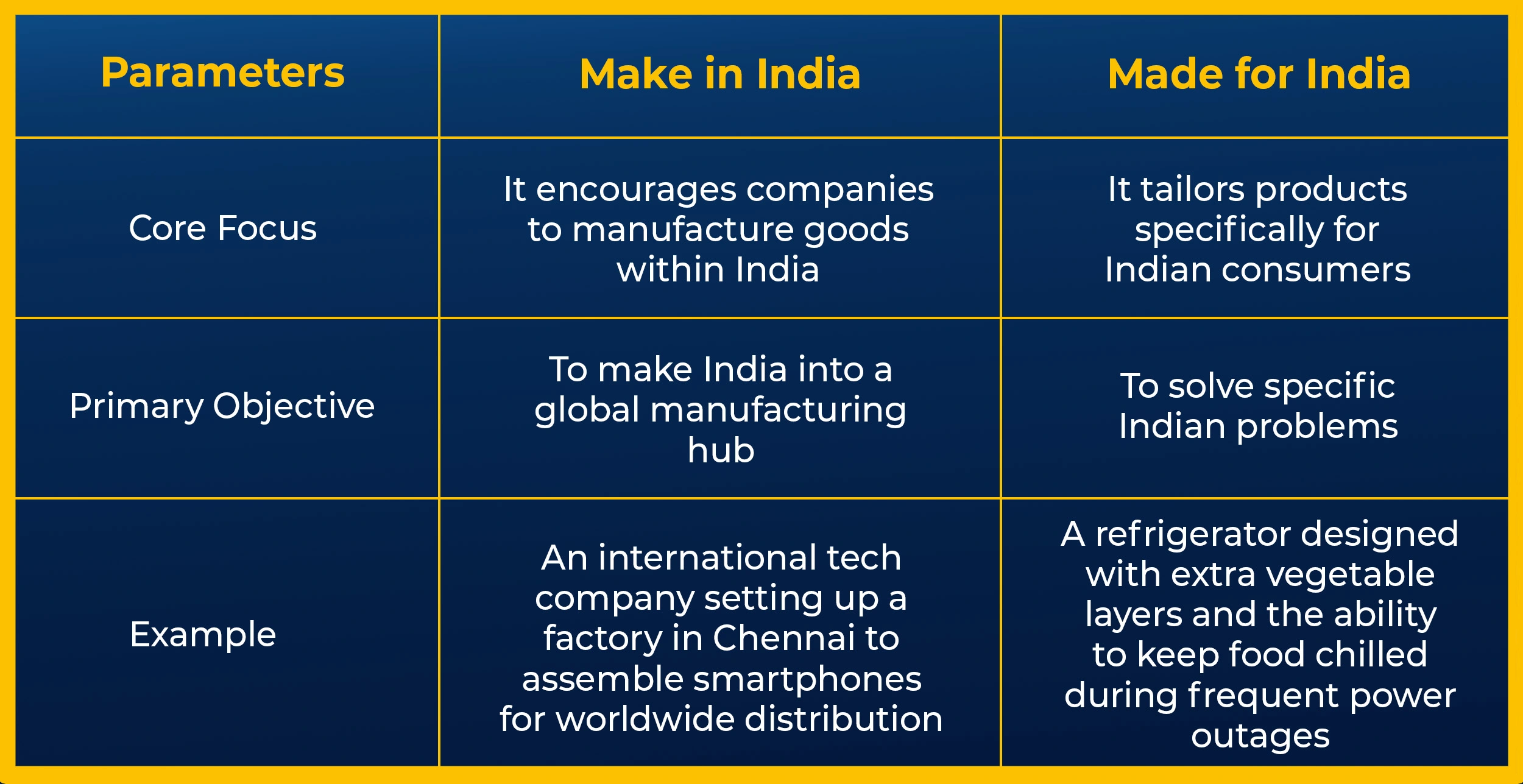
Though both concepts may sound alike, they differ completely. Take a look:
You can understand this transition better with Semicon 2.0. India used to be an importer of semiconductor chips. With the Government-led initiative, the India Semiconductor Mission (ISM) 2.0, 5 out of 12 approved projects within the nation have commenced their commercial operations.
The primary reason why the nation has moved ahead from electronic component sourcing in India to becoming a manufacturing hub is rising local demand. Increasing consumption within the country has maximised the demand for manufacturing. Other than this:
Strong government support: The Government of India has introduced the Electronics Components Manufacturing Scheme in India (ECMS) with a financial outlay of around USD 4.16 billion (INR 40,000 crore) to establish production houses and increase capacity.
Global supply chain shift: With the China+1 strategy, global tech companies want to reduce their reliance on China and move to India as a stable manufacturing alternative.
India aims to expand the manufacturing output of the electronics and semiconductor industry between USD 5.3 trillion and USD 8 trillion by 2047, under the Vikshit Bharat roadmap.
In addition to production, electronic goods have become the 3rd largest category in exports, accounting for USD 47.96 billion in FY- 2025 - 26. In mobile manufacturing alone, India has risen to become the 2nd largest in the world. In 2014, 26% of mobile phones sold in India were locally made. By December, 2024, the number reached 99.2%.
What opportunities exist in the electronics supply chain in India?
Not only in manufacturing, but the electronics supply chain in India is also growing. Here are some of the major growth opportunities:
1. Component and sub-assembly manufacturing
In India, localised passive and active components like Printed Circuit Boards (PCBs), capacitors, resistors, connectors and antennas remain in high demand.
2. Semiconductor ecosystem
The expanded Semicon India Programme offers growth opportunities in chip fabrication, packaging, testing and design capabilities.
3. Electronic manufacturing services (EMS)
While the EMS sector secured up to USD 40 - 45 billion in FY- 2025 and is expected to surpass around USD 150 billion by FY- 30 India still holds only 5% to 6% of its global output. This gives foreign companies a possibility for contract manufacturing expansion.
Local production offers several key strategic advantages. The first one has to be cost - effective exports to markets across Europe, Africa and the Middle East with India’s expanding network of Free Trade Agreements (FTAs). Other benefits are:
1. Supply - chain diversification
Companies want manufacturing networks that are geographically diversified. Establishing an Indian sourcing or production unit can reduce dependence on a single manufacturing base.
2. Large domestic market
India has a growing domestic market for electronics, especially mobiles. According to the International Data Corporation (IDC), India’s smartphone shipments reached around 152 million units in 2025.
3. Local supplier development
As more global Original Equipment Manufacturers (OEMs) manufacture in India, opportunities increase for local suppliers to meet quality and technology requirements. This can gradually increase domestic value addition.
4. Global manufacturing potential
India's strategic location, growing workforce, renewable energy potential and supplier ecosystem create opportunities for companies looking for an additional manufacturing and sourcing hub.
Foreign electronic companies in India may face certain challenges in India, such as:
1. Complex regulatory structure
Foreign companies can struggle with frequent updates to local standards and a multi-layered customs duty system. However, this can be resolved by partnering with local legal and compliance experts who understand bodies like the Bureau of Indian Standards (BIS) and utilise automated digital tracking tools to adjust to policy changes.
2. Infrastructural bottlenecks
Inconsistent power supply and uneven transport infrastructure can lead to unexpected delays and high operating costs in India.
As a solution, the government is establishing facilities in modern industrial parks or Electronics Manufacturing Clusters (EMCs) that offer reliable plug-and-play utilities and advanced logistics support.
3. Lack of localised supply chain
Many foreign firms are forced to import core sub-assemblies and raw materials (such as semiconductors) because India's domestic component ecosystem is still growing. This is why companies can invest in joint ventures with local Indian manufacturing firms to build local supplier networks.
The Government of India supports electronic component manufacturing in India with key policies and schemes:
National Policy on Electronics 2019 (NPE 2019): NPE 2019 aims to make India a global hub for Electronics System Design and Manufacturing (ESDM). Foreign companies can benefit from incentives and tax reliefs.
Production Linked Incentive Scheme (PLI): The PLI scheme offers financial rewards of 4% to 6% on incremental sales of goods manufactured locally.
Scheme for Promotion of Manufacturing of Electronic Components and Semiconductors (SPECS): SPECS provides a 25% capital expenditure incentive for setting up manufacturing units for electronic components and semiconductors.
Modified Electronics Manufacturing Clusters (EMC 2.0) Scheme: EMC 2.0 builds plug-and-play infrastructure and ready-built factory sheds to create integrated manufacturing zones.
Semicon India Programme: The Semicon India Programme extends economic support of up to 50% of project costs for establishing semiconductor displays and ATMP facilities.
For a foreign electronics company, the India entry route can be structured around market opportunity, entry model, regulatory readiness, local partnerships, manufacturing/sourcing and commercialisation.
India’s electronics ecosystem is also increasingly focused on building domestic component and supply-chain capabilities through initiatives such as ECMS.
Assess the Indian market
Choose the right entry model
Depending on objectives and investment plans, a company can consider:
Evaluate regulatory and compliance requirements
Electronics products may require product-specific approvals, certifications, import compliance and other regulatory clearances. These should be assessed before finalising the business model and investment structure.
Build a local supply and partner ecosystem
Foreign companies may need to identify:
Establish manufacturing or commercial operations
Companies planning local production can evaluate manufacturing locations, supplier ecosystems, infrastructure, workforce, logistics and applicable government incentives.
Launch and scale the business
After entry, companies need support with distribution rollout, channel development, sourcing, recruitment, supply-chain optimisation and ongoing business expansion.

Tecnova supports global electronics companies across the India entry and expansion journey, with research and strategy, partner search, factory setup, sourcing and supply chain, company incorporation, human resources and commercialisation. Electronics is also one of the industrial sectors covered by Tecnova.
Tecnova can support with:
India Market Research - Market sizing, demand assessment, competitor benchmarking and end-user analysis.
Market Entry Strategy - Evaluate and structure the appropriate India entry model.
Partner and Distributor Search - Identify and assess potential distributors, suppliers, manufacturing partners and strategic partners.
Manufacturing Setup - Support location evaluation, factory setup and operational planning.
Sourcing & Supply Chain - Identify suppliers and develop a reliable local sourcing ecosystem.
Regulatory & Business Setup - Support incorporation, regulatory requirements and compliance.
Go-to-Market & Distribution - Develop channel strategy and support commercialisation.
Ongoing Expansion - Support companies with operational scaling, M&A, supply-chain optimisation and other growth initiatives.
Note: 1 USD = INR 96.15 used for conversion.
1. How to set up an electronics manufacturing plant in India?
Setting up a facility requires a phased market entry strategy. It begins with incorporating a legal entity (such as a wholly-owned subsidiary or joint venture), selecting a site within an approved Electronics Manufacturing Cluster (EMC), and securing environmental clearances and local state approvals. Partnering with a market entry consultant like Tecnova streamlines land acquisition, vendor ecosystem mapping, and regulatory compliance.
2. What are the legal requirements and BIS certification process for an electronics manufacturing unit?
Compliance is mandatory and strict. Key legal requirements include obtaining a Bureau of Indian Standards (BIS) certification for product quality, securing 'Consent to Establish' and 'Consent to Operate' from the State Pollution Control Board, registering under the Factories Act, and acquiring an Import-Export Code (IEC) from the DGFT.
3. What are the benefits of the PLI scheme for electronics manufacturing?
The Production Linked Incentive (PLI) scheme provides direct financial payouts based on incremental sales of goods manufactured in India. It is designed to offset capital disabilities, boost domestic value addition, and transform India into a global export hub by subsidizing large-scale production and deep-tier component localization.
4. How to apply for the PLI scheme or SPECS for electronic components?
Applications are processed through the Ministry of Electronics and Information Technology (MeitY). Companies must submit detailed project reports proving their ability to meet specific thresholds for capital expenditure (CapEx) and incremental sales over a base year. The Scheme for Promotion of Manufacturing of Electronic Components and Semiconductors (SPECS) specifically offers a 25% financial incentive on capital expenditure for the supply chain.
5. What is the China Plus One strategy for the electronics supply chain?
Global Original Equipment Manufacturers (OEMs) are actively diversifying their supply chains to mitigate risks associated with relying solely on China. India is capturing this shift by offering a massive domestic consumer base ("Made for India") combined with aggressive export incentives ("Make in India"), making it the most viable long-term alternative.
6. Cost of electronics manufacturing in India vs. China vs. Vietnam?
While China historically offered lower borrowing costs and established ecosystems, India is closing the gap rapidly. Government incentives like PLI and SPECS effectively neutralize the initial capital expenditure differences. Furthermore, India’s skilled engineering labor cost remains significantly lower than China's and highly competitive with Vietnam, offering better long-term scalability for OEM localization.
7. List of Electronics Manufacturing Clusters (EMC 2.0) in India?
The EMC 2.0 scheme funds the creation of world-class infrastructure. Prime clusters offering plug-and-play facilities, reliable power, and common testing centers are located in states like Uttar Pradesh (Noida), Tamil Nadu, Karnataka, Haryana, and Gujarat. These clusters are specifically zoned to accelerate India market entry for electronics companies.
8. How to choose the right EMS partner in India?
Selecting an Electronics Manufacturing Services (EMS) partner requires evaluating their capability for deep-tier domestic value addition, rather than just final assembly. Key criteria include their Printed Circuit Board (PCB) assembly and testing standards, cleanroom facilities, BIS compliance, and their integration into the local semiconductor ecosystem.
9. How to find PCB assembly and testing manufacturers in India?
The most reliable PCB assembly partners are typically anchored within the major EMCs. Vetting requires on-site technical audits, assessing their component sourcing networks, and verifying their capacity to handle high-volume, precision manufacturing aligned with global OEM standards.
10. What does domestic value addition in electronics manufacturing actually mean?
Historically, companies imported completely knocked down (CKD) kits and merely assembled them in India. True domestic value addition means moving up the supply chain—sourcing raw materials locally, fabricating PCBs, integrating locally manufactured semiconductor components, and shifting from basic electronic component sourcing to comprehensive, end-to-end manufacturing.
Make in India vs. Made for India: The rise of electronic component manufacturing in India
What is the difference between ‘Made for India’ and ‘Make in India’ electronics?
Why India has moved ahead from electronic component sourcing to becoming a manufacturing hub
How large is the opportunity for electronic component manufacturing in India?
Strategic growth areas within the electronics supply chain in India
· Component and sub-assembly manufacturing
· Semiconductor ecosystem expansion
· Electronics manufacturing services (EMS)
What are the strategic benefits of Make in India electronics for global OEMs?
· Supply-chain diversification
· Unlocking a large domestic market
· Local supplier development
· Global manufacturing and export potential
Navigating challenges: India market entry for electronics companies
· Overcoming regulatory complexities
· Solving infrastructural bottlenecks
· Building a localised supply chain
Government policies fueling electronic component manufacturing in India
Structuring your India market entry for electronics companies with Tecnova
The electronic component manufacturing industry in India has grown significantly over the years. It has witnessed a 6-fold increase in total production, from USD 19.76 billion in 2014-15 to USD 117.7 billion in 2024 - 25.
According to a news report, it is all set for a 14-fold jump to reach USD 500 billion by FY- 2031.
One major driver of this surge is the transition from ‘Made For India’ to ‘Make In India’. Followingly, let us explore how this shift changed India from a low-cost assembly destination to a manufacturing hub.
Though both concepts may sound alike, they differ completely. Take a look:
You can understand this transition better with Semicon 2.0. India used to be an importer of semiconductor chips. With the Government-led initiative, the India Semiconductor Mission (ISM) 2.0, 5 out of 12 approved projects within the nation have commenced their commercial operations.
The primary reason why the nation has moved ahead from electronic component sourcing in India to becoming a manufacturing hub is rising local demand. Increasing consumption within the country has maximised the demand for manufacturing. Other than this:
Strong government support: The Government of India has introduced the Electronics Components Manufacturing Scheme in India (ECMS) with a financial outlay of around USD 4.16 billion (INR 40,000 crore) to establish production houses and increase capacity.
Global supply chain shift: With the China+1 strategy, global tech companies want to reduce their reliance on China and move to India as a stable manufacturing alternative.
India aims to expand the manufacturing output of the electronics and semiconductor industry between USD 5.3 trillion and USD 8 trillion by 2047, under the Vikshit Bharat roadmap.
In addition to production, electronic goods have become the 3rd largest category in exports, accounting for USD 47.96 billion in FY- 2025 - 26. In mobile manufacturing alone, India has risen to become the 2nd largest in the world. In 2014, 26% of mobile phones sold in India were locally made. By December, 2024, the number reached 99.2%.
What opportunities exist in the electronics supply chain in India?
Not only in manufacturing, but the electronics supply chain in India is also growing. Here are some of the major growth opportunities:
1. Component and sub-assembly manufacturing
In India, localised passive and active components like Printed Circuit Boards (PCBs), capacitors, resistors, connectors and antennas remain in high demand.
2. Semiconductor ecosystem
The expanded Semicon India Programme offers growth opportunities in chip fabrication, packaging, testing and design capabilities.
3. Electronic manufacturing services (EMS)
While the EMS sector secured up to USD 40 - 45 billion in FY- 2025 and is expected to surpass around USD 150 billion by FY- 30 India still holds only 5% to 6% of its global output. This gives foreign companies a possibility for contract manufacturing expansion.
Local production offers several key strategic advantages. The first one has to be cost - effective exports to markets across Europe, Africa and the Middle East with India’s expanding network of Free Trade Agreements (FTAs). Other benefits are:
1. Supply - chain diversification
Companies want manufacturing networks that are geographically diversified. Establishing an Indian sourcing or production unit can reduce dependence on a single manufacturing base.
2. Large domestic market
India has a growing domestic market for electronics, especially mobiles. According to the International Data Corporation (IDC), India’s smartphone shipments reached around 152 million units in 2025.
3. Local supplier development
As more global Original Equipment Manufacturers (OEMs) manufacture in India, opportunities increase for local suppliers to meet quality and technology requirements. This can gradually increase domestic value addition.
4. Global manufacturing potential
India's strategic location, growing workforce, renewable energy potential and supplier ecosystem create opportunities for companies looking for an additional manufacturing and sourcing hub.
Foreign electronic companies in India may face certain challenges in India, such as:
1. Complex regulatory structure
Foreign companies can struggle with frequent updates to local standards and a multi-layered customs duty system. However, this can be resolved by partnering with local legal and compliance experts who understand bodies like the Bureau of Indian Standards (BIS) and utilise automated digital tracking tools to adjust to policy changes.
2. Infrastructural bottlenecks
Inconsistent power supply and uneven transport infrastructure can lead to unexpected delays and high operating costs in India.
As a solution, the government is establishing facilities in modern industrial parks or Electronics Manufacturing Clusters (EMCs) that offer reliable plug-and-play utilities and advanced logistics support.
3. Lack of localised supply chain
Many foreign firms are forced to import core sub-assemblies and raw materials (such as semiconductors) because India's domestic component ecosystem is still growing. This is why companies can invest in joint ventures with local Indian manufacturing firms to build local supplier networks.
The Government of India supports electronic component manufacturing in India with key policies and schemes:
National Policy on Electronics 2019 (NPE 2019): NPE 2019 aims to make India a global hub for Electronics System Design and Manufacturing (ESDM). Foreign companies can benefit from incentives and tax reliefs.
Production Linked Incentive Scheme (PLI): The PLI scheme offers financial rewards of 4% to 6% on incremental sales of goods manufactured locally.
Scheme for Promotion of Manufacturing of Electronic Components and Semiconductors (SPECS): SPECS provides a 25% capital expenditure incentive for setting up manufacturing units for electronic components and semiconductors.
Modified Electronics Manufacturing Clusters (EMC 2.0) Scheme: EMC 2.0 builds plug-and-play infrastructure and ready-built factory sheds to create integrated manufacturing zones.
Semicon India Programme: The Semicon India Programme extends economic support of up to 50% of project costs for establishing semiconductor displays and ATMP facilities.
For a foreign electronics company, the India entry route can be structured around market opportunity, entry model, regulatory readiness, local partnerships, manufacturing/sourcing and commercialisation.
India’s electronics ecosystem is also increasingly focused on building domestic component and supply-chain capabilities through initiatives such as ECMS.
Assess the Indian market
Choose the right entry model
Depending on objectives and investment plans, a company can consider:
Evaluate regulatory and compliance requirements
Electronics products may require product-specific approvals, certifications, import compliance and other regulatory clearances. These should be assessed before finalising the business model and investment structure.
Build a local supply and partner ecosystem
Foreign companies may need to identify:
Establish manufacturing or commercial operations
Companies planning local production can evaluate manufacturing locations, supplier ecosystems, infrastructure, workforce, logistics and applicable government incentives.
Launch and scale the business
After entry, companies need support with distribution rollout, channel development, sourcing, recruitment, supply-chain optimisation and ongoing business expansion.
Tecnova supports global electronics companies across the India entry and expansion journey, with research and strategy, partner search, factory setup, sourcing and supply chain, company incorporation, human resources and commercialisation. Electronics is also one of the industrial sectors covered by Tecnova.
Tecnova can support with:
India Market Research - Market sizing, demand assessment, competitor benchmarking and end-user analysis.
Market Entry Strategy - Evaluate and structure the appropriate India entry model.
Partner and Distributor Search - Identify and assess potential distributors, suppliers, manufacturing partners and strategic partners.
Manufacturing Setup - Support location evaluation, factory setup and operational planning.
Sourcing & Supply Chain - Identify suppliers and develop a reliable local sourcing ecosystem.
Regulatory & Business Setup - Support incorporation, regulatory requirements and compliance.
Go-to-Market & Distribution - Develop channel strategy and support commercialisation.
Ongoing Expansion - Support companies with operational scaling, M&A, supply-chain optimisation and other growth initiatives.
Note: 1 USD = INR 96.15 used for conversion.
1. How to set up an electronics manufacturing plant in India?
Setting up a facility requires a phased market entry strategy. It begins with incorporating a legal entity (such as a wholly-owned subsidiary or joint venture), selecting a site within an approved Electronics Manufacturing Cluster (EMC), and securing environmental clearances and local state approvals. Partnering with a market entry consultant like Tecnova streamlines land acquisition, vendor ecosystem mapping, and regulatory compliance.
2. What are the legal requirements and BIS certification process for an electronics manufacturing unit?
Compliance is mandatory and strict. Key legal requirements include obtaining a Bureau of Indian Standards (BIS) certification for product quality, securing 'Consent to Establish' and 'Consent to Operate' from the State Pollution Control Board, registering under the Factories Act, and acquiring an Import-Export Code (IEC) from the DGFT.
3. What are the benefits of the PLI scheme for electronics manufacturing?
The Production Linked Incentive (PLI) scheme provides direct financial payouts based on incremental sales of goods manufactured in India. It is designed to offset capital disabilities, boost domestic value addition, and transform India into a global export hub by subsidizing large-scale production and deep-tier component localization.
4. How to apply for the PLI scheme or SPECS for electronic components?
Applications are processed through the Ministry of Electronics and Information Technology (MeitY). Companies must submit detailed project reports proving their ability to meet specific thresholds for capital expenditure (CapEx) and incremental sales over a base year. The Scheme for Promotion of Manufacturing of Electronic Components and Semiconductors (SPECS) specifically offers a 25% financial incentive on capital expenditure for the supply chain.
5. What is the China Plus One strategy for the electronics supply chain?
Global Original Equipment Manufacturers (OEMs) are actively diversifying their supply chains to mitigate risks associated with relying solely on China. India is capturing this shift by offering a massive domestic consumer base ("Made for India") combined with aggressive export incentives ("Make in India"), making it the most viable long-term alternative.
6. Cost of electronics manufacturing in India vs. China vs. Vietnam?
While China historically offered lower borrowing costs and established ecosystems, India is closing the gap rapidly. Government incentives like PLI and SPECS effectively neutralize the initial capital expenditure differences. Furthermore, India’s skilled engineering labor cost remains significantly lower than China's and highly competitive with Vietnam, offering better long-term scalability for OEM localization.
7. List of Electronics Manufacturing Clusters (EMC 2.0) in India?
The EMC 2.0 scheme funds the creation of world-class infrastructure. Prime clusters offering plug-and-play facilities, reliable power, and common testing centers are located in states like Uttar Pradesh (Noida), Tamil Nadu, Karnataka, Haryana, and Gujarat. These clusters are specifically zoned to accelerate India market entry for electronics companies.
8. How to choose the right EMS partner in India?
Selecting an Electronics Manufacturing Services (EMS) partner requires evaluating their capability for deep-tier domestic value addition, rather than just final assembly. Key criteria include their Printed Circuit Board (PCB) assembly and testing standards, cleanroom facilities, BIS compliance, and their integration into the local semiconductor ecosystem.
9. How to find PCB assembly and testing manufacturers in India?
The most reliable PCB assembly partners are typically anchored within the major EMCs. Vetting requires on-site technical audits, assessing their component sourcing networks, and verifying their capacity to handle high-volume, precision manufacturing aligned with global OEM standards.
10. What does domestic value addition in electronics manufacturing actually mean?
Historically, companies imported completely knocked down (CKD) kits and merely assembled them in India. True domestic value addition means moving up the supply chain—sourcing raw materials locally, fabricating PCBs, integrating locally manufactured semiconductor components, and shifting from basic electronic component sourcing to comprehensive, end-to-end manufacturing.











%20(1).png)

.jpg)
.png)

%20(1).png)
.jpg)


.png)


.jpeg)







.png)

.png)



.jpg)




.jpg)
.jpg)