Services


Sectors
Insights
COMMERCIALIZATION
Insights







Follow Us
• Introduction
• Why India’s pet food market attractive to foreign companies?
• Market size of the pet food market in India?
• How can foreign companies enter India’s pet food market ?
• What regulations should foreign pet food companies understand before entering India?
• What are the biggest pet food business opportunities in India?
• What distribution strategy should foreign pet food brands use in India?
• What challenges do foreign companies face when entering India’s pet food market?
• How foreign companies localise their pet food strategy for India?
• Tecnova’s pet food market research experience
India is slowly becoming a hotspot for international pet food companies. Increasing pet ownership and awareness about animal nutrition are the key drivers of this trend.
According to a report, Indian pet food retail sales reached USD 769.7 million in 2025. The sales are expected to grow at a CAGR of 11% to 15%.
For companies planning India’s pet food market entry, these numbers make the country an attractive destination, but the route to market requires careful planning.
The primary reason India's pet care market is attractive to foreign companies is the growing pet population. India's pet population expanded significantly from 28.4 million in 2020 to 39.2 million by 2025. This creates a vast consumer base for commercial pet food.
Other reasons are:
1. Pet humanisation and premiumisation
Today, modern pet owners treat their pets as family members. This increases the demand for organic food rather than offering them homemade leftovers.
2. Disposable income
Nuclear families, especially of the urban middle-to-upper class, have strong purchasing power. That is why they are willing to spend on premium pet care products.
3. Growth of e-commerce and quick commerce
The expansion of digital marketplaces makes it easy for foreign pet food brands to reach Indian homes quickly rather than investing in physical stores.
4. Local manufacturing
Importing retail pet food into India attracts a Basic Customs Duty of 20%, a 10% social welfare surcharge on that duty and an 18% IGST. Pet food manufacturing in India helps brands reduce the overall production cost.
This is why a leading provider of pet nutritional products invested around USD 135.5 million to establish a research and development centre in Hyderabad, as per a news report.

The pet food market in India was valued at USD 418.4 million (INR 4,000 crore) in 2024, accounting for nearly 80% of the country’s overall pet care market. Driven by rising pet ownership, increasing awareness of pet nutrition, premiumisation and the expansion of organised retail and e-commerce channels, the market is projected to grow significantly and reach around USD 1.05 billion (INR 10,000 crore) by 2028, based on an exchange rate of 1 USD = INR 95.
There are 4 major India’s pet food market entry routes. These are:
1. Import and distribution
Foreign brands can import finished products through an Indian distributor. The distributor will handle everything, from warehousing to selling the products in retails outlets and on e-commerce platforms.
2. Local contract manufacturing
In this route, foreign brands can provide the IP and recipes, while a local third-party manufacturer in India handles production and packaging.
3. Joint venture or strategic partnership
Foreign brands can also partner with India’s local pet care firms for pooling capital and gain market expertise.
4. Wholly-owned operations
If a foreign brand is all set to capture the Indian market for the long term, it can establish a Wholly-Owned Subsidiary (WOS). This way, the brand can take total control over the supply chain and pricing.
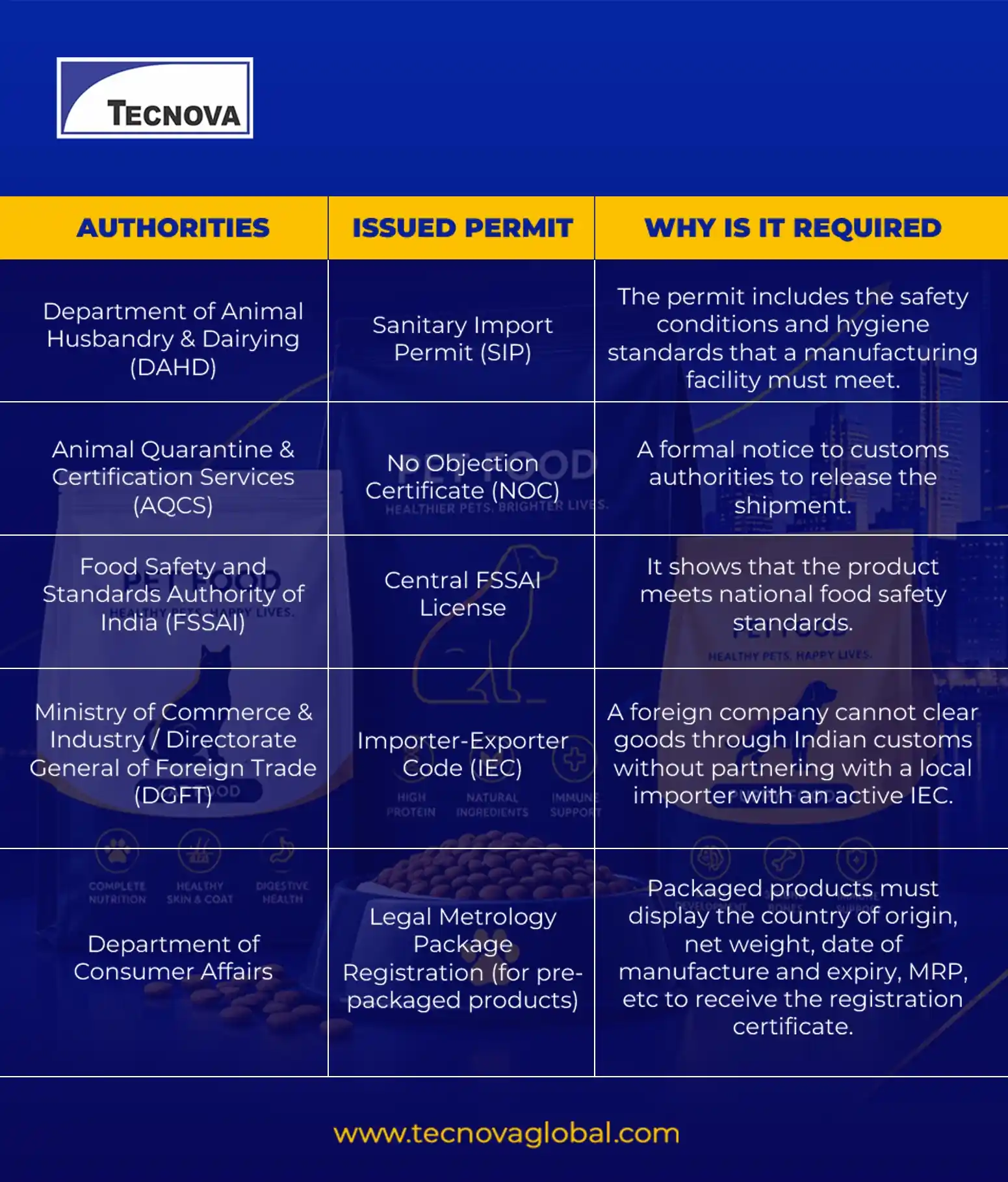
The pet food market in India for foreign companies is diverse. However, the companies must understand the necessary quality standards and regulations for a hassle-free market entry. The following table highlights key authorities along with their issued permit:
The growing market creates several pet food business opportunities in India, such as:
Foreign companies considering India’s pet food market entry should first understand India’s versatile geography and consumer segments.
India is not a single national market. Delhi-NCR, Mumbai, Bengaluru, Hyderabad, Chennai, Pune and Kolkata can have different dynamics than Bhopal, Guwahati, Nagpur, Mohali, etc.
For example, a premium imported dog-food brand can initially launch in Bengaluru through veterinary clinics and its own online store. Then, it can introduce small packs and locally manufactured variants to reach a wide customer base in comparatively smaller cities like Mysore, Salem, etc.
Here are 2 exclusive distribution strategies to meet consumer demand effectively:
1. Specialty stores
While online channels help in product discovery, specialty stores are more important as pet owners often look for exclusive nutritional guidance. In 2025, specialty stores captured around 34.1% of India’s pet food market.
2. Subscription models
Subscription models are also useful as pet food is not a one-time purchase. Pet parents can enroll in a brand’s subscription model to receive products on time.
The biggest challenge for foreign companies is affordability. India's pet food consumer base includes premium buyers, but a significant portion of households is price-sensitive. Imported products can therefore struggle to be widely available to all consumers:
Other challenges include:
● Complex import and regulatory procedures
● Dependence on distributors and channel partners
● Limited consumer awareness of specialised nutrition in some segments
● Differences in purchasing behaviour between metropolitan and small cities.
Tecnova has supported leading international pet food companies with pet food market research in India, covering market assessment, competitive intelligence, consumer trends, distribution channels and market entry opportunities. Our experience includes supporting global companies from France, Germany and Canada across assignments involving market research, distribution partner search and lobbying-related requirements.
These engagements have strengthened Tecnova’s understanding of the Indian pet food ecosystem and the strategic considerations involved in India market entry for pet food companies.

By combining market intelligence with practical execution support, Tecnova helps international pet food companies evaluate opportunities, understand the pet food market in India, identify potential partners and develop informed strategies for market entry and expansion.
➣ How can a foreign pet food company enter the Indian market?
A foreign pet food company can enter India through several models, including importing and distributing products, appointing an Indian distributor, establishing a local subsidiary, partnering with an Indian company, or setting up local manufacturing. The appropriate model depends on product category, target customers, pricing, regulatory requirements, investment capacity and long-term growth objectives. A structured India pet food market entry assessment can help determine the most suitable route.
➣ What is the best market entry model for a foreign pet food company in India?
There is no single market entry model that suits every foreign pet food company. Companies can evaluate direct imports, distributor partnerships, contract manufacturing, joint ventures, acquisitions, or wholly owned operations based on their commercial objectives.
An India market entry strategy should consider market size, competition, distribution economics, regulatory requirements, localisation opportunities and the company's desired level of control.
➣ Can foreign pet food companies manufacture their products in India?
Yes. Foreign pet food companies can explore manufacturing in India either by establishing their own production facility or partnering with an Indian contract manufacturer, subject to applicable regulatory and operational requirements. Local manufacturing can support competitive pricing, supply-chain efficiency, product localisation and expansion across Indian markets.
➣ Should foreign pet food brands import or manufacture in India?
The decision between importing and manufacturing in India depends on factors such as landed cost, tariffs and duties, production economics, demand volumes, product shelf life, supply-chain requirements and regulatory considerations. Importing may be suitable during the initial market-entry phase, while local or contract manufacturing may become relevant as sales volumes and market presence increase.
➣ How can international pet food brands find a distributor in India?
International pet food brands can identify potential distributors by mapping the Indian pet retail, veterinary, e-commerce, modern trade and general trade networks. Distributor evaluation should cover geographic reach, warehousing capabilities, channel relationships, sales force, category experience, financial strength and willingness to invest in the brand. A structured pet food distributor India search can help identify and assess suitable partners.
➣ How can foreign pet food companies find a contract manufacturer in India?
Foreign companies can identify Indian contract manufacturers by evaluating facilities based on production capabilities, product categories, quality systems, certifications, capacity, minimum order quantities, formulation capabilities, packaging options and scalability. Companies should also conduct commercial and operational due diligence before entering into a manufacturing agreement.
➣ Is India a good market for premium and imported pet food brands?
India's growing pet population, increasing pet ownership, urbanisation, changing consumer preferences and expanding organised pet-care ecosystem are creating opportunities across different pet food segments. For premium and imported products, however, companies need to assess consumer willingness to pay, competitive positioning, import economics, distribution reach and regulatory requirements before committing investment.
➣ What pet food categories have the highest growth potential in India?
Potential growth areas can include premium pet food, specialised nutrition, health-focused products, treats and snacks, functional nutrition and products tailored to specific pet needs. However, growth potential varies by animal type, price segment, geography and sales channel. A detailed assessment of pet food opportunities in India can identify the segments with the strongest commercial potential for a particular brand.
➣ Which pet food products are in demand among Indian pet owners?
Demand is expanding beyond basic pet food toward premium diets, specialised nutrition, treats, functional products and products addressing specific health or life-stage requirements. Demand also differs between dogs and cats and across income groups and cities. Foreign brands should therefore assess consumer preferences, purchasing behaviour, price points and channel-level demand before selecting products for India.
➣ What are the opportunities for international pet food brands in India?
International brands can explore opportunities across premium pet food, specialised nutrition, treats, imported products, local manufacturing, e-commerce, organised retail, veterinary channels and strategic partnerships. Pet food business opportunities in India can also extend to product localisation, private-label manufacturing, distribution partnerships and expansion into underserved geographic markets.
➣ How competitive is the Indian pet food market for foreign brands?
The Indian pet food market includes established multinational brands, domestic companies, emerging brands, private labels and imported products. Competition varies considerably by product category, price segment, geography and distribution channel. Foreign companies should assess competitors' pricing, product portfolios, market positioning, distribution networks, promotional strategies and consumer perception before entering the market.
➣ What is the import potential for pet food products in India?
Imported pet food can address demand for premium, specialised, differentiated, or internationally positioned products. However, import potential depends on product-specific regulations, applicable duties and costs, regulatory compliance, shelf life, logistics, pricing and distributor margins. Companies should conduct an import feasibility assessment before selecting an import-led pet food market entry strategy in India.
➣ What are the costs of entering the Indian pet food market?
Market-entry costs vary depending on the chosen business model. Key cost components can include market research, regulatory compliance, product registration or approvals where applicable, imports and logistics, warehousing, distributor margins, marketing, local staffing, manufacturing, technology and business establishment. Companies should develop a market-entry investment model based on their selected route rather than relying on a standard entry-cost estimate.
➣ What regulatory approvals are required to import and sell pet food in India?
Foreign pet food companies need to assess India's applicable import, animal-product, food, labelling, customs, packaging and other regulatory requirements based on the specific product and ingredients. Requirements can vary by product composition and intended use. Companies should conduct a product-specific regulatory assessment and confirm the latest requirements with the relevant Indian authorities before importing or commercialising products.
➣ How can foreign pet food companies assess the Indian market before investing?
Companies can begin with pet food market research India covering market size and growth, consumer behaviour, product categories, pricing, competition, distribution channels, regulatory requirements, import economics, manufacturing options and potential partners. This assessment can then be converted into an India market-entry business case covering the preferred entry model, investment requirements, partner strategy, go-to-market plan and implementation roadmap.
• Introduction
• Why India’s pet food market attractive to foreign companies?
• Market size of the pet food market in India?
• How can foreign companies enter India’s pet food market ?
• What regulations should foreign pet food companies understand before entering India?
• What are the biggest pet food business opportunities in India?
• What distribution strategy should foreign pet food brands use in India?
• What challenges do foreign companies face when entering India’s pet food market?
• How foreign companies localise their pet food strategy for India?
• Tecnova’s pet food market research experience
India is slowly becoming a hotspot for international pet food companies. Increasing pet ownership and awareness about animal nutrition are the key drivers of this trend.
According to a report, Indian pet food retail sales reached USD 769.7 million in 2025. The sales are expected to grow at a CAGR of 11% to 15%.
For companies planning India’s pet food market entry, these numbers make the country an attractive destination, but the route to market requires careful planning.
The primary reason India's pet care market is attractive to foreign companies is the growing pet population. India's pet population expanded significantly from 28.4 million in 2020 to 39.2 million by 2025. This creates a vast consumer base for commercial pet food.
Other reasons are:
1. Pet humanisation and premiumisation
Today, modern pet owners treat their pets as family members. This increases the demand for organic food rather than offering them homemade leftovers.
2. Disposable income
Nuclear families, especially of the urban middle-to-upper class, have strong purchasing power. That is why they are willing to spend on premium pet care products.
3. Growth of e-commerce and quick commerce
The expansion of digital marketplaces makes it easy for foreign pet food brands to reach Indian homes quickly rather than investing in physical stores.
4. Local manufacturing
Importing retail pet food into India attracts a Basic Customs Duty of 20%, a 10% social welfare surcharge on that duty and an 18% IGST. Pet food manufacturing in India helps brands reduce the overall production cost.
This is why a leading provider of pet nutritional products invested around USD 135.5 million to establish a research and development centre in Hyderabad, as per a news report.

The pet food market in India was valued at USD 418.4 million (INR 4,000 crore) in 2024, accounting for nearly 80% of the country’s overall pet care market. Driven by rising pet ownership, increasing awareness of pet nutrition, premiumisation and the expansion of organised retail and e-commerce channels, the market is projected to grow significantly and reach around USD 1.05 billion (INR 10,000 crore) by 2028, based on an exchange rate of 1 USD = INR 95.
There are 4 major India’s pet food market entry routes. These are:
1. Import and distribution
Foreign brands can import finished products through an Indian distributor. The distributor will handle everything, from warehousing to selling the products in retails outlets and on e-commerce platforms.
2. Local contract manufacturing
In this route, foreign brands can provide the IP and recipes, while a local third-party manufacturer in India handles production and packaging.
3. Joint venture or strategic partnership
Foreign brands can also partner with India’s local pet care firms for pooling capital and gain market expertise.
4. Wholly-owned operations
If a foreign brand is all set to capture the Indian market for the long term, it can establish a Wholly-Owned Subsidiary (WOS). This way, the brand can take total control over the supply chain and pricing.
The pet food market in India for foreign companies is diverse. However, the companies must understand the necessary quality standards and regulations for a hassle-free market entry. The following table highlights key authorities along with their issued permit:
The growing market creates several pet food business opportunities in India, such as:
Foreign companies considering India’s pet food market entry should first understand India’s versatile geography and consumer segments.
India is not a single national market. Delhi-NCR, Mumbai, Bengaluru, Hyderabad, Chennai, Pune and Kolkata can have different dynamics than Bhopal, Guwahati, Nagpur, Mohali, etc.
For example, a premium imported dog-food brand can initially launch in Bengaluru through veterinary clinics and its own online store. Then, it can introduce small packs and locally manufactured variants to reach a wide customer base in comparatively smaller cities like Mysore, Salem, etc.
Here are 2 exclusive distribution strategies to meet consumer demand effectively:
1. Specialty stores
While online channels help in product discovery, specialty stores are more important as pet owners often look for exclusive nutritional guidance. In 2025, specialty stores captured around 34.1% of India’s pet food market.
2. Subscription models
Subscription models are also useful as pet food is not a one-time purchase. Pet parents can enroll in a brand’s subscription model to receive products on time.
The biggest challenge for foreign companies is affordability. India's pet food consumer base includes premium buyers, but a significant portion of households is price-sensitive. Imported products can therefore struggle to be widely available to all consumers:
Other challenges include:
● Complex import and regulatory procedures
● Dependence on distributors and channel partners
● Limited consumer awareness of specialised nutrition in some segments
● Differences in purchasing behaviour between metropolitan and small cities.
Tecnova has supported leading international pet food companies with pet food market research in India, covering market assessment, competitive intelligence, consumer trends, distribution channels and market entry opportunities. Our experience includes supporting global companies from France, Germany and Canada across assignments involving market research, distribution partner search and lobbying-related requirements.
These engagements have strengthened Tecnova’s understanding of the Indian pet food ecosystem and the strategic considerations involved in India market entry for pet food companies.
By combining market intelligence with practical execution support, Tecnova helps international pet food companies evaluate opportunities, understand the pet food market in India, identify potential partners and develop informed strategies for market entry and expansion.
➣ How can a foreign pet food company enter the Indian market?
A foreign pet food company can enter India through several models, including importing and distributing products, appointing an Indian distributor, establishing a local subsidiary, partnering with an Indian company, or setting up local manufacturing. The appropriate model depends on product category, target customers, pricing, regulatory requirements, investment capacity and long-term growth objectives. A structured India pet food market entry assessment can help determine the most suitable route.
➣ What is the best market entry model for a foreign pet food company in India?
There is no single market entry model that suits every foreign pet food company. Companies can evaluate direct imports, distributor partnerships, contract manufacturing, joint ventures, acquisitions, or wholly owned operations based on their commercial objectives.
An India market entry strategy should consider market size, competition, distribution economics, regulatory requirements, localisation opportunities and the company's desired level of control.
➣ Can foreign pet food companies manufacture their products in India?
Yes. Foreign pet food companies can explore manufacturing in India either by establishing their own production facility or partnering with an Indian contract manufacturer, subject to applicable regulatory and operational requirements. Local manufacturing can support competitive pricing, supply-chain efficiency, product localisation and expansion across Indian markets.
➣ Should foreign pet food brands import or manufacture in India?
The decision between importing and manufacturing in India depends on factors such as landed cost, tariffs and duties, production economics, demand volumes, product shelf life, supply-chain requirements and regulatory considerations. Importing may be suitable during the initial market-entry phase, while local or contract manufacturing may become relevant as sales volumes and market presence increase.
➣ How can international pet food brands find a distributor in India?
International pet food brands can identify potential distributors by mapping the Indian pet retail, veterinary, e-commerce, modern trade and general trade networks. Distributor evaluation should cover geographic reach, warehousing capabilities, channel relationships, sales force, category experience, financial strength and willingness to invest in the brand. A structured pet food distributor India search can help identify and assess suitable partners.
➣ How can foreign pet food companies find a contract manufacturer in India?
Foreign companies can identify Indian contract manufacturers by evaluating facilities based on production capabilities, product categories, quality systems, certifications, capacity, minimum order quantities, formulation capabilities, packaging options and scalability. Companies should also conduct commercial and operational due diligence before entering into a manufacturing agreement.
➣ Is India a good market for premium and imported pet food brands?
India's growing pet population, increasing pet ownership, urbanisation, changing consumer preferences and expanding organised pet-care ecosystem are creating opportunities across different pet food segments. For premium and imported products, however, companies need to assess consumer willingness to pay, competitive positioning, import economics, distribution reach and regulatory requirements before committing investment.
➣ What pet food categories have the highest growth potential in India?
Potential growth areas can include premium pet food, specialised nutrition, health-focused products, treats and snacks, functional nutrition and products tailored to specific pet needs. However, growth potential varies by animal type, price segment, geography and sales channel. A detailed assessment of pet food opportunities in India can identify the segments with the strongest commercial potential for a particular brand.
➣ Which pet food products are in demand among Indian pet owners?
Demand is expanding beyond basic pet food toward premium diets, specialised nutrition, treats, functional products and products addressing specific health or life-stage requirements. Demand also differs between dogs and cats and across income groups and cities. Foreign brands should therefore assess consumer preferences, purchasing behaviour, price points and channel-level demand before selecting products for India.
➣ What are the opportunities for international pet food brands in India?
International brands can explore opportunities across premium pet food, specialised nutrition, treats, imported products, local manufacturing, e-commerce, organised retail, veterinary channels and strategic partnerships. Pet food business opportunities in India can also extend to product localisation, private-label manufacturing, distribution partnerships and expansion into underserved geographic markets.
➣ How competitive is the Indian pet food market for foreign brands?
The Indian pet food market includes established multinational brands, domestic companies, emerging brands, private labels and imported products. Competition varies considerably by product category, price segment, geography and distribution channel. Foreign companies should assess competitors' pricing, product portfolios, market positioning, distribution networks, promotional strategies and consumer perception before entering the market.
➣ What is the import potential for pet food products in India?
Imported pet food can address demand for premium, specialised, differentiated, or internationally positioned products. However, import potential depends on product-specific regulations, applicable duties and costs, regulatory compliance, shelf life, logistics, pricing and distributor margins. Companies should conduct an import feasibility assessment before selecting an import-led pet food market entry strategy in India.
➣ What are the costs of entering the Indian pet food market?
Market-entry costs vary depending on the chosen business model. Key cost components can include market research, regulatory compliance, product registration or approvals where applicable, imports and logistics, warehousing, distributor margins, marketing, local staffing, manufacturing, technology and business establishment. Companies should develop a market-entry investment model based on their selected route rather than relying on a standard entry-cost estimate.
➣ What regulatory approvals are required to import and sell pet food in India?
Foreign pet food companies need to assess India's applicable import, animal-product, food, labelling, customs, packaging and other regulatory requirements based on the specific product and ingredients. Requirements can vary by product composition and intended use. Companies should conduct a product-specific regulatory assessment and confirm the latest requirements with the relevant Indian authorities before importing or commercialising products.
➣ How can foreign pet food companies assess the Indian market before investing?
Companies can begin with pet food market research India covering market size and growth, consumer behaviour, product categories, pricing, competition, distribution channels, regulatory requirements, import economics, manufacturing options and potential partners. This assessment can then be converted into an India market-entry business case covering the preferred entry model, investment requirements, partner strategy, go-to-market plan and implementation roadmap.

















%20(1).png)

.jpg)
.png)




%20(1).png)
.jpg)



.png)





.jpeg)
















.png)

.png)








.jpg)




.jpg)


.jpg)