Services


Sectors
Insights
COMMERCIALIZATION
Insights







Follow Us
Key takeaways: India market entry, GCC setup and expansion
How Tecnova helps
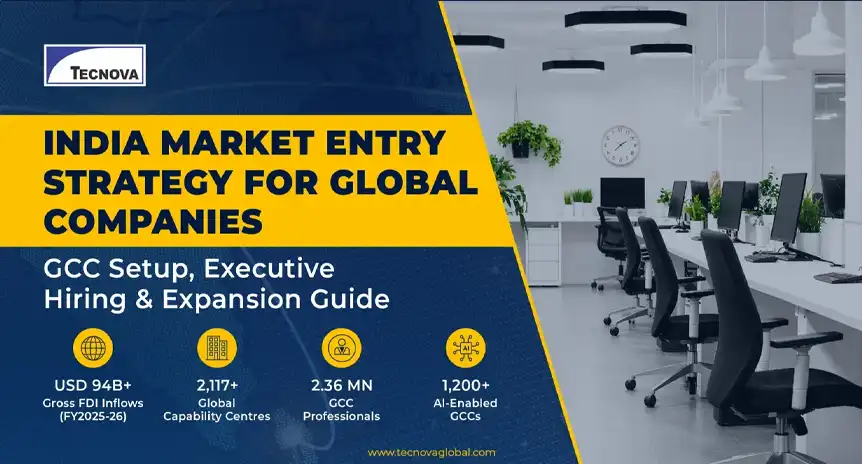
India has become one of the most attractive markets for multinational companies seeking sustainable growth. Organisations worldwide are establishing operations to serve both domestic and global markets. The country attracted over USD 94 billion in gross Foreign Direct Investment (FDI) during FY2025-26. At the same time, its rapidly growing GCC ecosystem continues to fuel innovation and business transformation.
A well-defined India market entry strategy is therefore essential for successful expansion, GCC setup and executive hiring.
India offers global businesses a unique combination of market scale, policy stability and innovation-led growth. The nation has consistently attracted among the highest annual FDI inflows globally, which reflects sustained investor confidence.
According to recent news, India also achieved a record total exports of USD 863.11 billion in FY2025-26, with services exports reaching USD 421.3 billion. It was driven by IT, consulting and Global Capability Centres.
Coupled with liberalised FDI policies, expanding digital infrastructure and a large skilled workforce, a well-planned India market entry strategy enables businesses to establish scalable operations and capitalise on long-term growth opportunities.
A Global Capability Centre (GCC) has evolved far beyond a traditional back-office operation. Today, it functions as a strategic business hub that supports innovation, technology development, research, analytics, engineering, finance, customer experience and global operations from a single location.
Instead of distributing functions across multiple countries, many multinational organisations are centralising critical capabilities within India to improve efficiency, strengthen innovation and reduce operational costs without compromising quality.
For businesses entering India, establishing a GCC creates opportunities to optimise operations while developing capabilities that support global growth.
India has established itself as the preferred destination for Global Capability Centres by combining skilled talent, competitive operating costs, strong digital infrastructure and a supportive policy environment. Here are some factors that continue to reinforce this leadership position:
• India hosts over 2,117 GCCs operating across 3,728 units, employing around 2.36 million professionals and generating USD 98.4 billion in market revenue. It makes India the world's largest GCC ecosystem.
• The nation has become the global hub for AI-driven GCCs, with over 1,200 centres integrating AI and machine learning capabilities, supported by 250 AI Centres of Excellence and nearly 250,000 AI professionals.
• India's mature talent ecosystem, supported by world-class engineering institutions and a rapidly expanding digital workforce, enables multinational organisations to establish innovation-led GCCs across multiple sectors.
These advantages have transformed India from a cost-efficient outsourcing destination into a global centre for innovation, strategic decision-making and enterprise transformation.
.png)
Establishing a successful Global Capability Centre requires a structured roadmap that balances compliance, talent, operations and long-term business objectives. Rather than treating market entry as a one-time exercise, global companies should adopt a phased India market entry strategy that supports sustainable growth.
Here is a detailed overview of what is the process of building a future-ready GCC in India:
➢ Assess Feasibility & Develop the Business Case
Every successful expansion begins with understanding whether India aligns with the organisation's strategic objectives. Businesses should also identify which functions are best suited for the GCC.
A robust business case should include projected investment, expected returns, risk assessment and scalability plans. Conducting this assessment early helps organisations make informed decisions while avoiding costly adjustments during implementation.
➢ Determine the GCC Structure & Legal Entity
Depending on business requirements, organisations may establish a wholly owned subsidiary, liaison office, branch office, or joint venture, subject to applicable regulations. Selecting the right legal structure influences taxation, operational flexibility, reporting obligations and future expansion opportunities.
➢ Meet Legal, FDI & Compliance Requirements
Although India has significantly simplified business regulations through digital approvals and ongoing ease-of-doing-business reforms, companies must still comply with FDI regulations, corporate governance requirements, taxation, labour laws, data protection obligations and sector-specific licensing where applicable.
➢ Set Up Infrastructure & Technology
Location selection should consider factors such as talent availability, connectivity, operating costs, business ecosystem maturity and access to industry clusters. At the same time, companies should invest in secure cloud infrastructure, cybersecurity frameworks and scalable IT systems capable of supporting global operations.
➢ Build Your Core GCC Team
Recruiting experienced leadership alongside specialised professionals enables organisations to establish strong governance, operational stability and long-term scalability. This is where strategic executive hiring in India becomes a critical competitive advantage.
India offers one of the world's largest pools of highly skilled professionals across technology, finance, engineering, artificial intelligence and digital transformation.
➢ Design the Operating Model & Governance Framework
A well-designed operating model ensures that the GCC functions as an integrated extension of the global business. Standardised processes, clearly defined responsibilities and measurable performance indicators improve efficiency while supporting collaboration across international business units.
Strong governance also enables organisations to respond quickly to evolving market conditions and business priorities.
➢ Execute Transition, Knowledge Transfer & Scaling
The final stage focuses on transitioning business functions, transferring institutional knowledge and preparing the GCC for future expansion.
Rather than moving all operations simultaneously, companies should adopt a phased transition approach that allows teams to stabilise processes, monitor performance and implement continuous improvements.

India continues to strengthen its position as a preferred GCC destination through investor-friendly policies and targeted incentives. Key government initiatives include:
• 100% FDI Under the Automatic Route
Most GCC-related sectors permit full foreign ownership without prior approval. This allows overseas companies to establish operations faster while retaining complete management control.
• State-Level Incentives
States including Karnataka, Telangana and Maharashtra offer investment-friendly policies, infrastructure support and employment-linked incentives to attract global businesses.
• Special Economic Zone (SEZ) Benefits
Businesses operating in eligible SEZs can benefit from customs duty exemptions, modern infrastructure and policies designed to improve operational efficiency.
• Simplified Compliance
Single-window approvals and streamlined regulatory processes reduce administrative complexity. This enables businesses to establish operations more efficiently.
• Innovation and R&D Support
Government initiatives encourage investments in artificial intelligence, semiconductor manufacturing, engineering and research through funding support, innovation ecosystems and industry-academia partnerships.
Collectively, these initiatives create a business-friendly ecosystem that supports a seamless India market entry strategy, accelerates GCC setup in India and enables global companies to scale with confidence.
While India offers significant growth opportunities, successful market entry requires businesses to prepare for operational and regulatory complexities. Recognising these challenges early allows organisations to develop effective mitigation strategies and build resilient operations. The following areas require particular attention during implementation:
1. Compliance and Regulatory Navigation
India's regulatory framework continues to become more business-friendly, but companies must still comply with corporate laws, labour regulations, taxation requirements and sector-specific guidelines. Managing these requirements can become challenging without local expertise and structured compliance processes.
2. Talent Retention and Competition
India offers one of the world's largest skilled workforces, yet demand for experienced professionals continues to increase. Leadership roles, AI experts and technology professionals remain highly competitive. This makes strategic hiring in India essential for attracting and retaining top talent.
3. Data Security and IP Protection
As GCCs increasingly manage critical business functions, organisations must establish robust cybersecurity frameworks and intellectual property protection measures. Strong security standards not only reduce business risks but also strengthen trust across global operations.
4. Cultural and Operational Integration
Integrating a newly established GCC with global teams requires more than operational readiness. Businesses must align organisational culture, communication practices and governance frameworks to ensure seamless collaboration across international locations.
Although these challenges are common during international expansion, they can be addressed effectively through careful planning, local market expertise and a structured India market entry strategy.

Building a Global Capability Centre is about building a business that can scale sustainably while remaining compliant, competitive and aligned with global objectives.
At Tecnova, we provide end-to-end advisory services that help businesses reduce risk, accelerate execution and achieve long-term success in India. Businesses can benefit from our expertise through:
• Market Entry Advisory: We evaluate opportunities and create customised India market entry strategies for overseas businesses.
• GCC Setup Support: Our team, at Tecnova, assists with operating model, location selection, compliance and operational planning.
• Executive Hiring: We help recruit experienced leaders with strong industry and local market expertise.
• Regulatory Guidance: We ensure compliance with FDI, tax, labour and corporate regulations.
By combining strategic consulting, local market intelligence, regulatory expertise and execution capabilities, Tecnova enables organisations to establish resilient, future-ready operations that support sustainable global growth.
1. What is the best India market entry strategy for a foreign company?
The right India market entry strategy depends on the company's objectives, industry, investment size and desired level of control. Overseas businesses should typically evaluate market opportunity, legal entity options, FDI regulations, location, taxation, talent availability, distribution channels and long-term scalability before entering India. A phased approach can help reduce risks and validate the market before significant investment.
2. How can a foreign company set up a business in India?
A foreign company can establish an Indian presence through structures such as a wholly owned subsidiary, branch office, liaison office or, where appropriate, a joint venture. The appropriate structure depends on the company's intended activities, ownership requirements, FDI rules, taxation and operating model. Legal incorporation, regulatory registrations, banking, tax and ongoing corporate compliance must also be addressed.
3. What are the key factors to consider before investing in India?
Before investing in India, global companies should assess market demand, competitive dynamics, regulatory requirements, FDI policies, taxation, supply chains, infrastructure, talent availability and operating costs. A detailed feasibility study and India market entry assessment can help determine the most suitable investment model and identify potential risks before capital is committed.
4. How much does it cost to set up a business or GCC in India?
The cost of establishing a business or GCC in India varies significantly based on location, legal structure, workforce size, technology requirements, office infrastructure and business functions. Companies should evaluate both initial setup costs and recurring expenses such as salaries, real estate, technology, compliance and administration when developing their India business plan.
5. What is a GCC and why should global companies establish one in India?
A Global Capability Centre (GCC) is an offshore or captive centre established by a multinational company to perform strategic functions such as technology, engineering, finance, analytics, R&D, cybersecurity and business operations. India offers access to a large skilled talent pool, mature technology ecosystems and capabilities that can support both domestic and global operations.
6. How long does it take to establish a GCC in India?
The GCC setup timeline depends on the legal structure, location, hiring requirements, infrastructure, technology environment and regulatory approvals involved. A phased implementation covering feasibility, entity setup, location selection, leadership hiring, infrastructure, recruitment and operational transition can help companies establish their GCC in a structured manner.
7. How can foreign companies hire senior executives in India?
International companies can use specialised executive hiring and India market entry support to identify leaders with relevant industry expertise, local market knowledge and experience managing Indian operations. Key leadership positions may include country heads, CEOs, CFOs, HR leaders, operations heads and functional executives, depending on the company's India growth strategy.
8. Which Indian cities are best for setting up a GCC?
The ideal GCC location depends on the functions being established and the company's talent, cost and operational priorities. Major technology and business hubs such as Bengaluru, Hyderabad, Mumbai, Delhi-NCR, Pune and Chennai offer established talent pools and business ecosystems. Companies should compare locations based on talent availability, infrastructure, operating costs, connectivity and scalability rather than selecting a city solely on reputation.
9. What regulatory compliances do foreign companies need to consider when entering India?
Foreign companies entering India may need to address FDI regulations, company incorporation requirements, taxation, transfer pricing, employment and labour regulations, corporate governance, foreign exchange regulations, data protection and sector-specific requirements. The exact compliance framework depends on the company's legal structure, activities and industry.
10. Should a global company use an India market entry consultant?
An India market entry consultant "Tecnova" can help overseas companies reduce uncertainty and accelerate the establishment of local operations. Support can cover market assessment, entry strategy, entity setup, location selection, GCC establishment, regulatory compliance, executive hiring and post-entry operations. This can be particularly valuable for companies entering India for the first time and unfamiliar with the local business environment.
Key takeaways: India market entry, GCC setup and expansion
How Tecnova helps
India has become one of the most attractive markets for multinational companies seeking sustainable growth. Organisations worldwide are establishing operations to serve both domestic and global markets. The country attracted over USD 94 billion in gross Foreign Direct Investment (FDI) during FY2025-26. At the same time, its rapidly growing GCC ecosystem continues to fuel innovation and business transformation.
A well-defined India market entry strategy is therefore essential for successful expansion, GCC setup and executive hiring.
India offers global businesses a unique combination of market scale, policy stability and innovation-led growth. The nation has consistently attracted among the highest annual FDI inflows globally, which reflects sustained investor confidence.
According to recent news, India also achieved a record total exports of USD 863.11 billion in FY2025-26, with services exports reaching USD 421.3 billion. It was driven by IT, consulting and Global Capability Centres.
Coupled with liberalised FDI policies, expanding digital infrastructure and a large skilled workforce, a well-planned India market entry strategy enables businesses to establish scalable operations and capitalise on long-term growth opportunities.
A Global Capability Centre (GCC) has evolved far beyond a traditional back-office operation. Today, it functions as a strategic business hub that supports innovation, technology development, research, analytics, engineering, finance, customer experience and global operations from a single location.
Instead of distributing functions across multiple countries, many multinational organisations are centralising critical capabilities within India to improve efficiency, strengthen innovation and reduce operational costs without compromising quality.
For businesses entering India, establishing a GCC creates opportunities to optimise operations while developing capabilities that support global growth.
India has established itself as the preferred destination for Global Capability Centres by combining skilled talent, competitive operating costs, strong digital infrastructure and a supportive policy environment. Here are some factors that continue to reinforce this leadership position:
• India hosts over 2,117 GCCs operating across 3,728 units, employing around 2.36 million professionals and generating USD 98.4 billion in market revenue. It makes India the world's largest GCC ecosystem.
• The nation has become the global hub for AI-driven GCCs, with over 1,200 centres integrating AI and machine learning capabilities, supported by 250 AI Centres of Excellence and nearly 250,000 AI professionals.
• India's mature talent ecosystem, supported by world-class engineering institutions and a rapidly expanding digital workforce, enables multinational organisations to establish innovation-led GCCs across multiple sectors.
These advantages have transformed India from a cost-efficient outsourcing destination into a global centre for innovation, strategic decision-making and enterprise transformation.
Establishing a successful Global Capability Centre requires a structured roadmap that balances compliance, talent, operations and long-term business objectives. Rather than treating market entry as a one-time exercise, global companies should adopt a phased India market entry strategy that supports sustainable growth.
Here is a detailed overview of what is the process of building a future-ready GCC in India:
➢ Assess Feasibility & Develop the Business Case
Every successful expansion begins with understanding whether India aligns with the organisation's strategic objectives. Businesses should also identify which functions are best suited for the GCC.
A robust business case should include projected investment, expected returns, risk assessment and scalability plans. Conducting this assessment early helps organisations make informed decisions while avoiding costly adjustments during implementation.
➢ Determine the GCC Structure & Legal Entity
Depending on business requirements, organisations may establish a wholly owned subsidiary, liaison office, branch office, or joint venture, subject to applicable regulations. Selecting the right legal structure influences taxation, operational flexibility, reporting obligations and future expansion opportunities.
➢ Meet Legal, FDI & Compliance Requirements
Although India has significantly simplified business regulations through digital approvals and ongoing ease-of-doing-business reforms, companies must still comply with FDI regulations, corporate governance requirements, taxation, labour laws, data protection obligations and sector-specific licensing where applicable.
➢ Set Up Infrastructure & Technology
Location selection should consider factors such as talent availability, connectivity, operating costs, business ecosystem maturity and access to industry clusters. At the same time, companies should invest in secure cloud infrastructure, cybersecurity frameworks and scalable IT systems capable of supporting global operations.
➢ Build Your Core GCC Team
Recruiting experienced leadership alongside specialised professionals enables organisations to establish strong governance, operational stability and long-term scalability. This is where strategic executive hiring in India becomes a critical competitive advantage.
India offers one of the world's largest pools of highly skilled professionals across technology, finance, engineering, artificial intelligence and digital transformation.
➢ Design the Operating Model & Governance Framework
A well-designed operating model ensures that the GCC functions as an integrated extension of the global business. Standardised processes, clearly defined responsibilities and measurable performance indicators improve efficiency while supporting collaboration across international business units.
Strong governance also enables organisations to respond quickly to evolving market conditions and business priorities.
➢ Execute Transition, Knowledge Transfer & Scaling
The final stage focuses on transitioning business functions, transferring institutional knowledge and preparing the GCC for future expansion.
Rather than moving all operations simultaneously, companies should adopt a phased transition approach that allows teams to stabilise processes, monitor performance and implement continuous improvements.
India continues to strengthen its position as a preferred GCC destination through investor-friendly policies and targeted incentives. Key government initiatives include:
• 100% FDI Under the Automatic Route
Most GCC-related sectors permit full foreign ownership without prior approval. This allows overseas companies to establish operations faster while retaining complete management control.
• State-Level Incentives
States including Karnataka, Telangana and Maharashtra offer investment-friendly policies, infrastructure support and employment-linked incentives to attract global businesses.
• Special Economic Zone (SEZ) Benefits
Businesses operating in eligible SEZs can benefit from customs duty exemptions, modern infrastructure and policies designed to improve operational efficiency.
• Simplified Compliance
Single-window approvals and streamlined regulatory processes reduce administrative complexity. This enables businesses to establish operations more efficiently.
• Innovation and R&D Support
Government initiatives encourage investments in artificial intelligence, semiconductor manufacturing, engineering and research through funding support, innovation ecosystems and industry-academia partnerships.
Collectively, these initiatives create a business-friendly ecosystem that supports a seamless India market entry strategy, accelerates GCC setup in India and enables global companies to scale with confidence.
While India offers significant growth opportunities, successful market entry requires businesses to prepare for operational and regulatory complexities. Recognising these challenges early allows organisations to develop effective mitigation strategies and build resilient operations. The following areas require particular attention during implementation:
1. Compliance and Regulatory Navigation
India's regulatory framework continues to become more business-friendly, but companies must still comply with corporate laws, labour regulations, taxation requirements and sector-specific guidelines. Managing these requirements can become challenging without local expertise and structured compliance processes.
2. Talent Retention and Competition
India offers one of the world's largest skilled workforces, yet demand for experienced professionals continues to increase. Leadership roles, AI experts and technology professionals remain highly competitive. This makes strategic hiring in India essential for attracting and retaining top talent.
3. Data Security and IP Protection
As GCCs increasingly manage critical business functions, organisations must establish robust cybersecurity frameworks and intellectual property protection measures. Strong security standards not only reduce business risks but also strengthen trust across global operations.
4. Cultural and Operational Integration
Integrating a newly established GCC with global teams requires more than operational readiness. Businesses must align organisational culture, communication practices and governance frameworks to ensure seamless collaboration across international locations.
Although these challenges are common during international expansion, they can be addressed effectively through careful planning, local market expertise and a structured India market entry strategy.
Building a Global Capability Centre is about building a business that can scale sustainably while remaining compliant, competitive and aligned with global objectives.
At Tecnova, we provide end-to-end advisory services that help businesses reduce risk, accelerate execution and achieve long-term success in India. Businesses can benefit from our expertise through:
• Market Entry Advisory: We evaluate opportunities and create customised India market entry strategies for overseas businesses.
• GCC Setup Support: Our team, at Tecnova, assists with operating model, location selection, compliance and operational planning.
• Executive Hiring: We help recruit experienced leaders with strong industry and local market expertise.
• Regulatory Guidance: We ensure compliance with FDI, tax, labour and corporate regulations.
By combining strategic consulting, local market intelligence, regulatory expertise and execution capabilities, Tecnova enables organisations to establish resilient, future-ready operations that support sustainable global growth.
1. What is the best India market entry strategy for a foreign company?
The right India market entry strategy depends on the company's objectives, industry, investment size and desired level of control. Overseas businesses should typically evaluate market opportunity, legal entity options, FDI regulations, location, taxation, talent availability, distribution channels and long-term scalability before entering India. A phased approach can help reduce risks and validate the market before significant investment.
2. How can a foreign company set up a business in India?
A foreign company can establish an Indian presence through structures such as a wholly owned subsidiary, branch office, liaison office or, where appropriate, a joint venture. The appropriate structure depends on the company's intended activities, ownership requirements, FDI rules, taxation and operating model. Legal incorporation, regulatory registrations, banking, tax and ongoing corporate compliance must also be addressed.
3. What are the key factors to consider before investing in India?
Before investing in India, global companies should assess market demand, competitive dynamics, regulatory requirements, FDI policies, taxation, supply chains, infrastructure, talent availability and operating costs. A detailed feasibility study and India market entry assessment can help determine the most suitable investment model and identify potential risks before capital is committed.
4. How much does it cost to set up a business or GCC in India?
The cost of establishing a business or GCC in India varies significantly based on location, legal structure, workforce size, technology requirements, office infrastructure and business functions. Companies should evaluate both initial setup costs and recurring expenses such as salaries, real estate, technology, compliance and administration when developing their India business plan.
5. What is a GCC and why should global companies establish one in India?
A Global Capability Centre (GCC) is an offshore or captive centre established by a multinational company to perform strategic functions such as technology, engineering, finance, analytics, R&D, cybersecurity and business operations. India offers access to a large skilled talent pool, mature technology ecosystems and capabilities that can support both domestic and global operations.
6. How long does it take to establish a GCC in India?
The GCC setup timeline depends on the legal structure, location, hiring requirements, infrastructure, technology environment and regulatory approvals involved. A phased implementation covering feasibility, entity setup, location selection, leadership hiring, infrastructure, recruitment and operational transition can help companies establish their GCC in a structured manner.
7. How can foreign companies hire senior executives in India?
International companies can use specialised executive hiring and India market entry support to identify leaders with relevant industry expertise, local market knowledge and experience managing Indian operations. Key leadership positions may include country heads, CEOs, CFOs, HR leaders, operations heads and functional executives, depending on the company's India growth strategy.
8. Which Indian cities are best for setting up a GCC?
The ideal GCC location depends on the functions being established and the company's talent, cost and operational priorities. Major technology and business hubs such as Bengaluru, Hyderabad, Mumbai, Delhi-NCR, Pune and Chennai offer established talent pools and business ecosystems. Companies should compare locations based on talent availability, infrastructure, operating costs, connectivity and scalability rather than selecting a city solely on reputation.
9. What regulatory compliances do foreign companies need to consider when entering India?
Foreign companies entering India may need to address FDI regulations, company incorporation requirements, taxation, transfer pricing, employment and labour regulations, corporate governance, foreign exchange regulations, data protection and sector-specific requirements. The exact compliance framework depends on the company's legal structure, activities and industry.
10. Should a global company use an India market entry consultant?
An India market entry consultant "Tecnova" can help overseas companies reduce uncertainty and accelerate the establishment of local operations. Support can cover market assessment, entry strategy, entity setup, location selection, GCC establishment, regulatory compliance, executive hiring and post-entry operations. This can be particularly valuable for companies entering India for the first time and unfamiliar with the local business environment.















%20(1).png)

.jpg)
.png)



%20(1).png)
.jpg)



.png)





.jpeg)















.png)

.png)








.jpg)




.jpg)


.jpg)