Services


Sectors
Insights
COMMERCIALIZATION
Insights







Follow Us

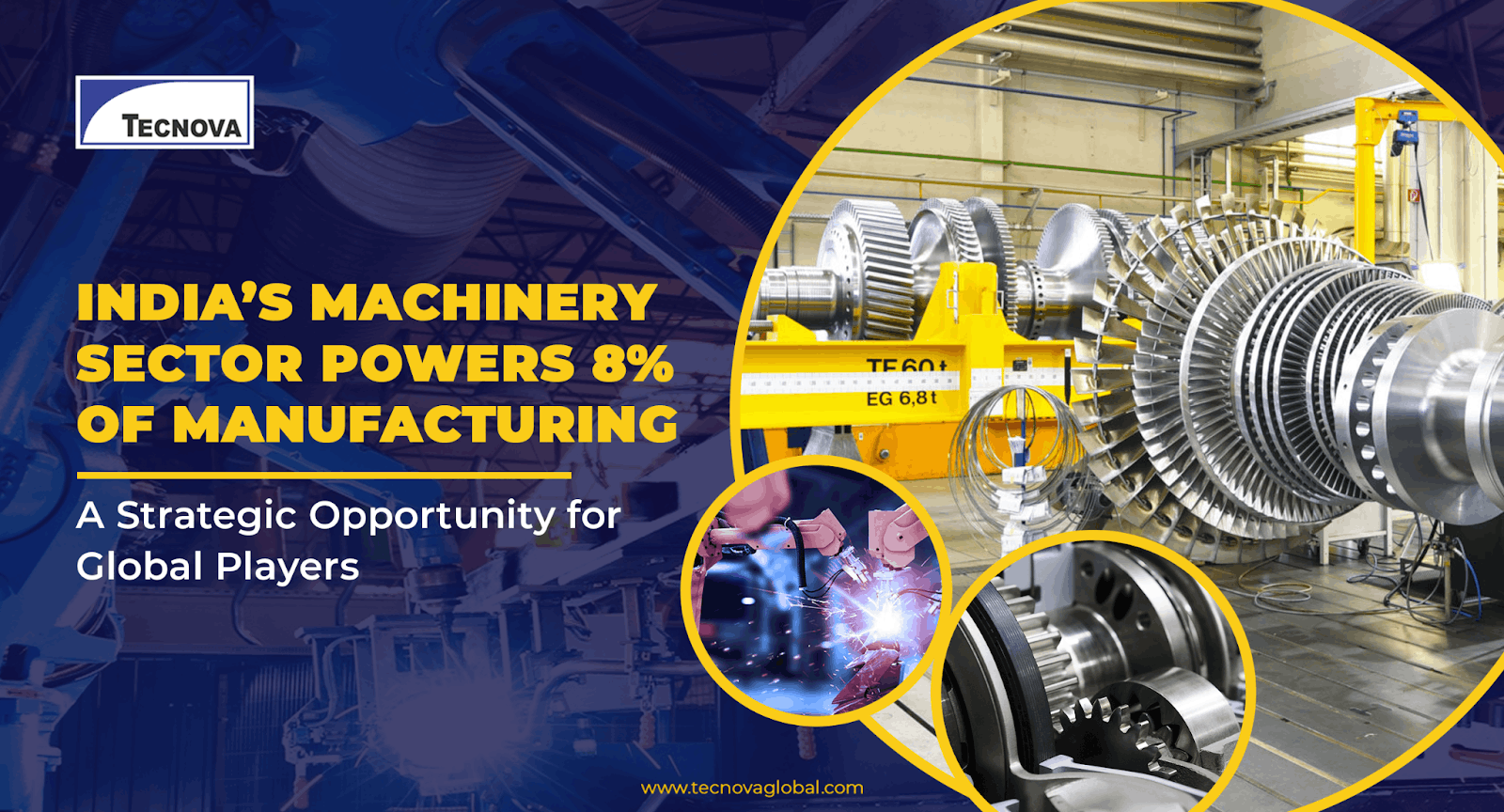
India's industrial growth is creating a compelling case for global machinery manufacturers to rethink how they serve the market. Industrial machinery manufacturing in India calls for a clear understanding of where domestic production makes commercial sense and where equipment must be adapted to meet local requirements.
According to a report, India’s manufacturing CAPEX reached approximately USD 31.45 billion in FY- 2025-26. On the other hand, the Union Budget 2026-27 also announced public capital expenditure of approximately USD 128.1 billion.
These investments signal opportunities for machinery suppliers across industrial segments. However, capturing this demand requires a strategic choice between Make in India and Made for India.
Launched in 2014, the Make in India initiative aims to strengthen domestic manufacturing, attract investment and develop local supply chains. As per a report, manufacturing FDI equity inflows reached USD 165.1 billion between April 2014 and March 2024, a 69% increase from USD 97.7 billion in the preceding decade.
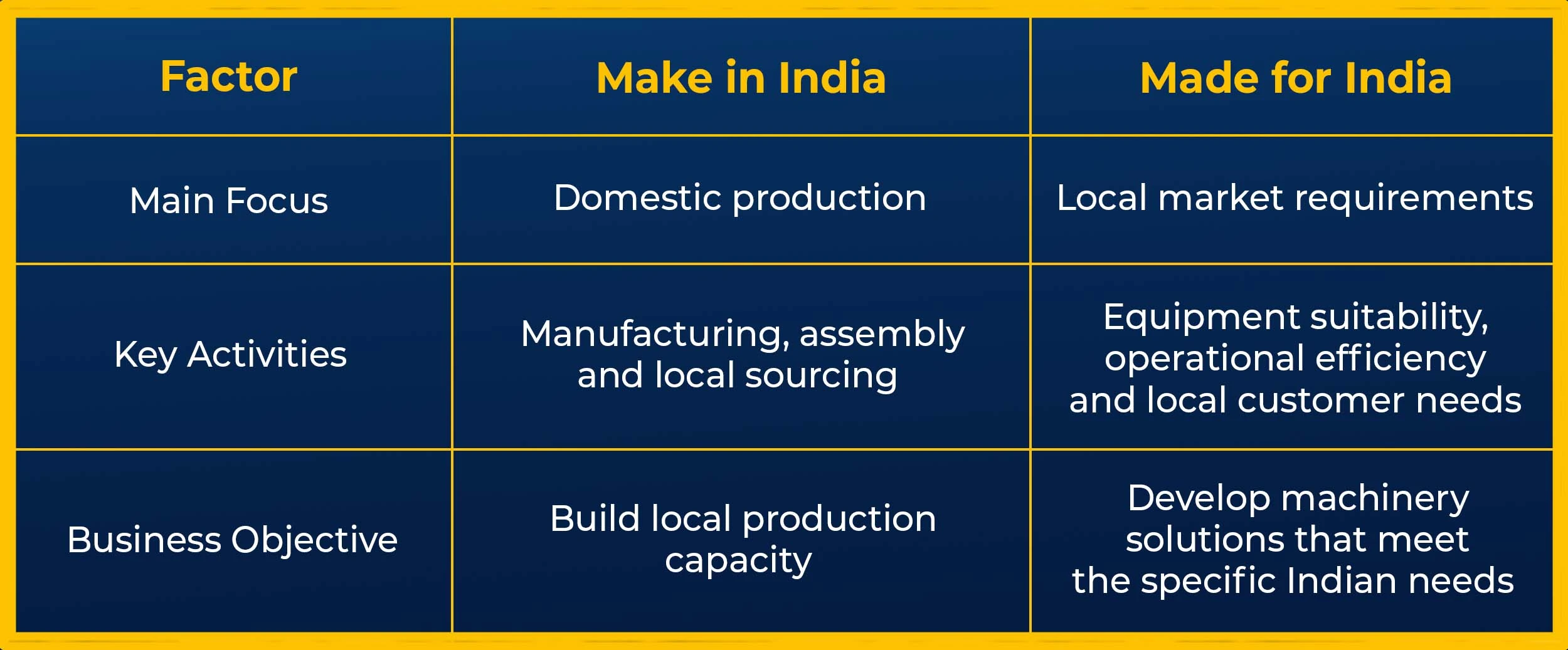
On the other hand, Made for India is a strategy that involves adapting equipment, technologies and industrial manufacturing processes to meet Indian requirements. This may include designing machinery for different operating conditions, accommodating local production needs, and aligning equipment costs with market expectations.
Here is a quick comparison of the two:
As per a government press release, the capital goods sector contributes approximately 1.9% of India's GDP.
Further, capital goods output grew by 8.1% year-on-year in December 2025, as measured by the Index of Industrial Production (IIP). These indicators point to demand for industrial equipment and production technologies, making several manufacturing segments worth exploring foreign investors.
However, if businesses only focus on demand alone, it does not guarantee commercial success. Foreign manufacturers must assess local competition, customer requirements, pricing expectations and service needs before selecting a product segment.
Pro Tip: Assess import dependence, local competition and after-sales demand before choosing an Indian machinery segment.

Foreign companies can enter India's industrial equipment market through a wholly owned subsidiary, a joint venture, contract manufacturing or local assembly. India generally permits 100% foreign direct investment in manufacturing under the automatic route. However, it is subject to applicable laws and sector-specific conditions.
Here is a detailed understanding of how foreign companies can manufacture industrial machinery in India.
Key steps for market entry
Understand policy and tariff requirements
The Union Budget 2025-26 removed 7 customs tariff rates, leaving 8, including the zero rate. The 2026-27 Budget also proposed customs duty exemptions for capital goods which are used in critical mineral processing and battery energy storage manufacturing.
A phased entry model can help manage investment risk. A company could begin with imported components, introduce local assembly and expand domestic sourcing as demand grows.
Quick Note: Customs duty rates and exemptions depend on the product's tariff classification, end use and applicable conditions.
The Make in India approach can help foreign machinery manufacturers build local production capacity, strengthen supply chains and serve Indian customers more effectively. Here is a detailed understanding of what are the advantages of Make-in-India machinery for foreign companies.
Access to a growing industrial market: India offers several opportunities across infrastructure, automotive manufacturing, food processing, mining and industrial automation. Foreign manufacturers can serve these sectors through locally produced machinery and specialized equipment.
India’s capital goods market was valued at approximately USD 52 billion in 2024 and is projected to reach USD 82 billion by 2030. This growth outlook points to opportunities for foreign machinery manufacturers to establish local production.
Stronger local supply chains : Domestic sourcing can reduce dependence on overseas suppliers. Data shows that capital goods imports grew by 6.6% in Q1, 9.2% in Q2 and 13.4% in Q3 in FY- 2025-26. This trend highlights demand for imported equipment and the potential to develop more local manufacturing facilities.
Foreign companies can strengthen their supply chains through:
Potential cost savings : Local manufacturing may reduce freight costs, import-related expenses and certain supply chain costs. However, the actual savings depend on production volumes, component availability, labor requirements and applicable customs duties. Foreign companies need to compare the total cost of local production with the cost of importing finished machinery. They need to include equipment, logistics, taxes, compliance and maintenance in the assessment.
Scope for technology transfer and local innovation: Foreign manufacturers can introduce advanced production methods, specialized engineering expertise and modern machinery technologies to India. At the same time, local partnerships can also help develop supplier capabilities and adapt products to regional requirements.
Foreign manufacturers should focus on the following areas to improve product suitability and commercial viability.
1. Adapt machinery to local requirements: Indian factories vary in size, operating conditions and production needs. Foreign manufacturers should assess power supply, temperature, dust exposure and available floor space before adapting equipment.
2. Develop cost-effective product configurations: They need to offer machinery with flexible specifications to suit different factory budgets and production volumes. In FY2024-25, India's food processing machinery production reached approximately USD 1.61 billion. On the other hand, imports stood at around USD 1.14 billion.
3. Strengthen local sourcing: They need to identify Indian suppliers for components, consumables and replacement parts. Local sourcing can help foreign manufacturers address supply chain gaps; at the same time, they can reduce dependence on selected imported components.
4. Priorities energy efficiency and productivity: Foreign businesses need to design machinery to reduce energy use, minimize downtime and improve output quality. India's Perform, Achieve and Trade programme covers 1,333 energy-intensive industrial units and addresses around 55% of industrial energy consumption. Energy-efficient equipment can help businesses manage operating costs and meet efficiency targets.
5. Build reliable after-sales support: Establish local access to spare parts, trained technicians, and maintenance services. A growing industrial base makes reliable equipment support an important competitive advantage.
6. Meet Indian standards and compliance requirements: Businesses need to check applicable safety standards, certification requirements, and quality control orders. They need to check this before they launch machinery. Compliance requirements can vary by product, so manufacturers should confirm the relevant rules before importing components or starting local production.
With over 40 years of experience, Tecnova has helped more than 2,000 global businesses navigate India market entry and expansion. Our expertise spans 35+ countries.
For foreign industrial machinery manufacturing in India, we provide support across different stages of market entry and expansion.

Market opportunity assessment: Identify attractive segments, target customers, regional demand and competing suppliers.
Entry strategy development: Compare a wholly owned subsidiary, joint venture, contract manufacturing and local assembly.
Partner identification: Evaluate potential distributors, manufacturing partners and component suppliers against defined business criteria.
Regulatory and investment guidance: Understand applicable foreign investment rules, product standards and policy requirements.
Commercial planning: Assess pricing, operating costs, sourcing options and routes to market.
Our objective is to design a market-entry plan built on commercial evidence, local industry knowledge and realistic growth.
➢ What should foreign companies know before entering India's industrial machinery market?
Foreign companies should assess market demand, local competition, customer requirements, manufacturing costs and regulatory obligations before entering India's industrial machinery market. They should also compare exporting, local assembly, contract manufacturing and direct investment to identify the most commercially viable entry strategy.
➢ Is India a good destination for industrial machinery manufacturing?
India offers opportunities for industrial machinery manufacturers across construction, mining, machine tools, food processing and process industries. However, the suitability of India as a manufacturing destination depends on demand for specific equipment, production economics, supplier capabilities and the company's long-term expansion objectives.
➢ How can foreign machinery companies establish manufacturing operations in India?
Foreign machinery companies can establish operations through a wholly owned subsidiary, a joint venture, contract manufacturing or local assembly. The decision should account for investment requirements, expected sales volumes, production control, supplier availability and applicable regulatory conditions.
➢ Is it better to manufacture industrial machinery in India or export it from overseas?
The choice depends on market demand, equipment complexity, production costs and customer expectations. Exporting may be suitable when demand is uncertain or machinery is highly specialised. Local assembly or manufacturing may become attractive when sales volumes, sourcing capabilities and operating economics justify a domestic presence.
➢ How can foreign companies find industrial machinery sourcing partners in India?
Foreign companies can identify Indian sourcing partners by researching relevant manufacturing clusters, assessing supplier capabilities and verifying quality standards. Important considerations include technical expertise, production capacity, delivery reliability, component traceability and the ability to meet international specifications.
➢ Can local manufacturing help foreign machinery companies reduce costs in India?
Local manufacturing can potentially reduce international freight costs, lead times and certain import-related expenses. However, the overall savings depend on production volumes, labor, component sourcing, capital investment, taxes, compliance and quality requirements. Companies should compare the total cost of local production with importing finished machinery before investing.
➢ What is the role of product localisation in India's industrial machinery market?
Product localisation helps manufacturers adapt equipment to customer requirements, operating environments and budget expectations. This may involve offering flexible configurations, improving energy efficiency, sourcing suitable components locally and strengthening spare-parts availability without compromising equipment performance or safety.
➢ What regulations should foreign machinery manufacturers check before entering India?
Foreign manufacturers should identify the product standards, safety certifications, quality control orders, factory requirements, environmental permissions and import regulations applicable to their equipment and business model. Requirements vary by product, so companies should verify the relevant obligations before importing machinery or starting local production.
➢ How can Tecnova support industrial machinery market entry in India?
Tecnova helps international companies evaluate India's market opportunities, develop market-entry strategies, identify manufacturing and distribution partners, assess investment options and understand relevant regulatory requirements. With over 40 years of experience and more than 2,000 global clients, Tecnova supports foreign businesses in planning and implementing their India expansion strategies.
India's industrial growth is creating a compelling case for global machinery manufacturers to rethink how they serve the market. Industrial machinery manufacturing in India calls for a clear understanding of where domestic production makes commercial sense and where equipment must be adapted to meet local requirements.
According to a report, India’s manufacturing CAPEX reached approximately USD 31.45 billion in FY- 2025-26. On the other hand, the Union Budget 2026-27 also announced public capital expenditure of approximately USD 128.1 billion.
These investments signal opportunities for machinery suppliers across industrial segments. However, capturing this demand requires a strategic choice between Make in India and Made for India.
Launched in 2014, the Make in India initiative aims to strengthen domestic manufacturing, attract investment and develop local supply chains. As per a report, manufacturing FDI equity inflows reached USD 165.1 billion between April 2014 and March 2024, a 69% increase from USD 97.7 billion in the preceding decade.
On the other hand, Made for India is a strategy that involves adapting equipment, technologies and industrial manufacturing processes to meet Indian requirements. This may include designing machinery for different operating conditions, accommodating local production needs, and aligning equipment costs with market expectations.
Here is a quick comparison of the two:
As per a government press release, the capital goods sector contributes approximately 1.9% of India's GDP.
Further, capital goods output grew by 8.1% year-on-year in December 2025, as measured by the Index of Industrial Production (IIP). These indicators point to demand for industrial equipment and production technologies, making several manufacturing segments worth exploring foreign investors.
However, if businesses only focus on demand alone, it does not guarantee commercial success. Foreign manufacturers must assess local competition, customer requirements, pricing expectations and service needs before selecting a product segment.
Pro Tip: Assess import dependence, local competition and after-sales demand before choosing an Indian machinery segment.
Foreign companies can enter India's industrial equipment market through a wholly owned subsidiary, a joint venture, contract manufacturing or local assembly. India generally permits 100% foreign direct investment in manufacturing under the automatic route. However, it is subject to applicable laws and sector-specific conditions.
Here is a detailed understanding of how foreign companies can manufacture industrial machinery in India.
Key steps for market entry
Understand policy and tariff requirements
The Union Budget 2025-26 removed 7 customs tariff rates, leaving 8, including the zero rate. The 2026-27 Budget also proposed customs duty exemptions for capital goods which are used in critical mineral processing and battery energy storage manufacturing.
A phased entry model can help manage investment risk. A company could begin with imported components, introduce local assembly and expand domestic sourcing as demand grows.
Quick Note: Customs duty rates and exemptions depend on the product's tariff classification, end use and applicable conditions.
The Make in India approach can help foreign machinery manufacturers build local production capacity, strengthen supply chains and serve Indian customers more effectively. Here is a detailed understanding of what are the advantages of Make-in-India machinery for foreign companies.
Access to a growing industrial market: India offers several opportunities across infrastructure, automotive manufacturing, food processing, mining and industrial automation. Foreign manufacturers can serve these sectors through locally produced machinery and specialized equipment.
India’s capital goods market was valued at approximately USD 52 billion in 2024 and is projected to reach USD 82 billion by 2030. This growth outlook points to opportunities for foreign machinery manufacturers to establish local production.
Stronger local supply chains : Domestic sourcing can reduce dependence on overseas suppliers. Data shows that capital goods imports grew by 6.6% in Q1, 9.2% in Q2 and 13.4% in Q3 in FY- 2025-26. This trend highlights demand for imported equipment and the potential to develop more local manufacturing facilities.
Foreign companies can strengthen their supply chains through:
Potential cost savings : Local manufacturing may reduce freight costs, import-related expenses and certain supply chain costs. However, the actual savings depend on production volumes, component availability, labor requirements and applicable customs duties. Foreign companies need to compare the total cost of local production with the cost of importing finished machinery. They need to include equipment, logistics, taxes, compliance and maintenance in the assessment.
Scope for technology transfer and local innovation: Foreign manufacturers can introduce advanced production methods, specialized engineering expertise and modern machinery technologies to India. At the same time, local partnerships can also help develop supplier capabilities and adapt products to regional requirements.
Foreign manufacturers should focus on the following areas to improve product suitability and commercial viability.
1. Adapt machinery to local requirements: Indian factories vary in size, operating conditions and production needs. Foreign manufacturers should assess power supply, temperature, dust exposure and available floor space before adapting equipment.
2. Develop cost-effective product configurations: They need to offer machinery with flexible specifications to suit different factory budgets and production volumes. In FY2024-25, India's food processing machinery production reached approximately USD 1.61 billion. On the other hand, imports stood at around USD 1.14 billion.
3. Strengthen local sourcing: They need to identify Indian suppliers for components, consumables and replacement parts. Local sourcing can help foreign manufacturers address supply chain gaps; at the same time, they can reduce dependence on selected imported components.
4. Priorities energy efficiency and productivity: Foreign businesses need to design machinery to reduce energy use, minimize downtime and improve output quality. India's Perform, Achieve and Trade programme covers 1,333 energy-intensive industrial units and addresses around 55% of industrial energy consumption. Energy-efficient equipment can help businesses manage operating costs and meet efficiency targets.
5. Build reliable after-sales support: Establish local access to spare parts, trained technicians, and maintenance services. A growing industrial base makes reliable equipment support an important competitive advantage.
6. Meet Indian standards and compliance requirements: Businesses need to check applicable safety standards, certification requirements, and quality control orders. They need to check this before they launch machinery. Compliance requirements can vary by product, so manufacturers should confirm the relevant rules before importing components or starting local production.
With over 40 years of experience, Tecnova has helped more than 2,000 global businesses navigate India market entry and expansion. Our expertise spans 35+ countries.
For foreign industrial machinery manufacturing in India, we provide support across different stages of market entry and expansion.
Market opportunity assessment: Identify attractive segments, target customers, regional demand and competing suppliers.
Entry strategy development: Compare a wholly owned subsidiary, joint venture, contract manufacturing and local assembly.
Partner identification: Evaluate potential distributors, manufacturing partners and component suppliers against defined business criteria.
Regulatory and investment guidance: Understand applicable foreign investment rules, product standards and policy requirements.
Commercial planning: Assess pricing, operating costs, sourcing options and routes to market.
Our objective is to design a market-entry plan built on commercial evidence, local industry knowledge and realistic growth.
➢ What should foreign companies know before entering India's industrial machinery market?
Foreign companies should assess market demand, local competition, customer requirements, manufacturing costs and regulatory obligations before entering India's industrial machinery market. They should also compare exporting, local assembly, contract manufacturing and direct investment to identify the most commercially viable entry strategy.
➢ Is India a good destination for industrial machinery manufacturing?
India offers opportunities for industrial machinery manufacturers across construction, mining, machine tools, food processing and process industries. However, the suitability of India as a manufacturing destination depends on demand for specific equipment, production economics, supplier capabilities and the company's long-term expansion objectives.
➢ How can foreign machinery companies establish manufacturing operations in India?
Foreign machinery companies can establish operations through a wholly owned subsidiary, a joint venture, contract manufacturing or local assembly. The decision should account for investment requirements, expected sales volumes, production control, supplier availability and applicable regulatory conditions.
➢ Is it better to manufacture industrial machinery in India or export it from overseas?
The choice depends on market demand, equipment complexity, production costs and customer expectations. Exporting may be suitable when demand is uncertain or machinery is highly specialised. Local assembly or manufacturing may become attractive when sales volumes, sourcing capabilities and operating economics justify a domestic presence.
➢ How can foreign companies find industrial machinery sourcing partners in India?
Foreign companies can identify Indian sourcing partners by researching relevant manufacturing clusters, assessing supplier capabilities and verifying quality standards. Important considerations include technical expertise, production capacity, delivery reliability, component traceability and the ability to meet international specifications.
➢ Can local manufacturing help foreign machinery companies reduce costs in India?
Local manufacturing can potentially reduce international freight costs, lead times and certain import-related expenses. However, the overall savings depend on production volumes, labor, component sourcing, capital investment, taxes, compliance and quality requirements. Companies should compare the total cost of local production with importing finished machinery before investing.
➢ What is the role of product localisation in India's industrial machinery market?
Product localisation helps manufacturers adapt equipment to customer requirements, operating environments and budget expectations. This may involve offering flexible configurations, improving energy efficiency, sourcing suitable components locally and strengthening spare-parts availability without compromising equipment performance or safety.
➢ What regulations should foreign machinery manufacturers check before entering India?
Foreign manufacturers should identify the product standards, safety certifications, quality control orders, factory requirements, environmental permissions and import regulations applicable to their equipment and business model. Requirements vary by product, so companies should verify the relevant obligations before importing machinery or starting local production.
➢ How can Tecnova support industrial machinery market entry in India?
Tecnova helps international companies evaluate India's market opportunities, develop market-entry strategies, identify manufacturing and distribution partners, assess investment options and understand relevant regulatory requirements. With over 40 years of experience and more than 2,000 global clients, Tecnova supports foreign businesses in planning and implementing their India expansion strategies.