Services


Sectors
Insights
COMMERCIALIZATION
Insights







Follow Us

Post-Merger Integration: Turning Acquisitions into Long-Term Business Value
India's growing M&A landscape presents significant opportunities for international investors. However, successful acquisitions depend on what happens after the deal closes.
Key Insights:
• 155% Growth in M&A Deal Value: Cross-border M&A deal value in India increased to USD 33.2 billion in 2025.
• 52% Cite Cultural Friction: M&A leaders identify cultural incompatibility as a major reason for integration failures.
• 35% Supply Chain Fragility: Organisations report supply chain vulnerabilities, making operational continuity a critical integration priority.
• 1 in 3 Achieve Deal Objectives: Only around one-third of acquirers fully achieved their prioritised deal objectives in a 2026 integration survey.
• 59% vs. 28%: Successful acquirers are more likely to assign clear ownership, timelines and funding to value initiatives before integration.
For Global Companies: Successful post-merger integration requires more than combining businesses. It demands cultural alignment, talent retention, regulatory coordination, financial consolidation and operational continuity.
How can Tecnova help Foreign Companies?
• Integration Strategy: Define priorities, governance structures and measurable milestones.
• Regulatory Coordination: Identify applicable Indian compliance requirements.
• Operational Alignment: Integrate business processes, supplier relationships and local operating models.
• Performance Monitoring: Track costs, cash flow, synergies and integration outcomes.
Tecnova: From Acquisition Strategy to Integration Execution
With 40+ years of experience, 2,000+ clients and operations across 35+ countries, Tecnova helps international businesses navigate India's business environment and execute their expansion objectives.
Post-merger integration challenges in India can determine whether a promising acquisition delivers lasting business value or becomes a costly setback. Real work usually starts after the deal closes to foreign companies. Certain factors can delay expected returns, such as differences in workplace culture, regulatory requirements, financial systems and operational processes.
India is a prime destination for cross-border investment. A 2026 report shows that cross-border M&A deal value rose 155% to USD 33.2 billion in 2025. This growth creates opportunities for international investors.
However, businesses need a clear plan,local expertise and strong execution from day one for successful integration.
Post-merger integration (PMI) helps companies combine two businesses. It helps businesses align their teams and achieve strategic goals for an acquisition. If they do not have a structured approach, certain factors like expected cost savings, revenue growth and operational efficiencies may remain unrealized.
A well-planned PMI strategy helps foreign acquirers with the following.
• Helps businesses align objectives, leadership responsibilities and performance targets
• Keeps a smooth momentum of day-to-day business operations
• Helps businesses retainkey employees, customers and supplier relationships
• Combines financial systems and operational processes without disruption
• Identifies legal liabilities and addresses compliance gaps
• Tracks synergies against measurable financial and operational outcomes
Quick Note: Businesses need to start integration planning before closing, not after the acquisition is complete

As per a survey, 52% of M&A leaders cited cultural incompatibility and friction between acquiring and target companies as reasons for integration failure. Other post-merger integration challenges in India involve talent retention, regulatory compliance, financial consolidation and operational continuity.
Foreign acquirers need to address these issues together because a problem in one area can affect the entire business. Here is a detailed understanding of what are the biggest post-merger integration challenges for foreign companies acquiring in India:
1. Cultural misalignment and organisational differences
This can be a challenging part because companies can have different communication norms and decision-making processes. A foreign parent company can prefer centralized control. On the other hand, the Indian business relies on local autonomy and established relationhips.
Companies need to pay attention to these approaches to align with this:
• They must establish common values but not disregard local assets.
• They should align reporting structures and decision-making authorities.
• Lastly, they need toexplain changes to employees before they take effect.
Therefore, companies must conduct a cultural assessment before they finalize the integration model.
2. Talent retention and human resource integration
Employee uncertainty can lead to resignations, most importantly among senior managers and employees who hold critical customer relationships. Certain factors, such as differences in pay structures, incentives, appraisal systems and career paths, can deepen dissatisfaction.
Identifying key employees and establishing retention plans can help reduce the risk of losing critical talent. Reviewing employment contracts is especially important, particularly considering India's Four Labor Codes, which came into effect on 21st November 2025. Acquirers need to assess the applicable wage, social security, industrial relations and workplace safety requirements to ensure compliance during integration.
3. Regulatory compliance and legal liabilities
M&A compliance risks in India can continue even after businesses close the deal. These include pending litigation, sector-specific licenses, employment commitments, contractual conditions and competition law obligations.
The Competition Commission of India’s (CCI) 2024 framework introduced a deal-value threshold. The threshold is approximately USD 212 million equivalent for transactions that meet the applicable conditions. It includes substantial business operations in India. The frame work also provides a shorter overall assessment timeline of 150 days.
4.Financial integration, taxation and reporting
Financial integration can be complicated if the parent and acquired business have different accounting policies, financial calendars, tax processes, or enterprise resource planning systems. Misaligned reporting and cash-flow forecasting can impact performance.
Businesses need to have a structured approach which should cover:
• Opening balance sheet validation and purchase price allocation
• Tax exposures, indirect tax credits and inter company transactions
• Consolidated reporting, internal controls and audit schedules
• Working capital, treasury and cash management
5. Operational integration and supply chain continuity
If the responsibilities change too rapidly, operational integration can have an impact on the business. For example, it can affect production, procurement and customer management. Before standardising processes, it is important for foreign companies to grasplocal supplier needs, distribution systems and the way business is done withinthe region.
A 2025 study found that 35% of surveyed organisations described their supply chains as fragile,highlighting the need to assess operational risks before implementing majorchanges.
Businesses need to start with a review of critical suppliers, inventory levels, productioncapacity and customer commitments. Then they can prioritise changes that improve efficiency without interrupting deliveries.
6.Technology, IT systems and data integration
Different software platforms, cybersecurity controls and data structures can prevent teams fromsharing information. If they do a rushed migration, they may disrupt payroll,customer support or financial reporting.
The Digital Personal Data Protection Rules, 2025, introduce a phased compliance framework for personal data. Foreign acquirers need to map the data they hold, review access rights and assess applicable obligations under the notified implementation schedule.
Pro Tip: Businesses can audit data access, backups and cybersecurity controls before combining IT systems.
7. Synergy realisation, integration costs and execution delays
Synergy realisation sometimes falls short. It can happen when companies overestimate savings,underestimate integration costs or assign unclear responsibilities. Somefactors can weaken the acquisition's financial case. For example, delays insystem migration, procurement consolidation and cross-selling can weaken theacquisition's financial case.
To address this, businesses can build a synergy tracker with a baseline,target, accountable owner and delivery date for each initiative.
Industry reports state that India recorded 271 M&A transactions in Q1 2026, one of the highest quarterly volumes in recent years. It shows us the need for foreign acquirers to plan for regulatory approvals and post-closing compliance.
Here is a quick snapshot of the three developments which deserve attention in 2026:
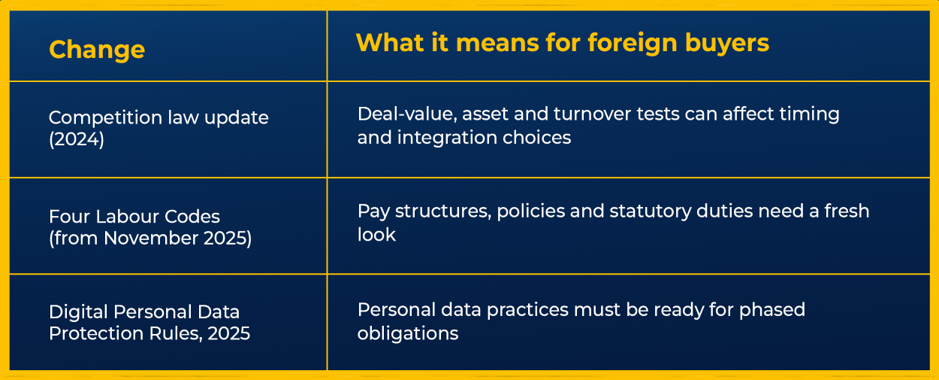
These reforms create a clearer framework for business operations. However, companies still need to confirm the provisions that apply to their specific transaction.
Foreign companies can overcome M&A integrationissues in India by focusing on certain factors. For example, they can overcomechallenges through early planning, clear accountability and local expertise. Itis important for businesses to follow a structured approach.
As per a 2026 integration survey, only about one in three acquirers fully achieved their prioritised deal objectives. That surveyalso found that 59% of successful acquirers assigned clear owners, timelinesand funding to value initiatives before integration, as compared to 28% of lesssuccessful acquirers.
Yourbusiness needs to have these practical approaches:
• Have clear objectives: Break down the acquisition strategy into tangiblefinancial and operational outcomes.
• Establish governance: Businesses need to create an integration management office with definedresponsibilities and escalation procedures.
• Adapt to local requirements: Align global policieswith Indian laws, market practices and sector-specific rules.
• Track performance: Businesses should review costs, revenue, employee retention, compliance and synergy delivery through regular dashboards.
Experienced M&A consulting in India canhelp foreign investors connect these priorities with local execution. The focus here is to preserve business value at the same time the two organisations movetowards a shared operating model.
Businesses need to establish control, protect business continuity and create a clear path towards integration in the first 100 days. The plan should assign owners and deadlines to every critical activity.
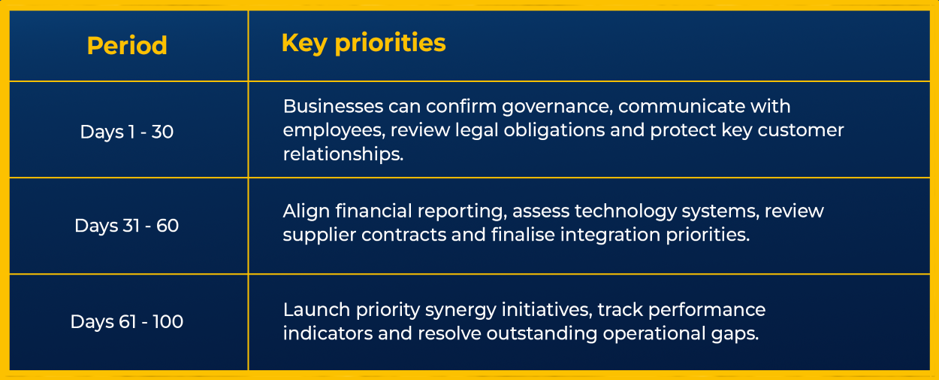
By day 100, leadership should have a documented integration roadmap, a validated financial baseline, a compliance action plan and clear accountability for the next phase.
Tecnova brings over 40 years of experience and has helped more than 2,000 companies enter and expand in India. Our experience within bound acquisitions can help foreign companies with a structured approach to integration. At Tecnova, we can help you with the following:
• Integration strategy: We can help you define priorities, governance structures and measurable milestones.
• Regulatory coordination: Identify applicable compliance requirements and coordinate with relevant legal, tax and sector specialists.
• Operational alignment: Review business processes, supplier relationships and local operating models.
• Financial and performance monitoring: Establish reportingframeworks to track costs, cash flow and synergies.
With astructured integration plan and informed local support, foreign investors can address post-merger integration challenges in India with greater clarity.
Disclaimer: This article is for general information and is not legal, tax or investment advice. Rules, thresholds and timelines change, so confirm current requirements with qualified advisers.
Post-Merger Integration: Turning Acquisitions into Long-Term Business Value
India's growing M&A landscape presents significant opportunities for international investors. However, successful acquisitions depend on what happens after the deal closes.
Key Insights:
• 155% Growth in M&A Deal Value: Cross-border M&A deal value in India increased to USD 33.2 billion in 2025.
• 52% Cite Cultural Friction: M&A leaders identify cultural incompatibility as a major reason for integration failures.
• 35% Supply Chain Fragility: Organisations report supply chain vulnerabilities, making operational continuity a critical integration priority.
• 1 in 3 Achieve Deal Objectives: Only around one-third of acquirers fully achieved their prioritised deal objectives in a 2026 integration survey.
• 59% vs. 28%: Successful acquirers are more likely to assign clear ownership, timelines and funding to value initiatives before integration.
For Global Companies: Successful post-merger integration requires more than combining businesses. It demands cultural alignment, talent retention, regulatory coordination, financial consolidation and operational continuity.
How can Tecnova help Foreign Companies?
• Integration Strategy: Define priorities, governance structures and measurable milestones.
• Regulatory Coordination: Identify applicable Indian compliance requirements.
• Operational Alignment: Integrate business processes, supplier relationships and local operating models.
• Performance Monitoring: Track costs, cash flow, synergies and integration outcomes.
Tecnova: From Acquisition Strategy to Integration Execution
With 40+ years of experience, 2,000+ clients and operations across 35+ countries, Tecnova helps international businesses navigate India's business environment and execute their expansion objectives.
Post-merger integration challenges in India can determine whether a promising acquisition delivers lasting business value or becomes a costly setback. Real work usually starts after the deal closes to foreign companies. Certain factors can delay expected returns, such as differences in workplace culture, regulatory requirements, financial systems and operational processes.
India is a prime destination for cross-border investment. A 2026 report shows that cross-border M&A deal value rose 155% to USD 33.2 billion in 2025. This growth creates opportunities for international investors.
However, businesses need a clear plan,local expertise and strong execution from day one for successful integration.
Post-merger integration (PMI) helps companies combine two businesses. It helps businesses align their teams and achieve strategic goals for an acquisition. If they do not have a structured approach, certain factors like expected cost savings, revenue growth and operational efficiencies may remain unrealized.
A well-planned PMI strategy helps foreign acquirers with the following.
• Helps businesses align objectives, leadership responsibilities and performance targets
• Keeps a smooth momentum of day-to-day business operations
• Helps businesses retainkey employees, customers and supplier relationships
• Combines financial systems and operational processes without disruption
• Identifies legal liabilities and addresses compliance gaps
• Tracks synergies against measurable financial and operational outcomes
Quick Note: Businesses need to start integration planning before closing, not after the acquisition is complete

As per a survey, 52% of M&A leaders cited cultural incompatibility and friction between acquiring and target companies as reasons for integration failure. Other post-merger integration challenges in India involve talent retention, regulatory compliance, financial consolidation and operational continuity.
Foreign acquirers need to address these issues together because a problem in one area can affect the entire business. Here is a detailed understanding of what are the biggest post-merger integration challenges for foreign companies acquiring in India:
1. Cultural misalignment and organisational differences
This can be a challenging part because companies can have different communication norms and decision-making processes. A foreign parent company can prefer centralized control. On the other hand, the Indian business relies on local autonomy and established relationhips.
Companies need to pay attention to these approaches to align with this:
• They must establish common values but not disregard local assets.
• They should align reporting structures and decision-making authorities.
• Lastly, they need toexplain changes to employees before they take effect.
Therefore, companies must conduct a cultural assessment before they finalize the integration model.
2. Talent retention and human resource integration
Employee uncertainty can lead to resignations, most importantly among senior managers and employees who hold critical customer relationships. Certain factors, such as differences in pay structures, incentives, appraisal systems and career paths, can deepen dissatisfaction.
Identifying key employees and establishing retention plans can help reduce the risk of losing critical talent. Reviewing employment contracts is especially important, particularly considering India's Four Labor Codes, which came into effect on 21st November 2025. Acquirers need to assess the applicable wage, social security, industrial relations and workplace safety requirements to ensure compliance during integration.
3. Regulatory compliance and legal liabilities
M&A compliance risks in India can continue even after businesses close the deal. These include pending litigation, sector-specific licenses, employment commitments, contractual conditions and competition law obligations.
The Competition Commission of India’s (CCI) 2024 framework introduced a deal-value threshold. The threshold is approximately USD 212 million equivalent for transactions that meet the applicable conditions. It includes substantial business operations in India. The frame work also provides a shorter overall assessment timeline of 150 days.
4.Financial integration, taxation and reporting
Financial integration can be complicated if the parent and acquired business have different accounting policies, financial calendars, tax processes, or enterprise resource planning systems. Misaligned reporting and cash-flow forecasting can impact performance.
Businesses need to have a structured approach which should cover:
• Opening balance sheet validation and purchase price allocation
• Tax exposures, indirect tax credits and inter company transactions
• Consolidated reporting, internal controls and audit schedules
• Working capital, treasury and cash management
5. Operational integration and supply chain continuity
If the responsibilities change too rapidly, operational integration can have an impact on the business. For example, it can affect production, procurement and customer management. Before standardising processes, it is important for foreign companies to grasplocal supplier needs, distribution systems and the way business is done withinthe region.
A 2025 study found that 35% of surveyed organisations described their supply chains as fragile,highlighting the need to assess operational risks before implementing majorchanges.
Businesses need to start with a review of critical suppliers, inventory levels, productioncapacity and customer commitments. Then they can prioritise changes that improve efficiency without interrupting deliveries.
6.Technology, IT systems and data integration
Different software platforms, cybersecurity controls and data structures can prevent teams fromsharing information. If they do a rushed migration, they may disrupt payroll,customer support or financial reporting.
The Digital Personal Data Protection Rules, 2025, introduce a phased compliance framework for personal data. Foreign acquirers need to map the data they hold, review access rights and assess applicable obligations under the notified implementation schedule.
Pro Tip: Businesses can audit data access, backups and cybersecurity controls before combining IT systems.
7. Synergy realisation, integration costs and execution delays
Synergy realisation sometimes falls short. It can happen when companies overestimate savings,underestimate integration costs or assign unclear responsibilities. Somefactors can weaken the acquisition's financial case. For example, delays insystem migration, procurement consolidation and cross-selling can weaken theacquisition's financial case.
To address this, businesses can build a synergy tracker with a baseline,target, accountable owner and delivery date for each initiative.
Industry reports state that India recorded 271 M&A transactions in Q1 2026, one of the highest quarterly volumes in recent years. It shows us the need for foreign acquirers to plan for regulatory approvals and post-closing compliance.
Here is a quick snapshot of the three developments which deserve attention in 2026:
These reforms create a clearer framework for business operations. However, companies still need to confirm the provisions that apply to their specific transaction.
Foreign companies can overcome M&A integrationissues in India by focusing on certain factors. For example, they can overcomechallenges through early planning, clear accountability and local expertise. Itis important for businesses to follow a structured approach.
As per a 2026 integration survey, only about one in three acquirers fully achieved their prioritised deal objectives. That surveyalso found that 59% of successful acquirers assigned clear owners, timelinesand funding to value initiatives before integration, as compared to 28% of lesssuccessful acquirers.
Yourbusiness needs to have these practical approaches:
• Have clear objectives: Break down the acquisition strategy into tangiblefinancial and operational outcomes.
• Establish governance: Businesses need to create an integration management office with definedresponsibilities and escalation procedures.
• Adapt to local requirements: Align global policieswith Indian laws, market practices and sector-specific rules.
• Track performance: Businesses should review costs, revenue, employee retention, compliance and synergy delivery through regular dashboards.
Experienced M&A consulting in India canhelp foreign investors connect these priorities with local execution. The focus here is to preserve business value at the same time the two organisations movetowards a shared operating model.
Businesses need to establish control, protect business continuity and create a clear path towards integration in the first 100 days. The plan should assign owners and deadlines to every critical activity.
By day 100, leadership should have a documented integration roadmap, a validated financial baseline, a compliance action plan and clear accountability for the next phase.
Tecnova brings over 40 years of experience and has helped more than 2,000 companies enter and expand in India. Our experience within bound acquisitions can help foreign companies with a structured approach to integration. At Tecnova, we can help you with the following:
• Integration strategy: We can help you define priorities, governance structures and measurable milestones.
• Regulatory coordination: Identify applicable compliance requirements and coordinate with relevant legal, tax and sector specialists.
• Operational alignment: Review business processes, supplier relationships and local operating models.
• Financial and performance monitoring: Establish reportingframeworks to track costs, cash flow and synergies.
With astructured integration plan and informed local support, foreign investors can address post-merger integration challenges in India with greater clarity.
Disclaimer: This article is for general information and is not legal, tax or investment advice. Rules, thresholds and timelines change, so confirm current requirements with qualified advisers.